

Starr, Frederick, Aztec place-names
(Chicago : Priv. print. by the author, 1920.)
|
||

 Click here and hold to drag menu around
|





|
|
|
|

|
Page 3 | 
|
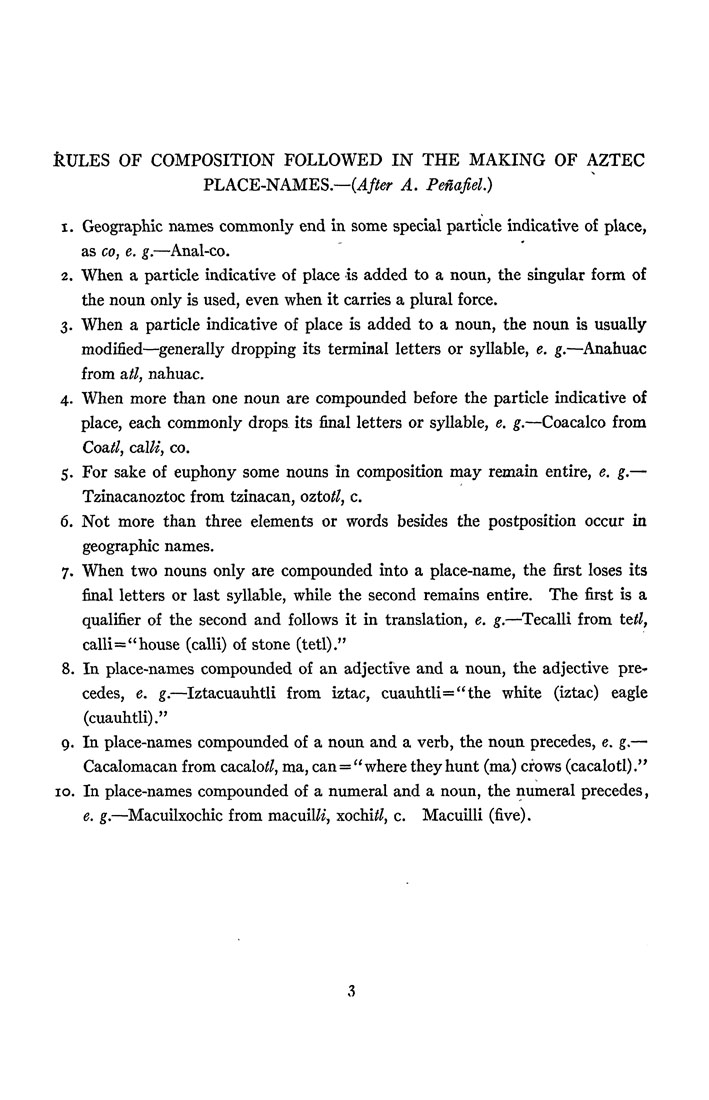
kVLES OF COMPOSITION FOLLOWED IN THE MAKING OF AZTEC PLACE-NAMES.—W/er A. Peiiafiel.) 1. Geographic names commonly end in some special particle indicative of place, as CO, e. g,—Anal-co. 2. When a particle indicative of place is added to a noun, the singular form of the noun only is used, even when it carries a plural force. 3. When a particle indicative of place is added to a noun, the noun is usually modified—^generally dropping its terminal letters or syllable, e, g,—^Anahuac from a//, nahuac. 4. When more than one noun are compounded before the particle indicative of place, each commonly drops its final letters or syllable, e. g.—Coacalco from Coa//, caXU, co. 5. For sake of euphony some nouns in composition may remain entire, e. g.— Tzinacanoztoc from tzinacan, oztotl, c. 6. Not more than three elements or words besides the postposition occur in geographic names. 7. When two nouns only are compounded into a place-name, the first loses its final letters or last syllaMe, while the second remains entire. The first is a qualifier of the second and follows it in translation, e. g,—Tecalli from tetl, calli=" house (calli) of stone (tetl)." 8. In place-names compounded of an adjective and a noun, the adjective pre* cedes, e. g.—Iztacuauhtli from iztac, cuauhtli="the white (iztac) eagle (cuauhtli)." 9. In place-names compounded of a noun and a verb, the noun precedes, e. g.— Cacalomacan from cacalo//, ma, can = " where they hunt (ma) crows (cacalotl).*' 10. In place-names compounded of a numeral and a noun, the numeral precedes, e, g,—Macuilxochic from macuiU/, xochitl, c. Macuilli (five). |
|
|
Page 3 |
|