

Griffis, William Elliot, The story of New Netherland
(Boston and New York : Houghton Mifflin Company, 1909.)
|
||

 Click here and hold to drag menu around
|





|
|
|
|

|
Page [226] | 
|
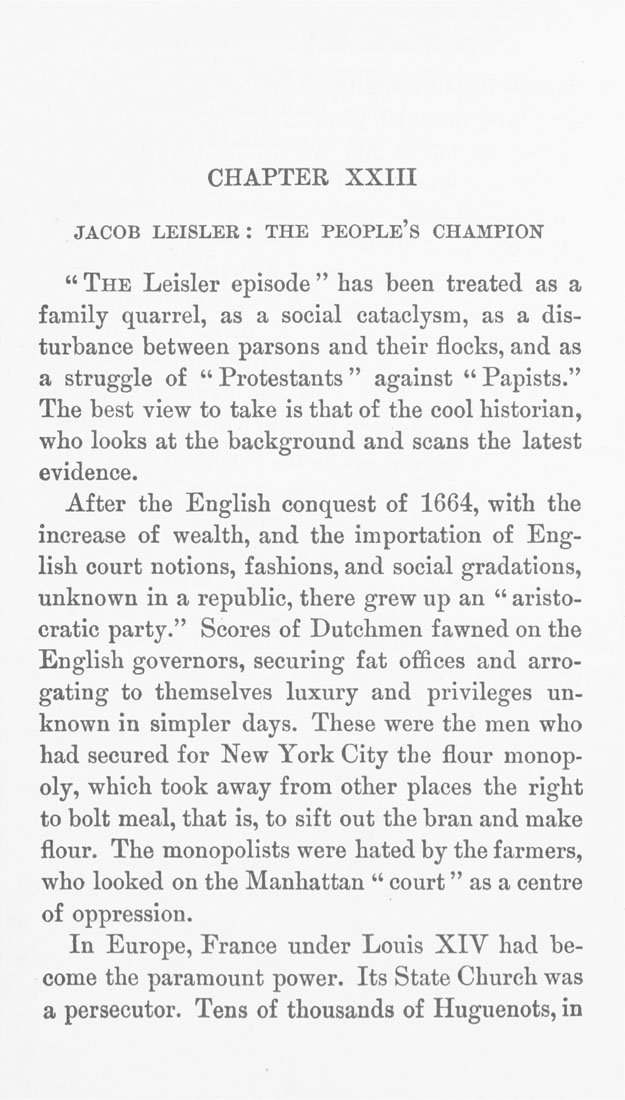
CHAPTER XXIII JACOB LEISLER : THE PEOPLE'S CHAMPION " The Leisler episode " has been treated as a family quarrel, as a social cataclysm, as a dis¬ turbance between parsons and their flocks, and as a struggle of "Protestants" against "Papists." The best view to take is that of the cool historian, who looks at the background and scans the latest evidence. After the English conquest of 1664, with the increase of wealth, and the importation of Eng¬ lish court notions, fashions, and social gradations, unknown in a republic, there grew up an " aristo¬ cratic party." Scores of Dutchmen fawned on the English governors, securing fat offices and arro¬ gating to themselves luxury and privileges un¬ known in simpler days. These were the men who had secured for New York City the flour monop¬ oly, which took away from other places the right to bolt meal, that is, to sift out the bran and make flour. The monopolists were hated by the farmers, who looked on the Manhattan " court" as a centre of oppression. In Europe, France under Louis XIV had be¬ come the paramount power. Its State Church was a persecutor. Tens of thousands of Huguenots, in |
|
|
Page [226] |
|