

Griffis, William Elliot, The story of New Netherland
(Boston and New York : Houghton Mifflin Company, 1909.)
|
||

 Click here and hold to drag menu around
|





|
|
|
|

|
Page [235] | 
|
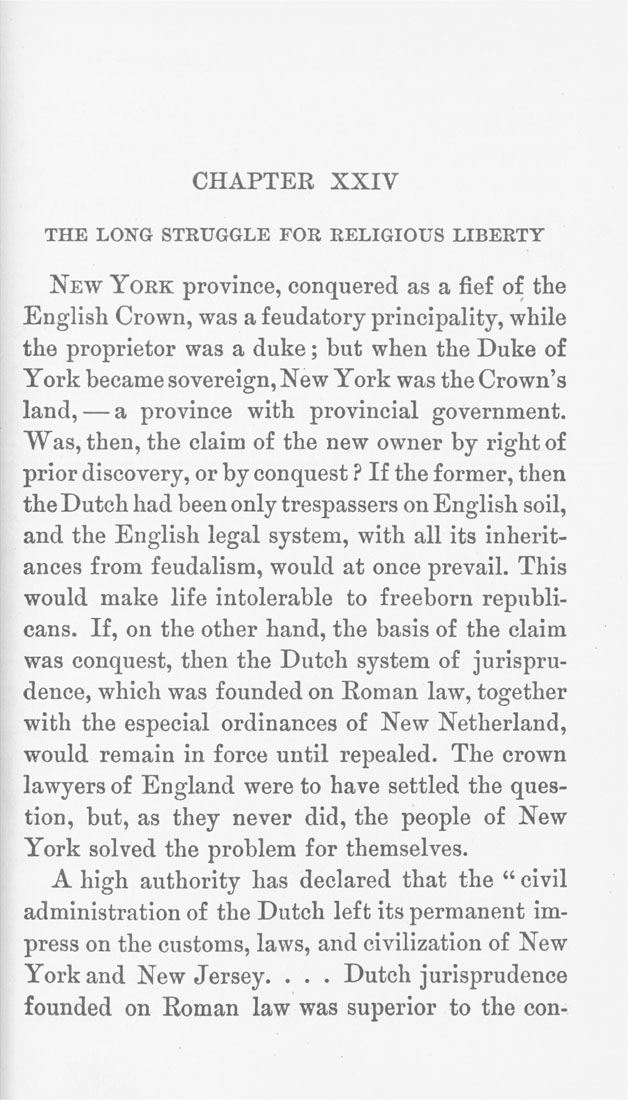
CHAPTER XXIV THE LONG STRUGGLE FOR RELIGIOUS LIBERTY New York province, conquered as a fief of the English Crown, was a feudatory principality, while the proprietor was a duke; but when the Duke of York became sovereign. New York was the Crown's land, — a province with provincial government. Was, then, the claim of the new owner by right of prior discovery, or by conquest ? If the former, then the Dutch had been only trespassers on English soil, and the English legal system, with all its inherit¬ ances from feudalism, would at once prevail. This would make life intolerable to freeborn republi¬ cans. If, on the other hand, the basis of the claim was conquest, then the Dutch system of jurispru¬ dence, which was founded on Roman law, together with the especial ordinances of New Netherland, would remain in force until repealed. The crown lawyers of England were to have settled the ques¬ tion, but, as they never did, the people of New York solved the problem for themselves. A high authority has declared that the " civil administration of the Dutch left its permanent im¬ press on the customs, laws, and civilization of New York and New Jersey. . . . Dutch jurisprudence founded on Roman law was superior to the con- |
|
|
Page [235] |
|