

Columbia Library columns (v.20(1970Nov-1971May))
(New York : Friends of the Columbia Libraries. )
|
||

 Click here and hold to drag menu around
|





|
|
|
|

|
v.20,no.3(1971:May): Page 23 | 
|
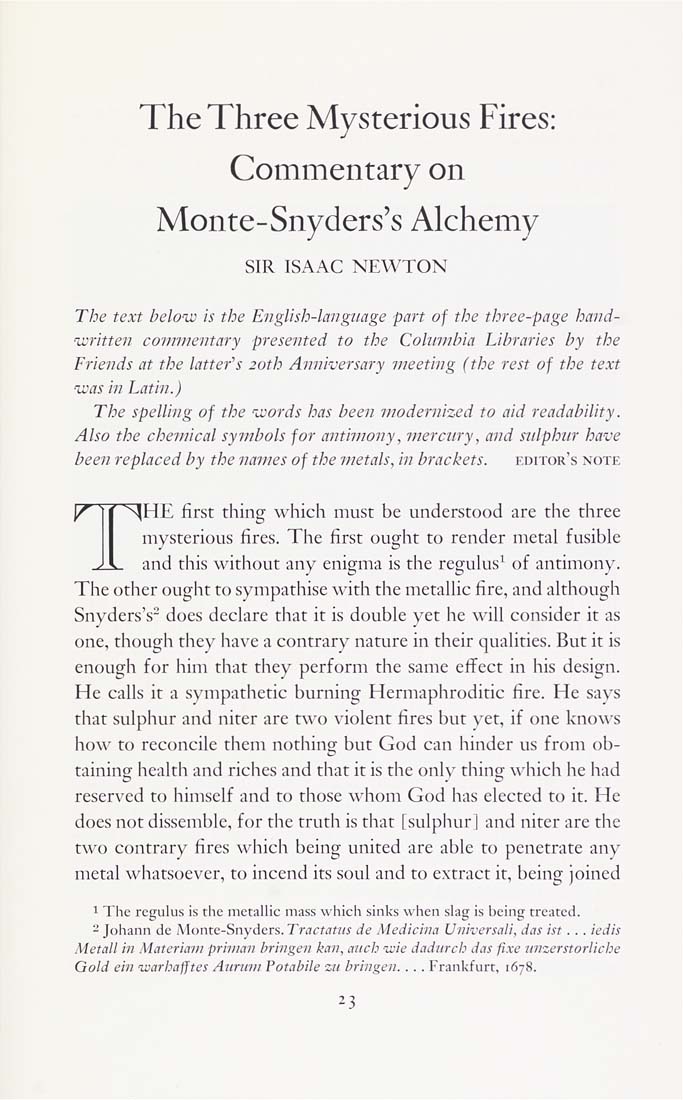
The Three Mysterious Fires: Commentary on Monte-Snyders's Alchemy SIR ISAAC NEWTON The text below is the English-language part of the three-page hand¬ written commentary presented to the Cohnnbia Libraries by the Friends at the latter's 2uth Anniversary meeting (the rest of the text was in Latin.) The spelling of the words has been modernized to aid readability. Also the chemical symbols for antimony, mercury, and sulphur have been replaced by the names of the metals, in brackets. editor's note T V If ^HE first thing which must be understood are the three mysterious fires. The first ought to render metal fusible and this without any enigma is the regulus' of antimony. The other ought to sympathise with the metallic fire, and although Snyders's- does declare that it is double yet he will consider it as one, though they have a contrary nature in their qualities. But it is enough for him that they perform the same effect in his design. He calls it a sympathetic burning Hermaphroditic fire. He says that sulphur and niter are two violent fires but yet, if one knows how to reconcile them nothing but God can hindet us from ob¬ taining health and riches and that it is the only thing which he had reserved to himself and to those whom God has elected to it. He does not dissemble, for the truth is that [sulphur] and niter are the two contrary fires which being united are able to penetrate any metal whatsoever, to incend its soul and to extract it, being joined 1 The regulus is the metallic mass which sinks when slag is being treated. - Johann de Montc-Snydcrs. Tractatus de Mediciiia Universali. das ist... led is Metall in Materiam priTiiaii bringen kan, aiich wie dadurch das fixe unzerstorliche Gold ein -ivarbafftes Aiirtnn Fotahile zii hrivi^eii. . . . Frankfurt. 1678. 23 |
|
|
v.20,no.3(1971:May): Page 23 |
|