

Columbia Library columns (v.37(1987Nov-1988May))
(New York : Friends of the Columbia Libraries. )
|
||

 Click here and hold to drag menu around
|





|
|
|
|

|
v.37,no.3(1988:May): Page 13 | 
|
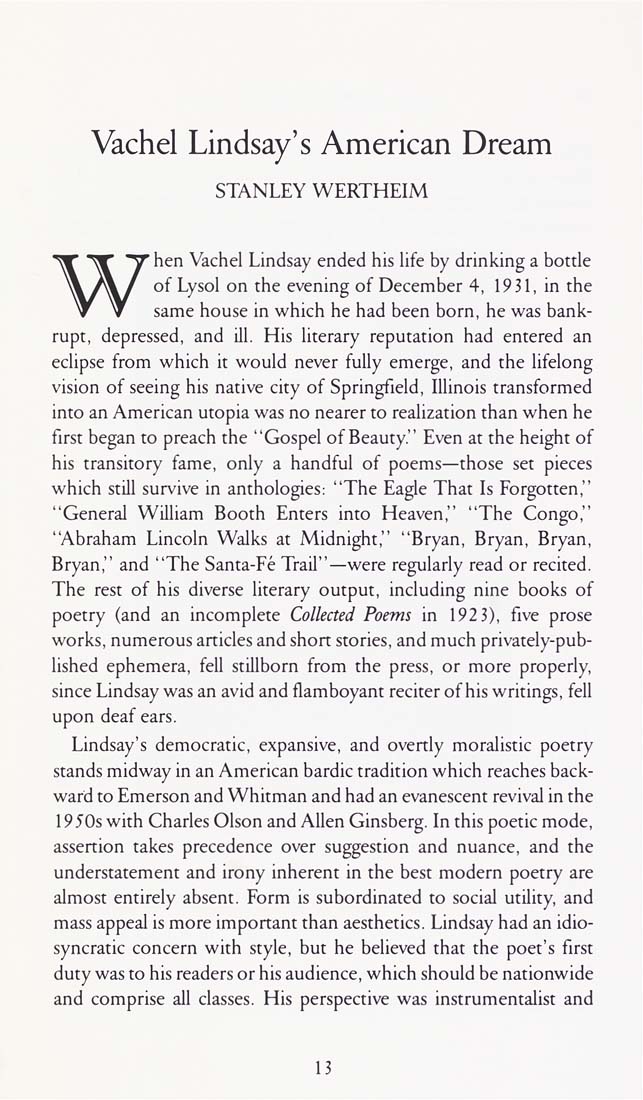
Vachel Lindsay's American Dream STANLEY WERTHEIM w: ■ hen Vachel Lindsay ended his life by drinking a bottle of Lysol on the evening of December 4, 1931, in the same house in which he had been born, he was bank¬ rupt, depressed, and ill. His literary reputation had entered an eclipse from which it would never fully emerge, and the lifelong vision of seeing his native city of Springfield, Illinois transformed into an American Utopia was no nearer to realization than when he first began to preach the "Gospel of Beauty." Even at the height of his transitory fame, only a handful of poems—those set pieces which still survive in anthologies: "The Eagle That Is Forgotten," "General William Booth Enters into Heaven," "The Congo," "Abraham Lincoln Walks at Midnight," "Bryan, Bryan, Bryan, Bryan," and "The Santa-Fe Trail"—were regularly read or recited. The rest of his diverse literary output, including nine books of poetry (and an incomplete Collected Poems in 1923), five prose works, numerous articles and short stories, and much privately-pub¬ lished ephemera, fell stillborn from the press, or more properly, since Lindsay was an avid and flamboyant reciter of his writings, fell upon deaf ears. Lindsay's democratic, expansive, and overtly moralistic poetry stands midway in an American bardic tradition which reaches back¬ ward to Emerson and Whitman and had an evanescent revival in the 1950s with Charles Olson and Allen Ginsberg. In this poetic mode, assertion takes precedence over suggestion and nuance, and the understatement and irony inherent in the best modern poetry are almost entirely absent. Form is subordinated to social utility, and mass appeal is more important than aesthetics. Lindsay had an idio¬ syncratic concern with style, but he believed that the poet's first duty was to his readers or his audience, which should be nationwide and comprise all classes. His perspective was instrumentalist and 13 |
|
|
v.37,no.3(1988:May): Page 13 |
|