

Ricard, Prosper, Morocco
(Paris ; London : Hachette, 1924.)
|
||

 Click here and hold to drag menu around
|





|
|
|
|

|
Page 59 | 
|
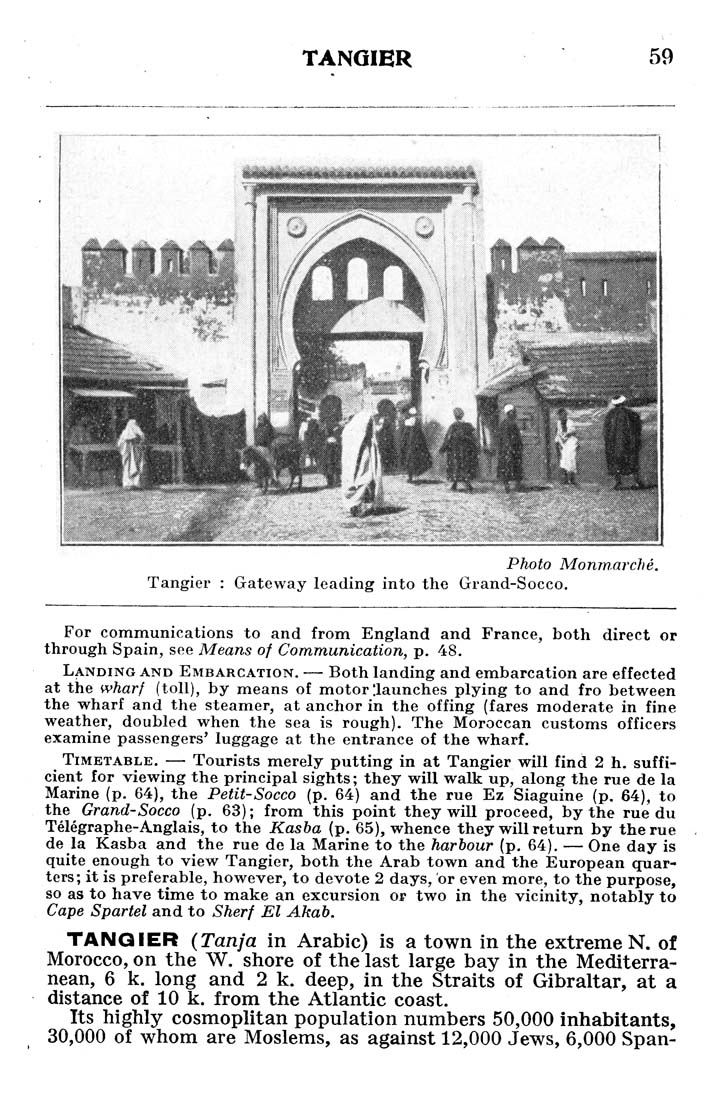
TANGIER 59 Photo Monm.arche. Tangier : Gateway leading into the Grand-Socco. For communications to and from England and France, both direct or through Spain, see Means of Communication, p. 48. Landing and Embarcation. — Roth landing and embarcation are effected at the wharf (toll), by means of motor ;iaunches plying to and fro between the wharf and the steamer, at anchor in the offing (fares moderate in fine weather, doubled when the sea is rough). The Moroccan customs officers examine passengers' luggage at the entrance of the wharf. Timetable. — Tourists merely putting in at Tangier will find 2 h. suffi¬ cient for viewing the principal sights; they will walk up, along the rue de la Marine (p. 64), the Petit-Socco (p. 64) and the rue Ez Siaguine (p. 64), to the Grand-Socco (p. 63); from this point they will proceed, by the rue du Telegraphe-Anglais, to the Kasba (p. 65), whence they will return by the rue de la Kasba and the rue de la Marine to the harbour (p. 64). — One day is quite enough to view Tangier, both the Arab town and the European quar¬ ters; it is preferable, however, to devote 2 days, or even more, to the purpose, so as to have time to make an excursion or two in the vicinity, notably to Cape Spartel and to Sherf El Akab. TANGIER (Tanja in Arabic) is a town in the extreme N. of Morocco, on the W. shore of the last large bay in the Mediterra¬ nean, 6 k. long and 2 k. deep, in the Straits of Gibraltar, at a distance of 10 k. from the Atlantic coast. Its highly cosmoplitan population numbers 50,000 inhabitants, 30,000 of whom are Moslems, as against 12,000 Jews, 6,000 Span- |
|
|
Page 59 |
|