

Ricard, Prosper, Morocco
(Paris ; London : Hachette, 1924.)
|
||

 Click here and hold to drag menu around
|





|
|
|
|

|
Page 79 | 
|
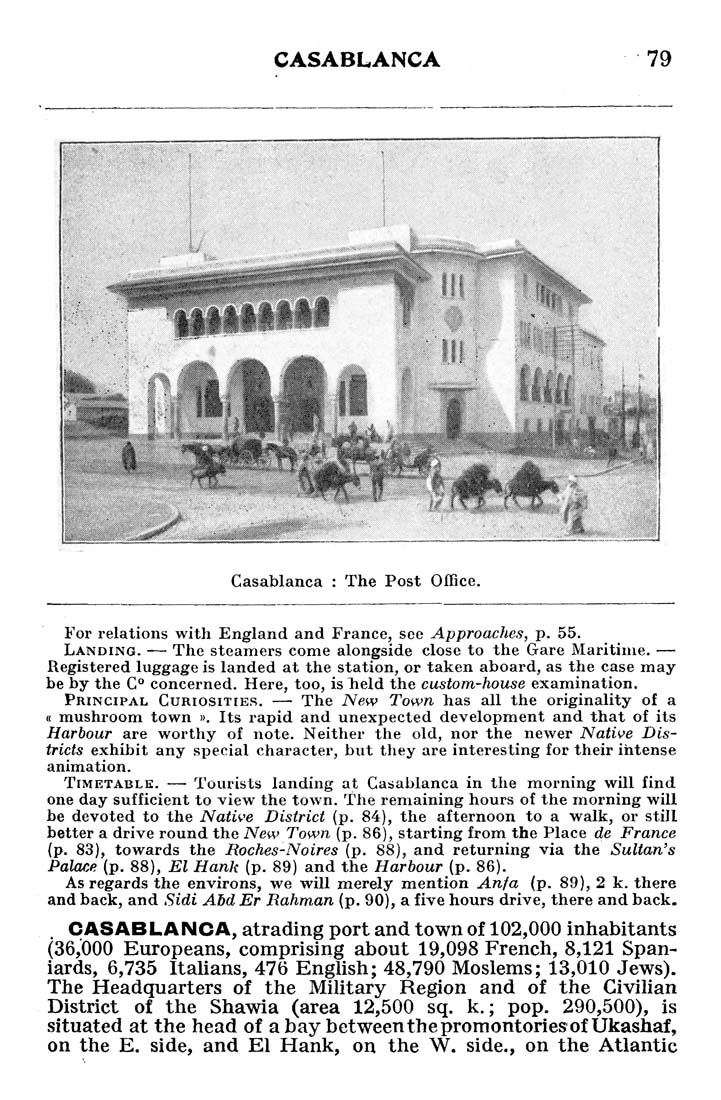
CASABLANCA 79 Casablanca : The Post Office. For relations with England and France, see Approaches, p. 55. Landing. — The steamers come alongside close to the Gare Maritime. — Registered luggage is landed at the station, or taken aboard, as the case may be by the C° concerned. Here, too, islield the custom-house examination. Principal Curiosities. — The New Town has all the originality of a « mushroom town ». Its rapid and unexpected development and that of its Harbour are worthy of note. Neither the old, nor the newer Native Dis¬ tricts exhibit any special character, but they are interesting for their intense animation. Timetable. — Tourists landing at Casablanca in the morning will find one day sufficient to view the town. The remaining hours of the morning will be devoted to the Native District (p. 84), the afternoon to a walk, or still better a drive round the New Town (p. 86), starting from the Place de France (p. 83), towards the Roches-Noires (p. 88), and returning via the Sultan's Palace (p. 88), El Hank (p. 89) and the Harbour (p. 86). As regards the environs, we will merely mention Anfa (p. 89), 2 k. there and back, and Sidi AM Er Rahman (p. 90), a five hours drive, there and back. CASABLANCA, atrading port and town of 102,000 inhabitants (36,000 Europeans, comprising about 19,098 French, 8,121 Span¬ iards, 6,735 Italians, 476 English; 48,790 Moslems; 13,010 Jews). The Headquarters of the Military Region and of the Civilian District of the Shawia (area 12,500 sq. k.; pop. 290,500), is situated at the head of a bay between the promontories of Ukashaf, on the E. side, and El Hank, on the W. side., on the Atlantic |
|
|
Page 79 |
|