

Ricard, Prosper, Morocco
(Paris ; London : Hachette, 1924.)
|
||

 Click here and hold to drag menu around
|





|
|
|
|

|
Page 149 | 
|
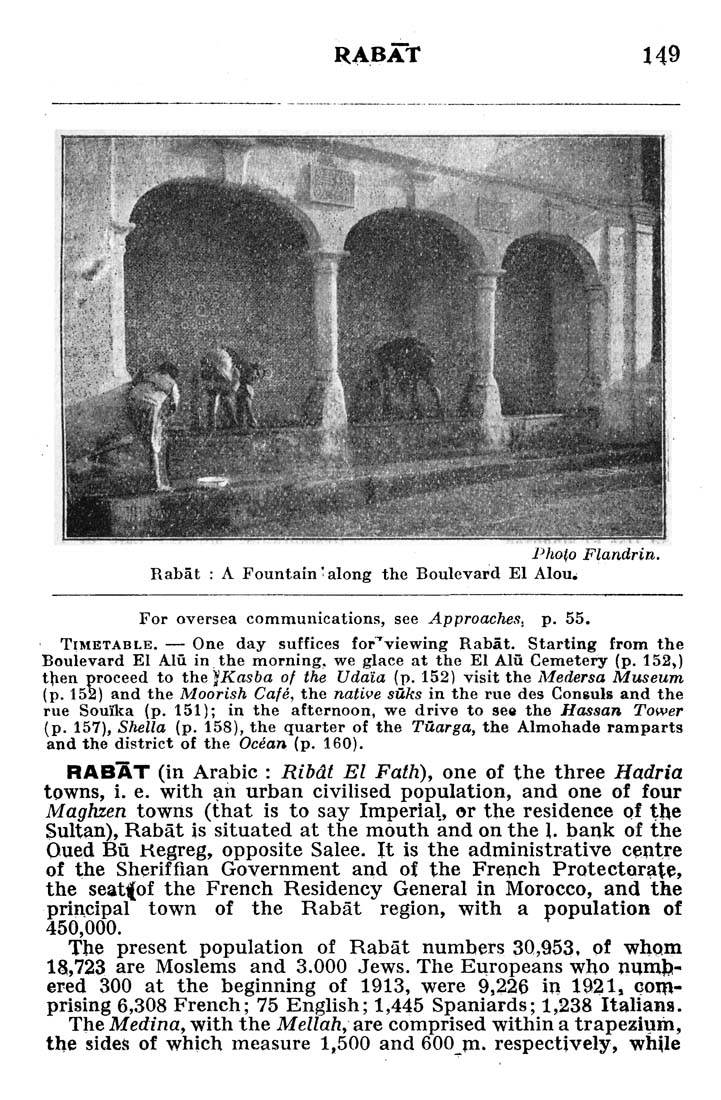
RABAT 149 PhotiO Flandrin. Rabat : A Fountain' along the Boulevard El Alou^ For oversea communications, see Approaches, p. 55. Timetable. — One day suffices for'viewing Rabat. Starting from the Boulevard El Alii in the morning, we glace at the El Alii Cemetery (p. 152,) tlien proceed to ihe^Kasba of the Udaia (p. 152) visit the Medersa Museum (p, 152) and the Moorish Cafe, the native siiks in the rue des Consuls and the rue Sou'ika (p. 151); in the afternoon, we drive to sea the Hassan Tower (p. 157), Sheila (p. 158), the quarter of the THarga, the Almohade ramparts and the district of the Ocean (p. 160). RABAT (in Arabic : Ribdt El Fath), one of the three Hadria towns, i. e. with an urban civilised population, and one of four Maghzen towns (that is to say Imperial, or the residence of tl>e 5ultan), Rabat is situated at the mouth and on the \. bank of the Oued Bu Kegreg, opposite Salee. It is the administrative centre of the Sheriffian Government and of the French Protectorate, the seatfof the French Residency General in Morocco, and the principal town of the Rabat region, with a population of 450,000. The present population of Rabat numbers 30,953, of wham 18,723 are Moslems and 3.000 Jews. The Europeans who numb¬ ered 300 at the beginning of 1913, were 9,226 in 1921, com¬ prising 6,308 French; 75 English; 1,445 Spaniards; 1,238 Italians. The Medina, with the Mellah, are comprised within a trapezium, the sides of which measure 1,500 and 600 ni. respectively, while |
|
|
Page 149 |
|