

Chester, Alden, Legal and judicial history of New York (v.2)
(New York : National Americana Society, 1911.)
|
||

 Click here and hold to drag menu around
|





|
|
|
|

|
Page 1 | 
|
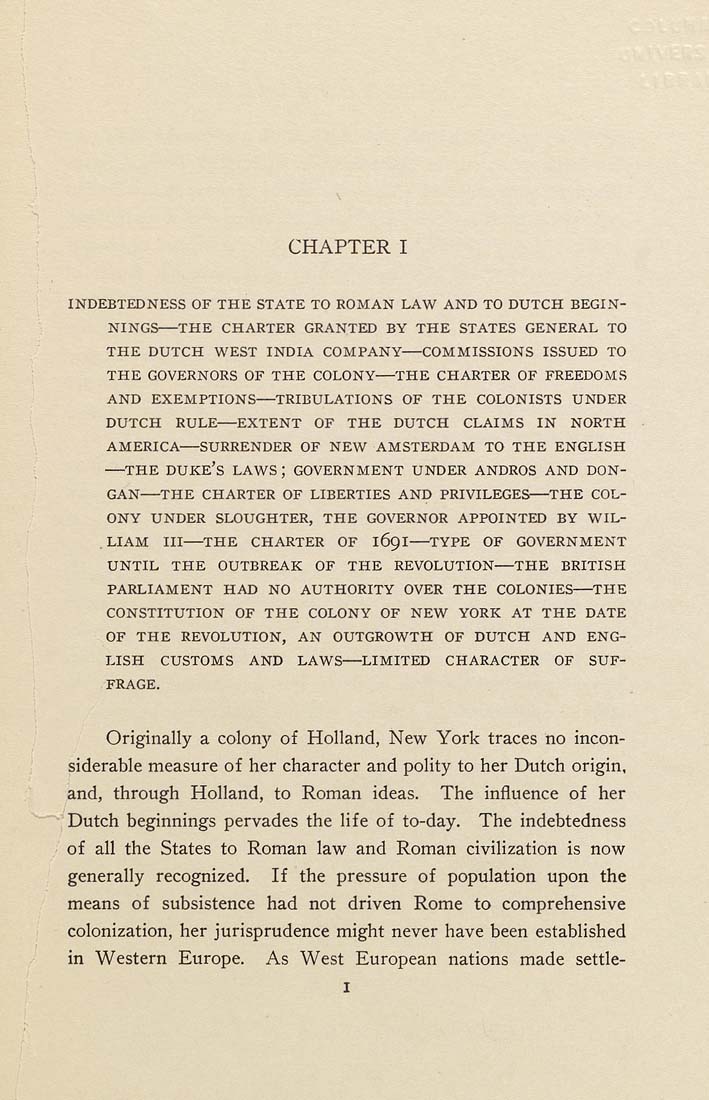
CHAPTER I INDEBTEDNESS OF THE STATE TO ROMAN LAW AND TO DUTCH BEGIN¬ NINGS----THE CHARTER GRANTED BY THE STATES GENERAL TO THE DUTCH WEST INDIA COMPANY----COMMISSIONS ISSUED TO THE GOVERNORS OF THE COLONY----THE CHARTER OF FREEDOM.S AND EXEMPTIONS—TRIBULATIONS OF THE COLONISTS UNDER DUTCH RULE----EXTENT OF THE DUTCH CLAIMS IN NORTH AMERICA----SURRENDER OF NEW AMSTERDAM TO THE ENGLISH ----THE duke's LAWS ; GOVERNMENT UNDER ANDROS AND DON- GAN----THE CHARTER OF LIBERTIES AND PRIVILEGES—THE COL¬ ONY UNDER SLOUGHTER, THE GOVERNOR APPOINTED BY WIL- .LIAM III----THE CHARTER OF 169I----TYPE OF GOVERNMENT UNTIL THE OUTBREAK OF THE REVOLUTION----THE BRITISH PARLIAMENT HAD NO AUTHORITY OVER THE COLONIES----THE CONSTITUTION OF THE COLONY OF NEW YORK AT THE DATE OF THE REVOLUTION, AN OUTGROWTH OF DUTCH AND ENG¬ LISH CUSTOMS AND LAWS----LIMITED CHARACTER OF SUF¬ FRAGE. Originally a colony of Holland, New York traces no incon¬ siderable measure of her character and polity to her Dutch origin, and, through Holland, to Roman ideas. The influence of her Dutch beginnings pervades the life of to-day. The indebtedness of all the States to Roman law and Roman civilization is now generally recognized. If the pressure of population upon the means of subsistence had not driven Rome to comprehensive colonization, her jurisprudence might never have been established in Western Europe. As West European nations made settle- I |
|
|
Page 1 |
|