

Chester, Alden, Legal and judicial history of New York (v.2)
(New York : National Americana Society, 1911.)
|
||

 Click here and hold to drag menu around
|





|
|
|
|

|
Page 21 | 
|
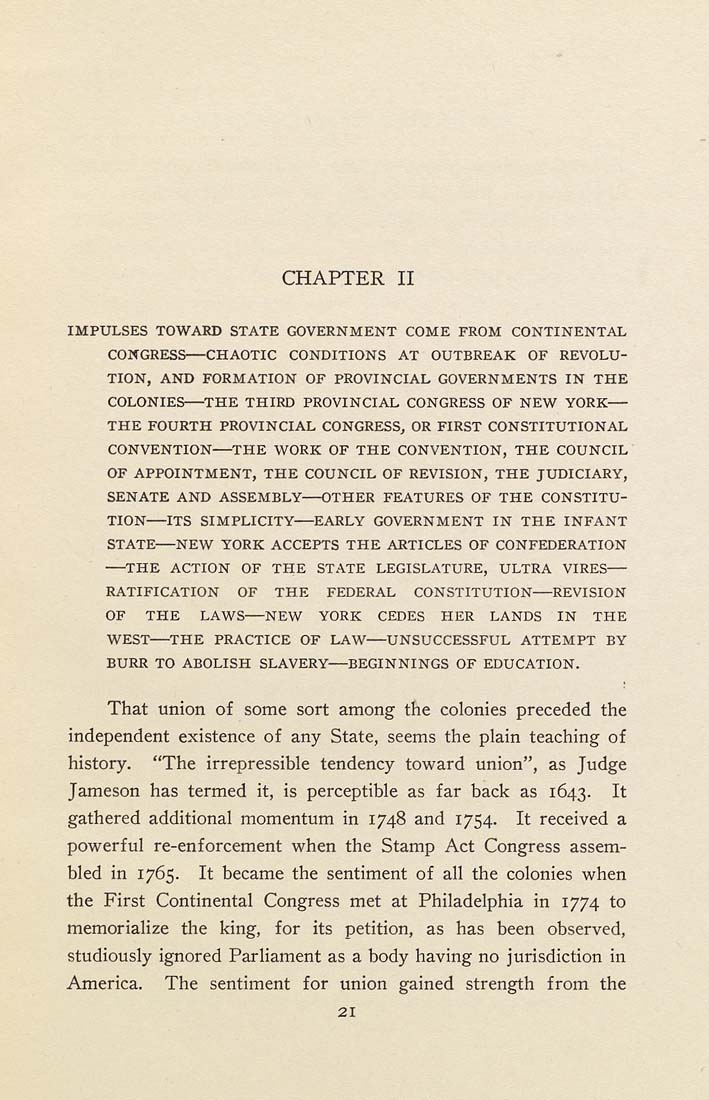
CHAPTER II IMPULSES TOWARD STATE GOVERNMENT COME FROM CONTINENTAL CONGRESS----CHAOTIC CONDITIONS AT OUTBREAK OF REVOLU¬ TION, AND FORMATION OF PROVINCIAL GOVERNMENTS IN THE COLONIES----THE THIRD PROVINCIAL CONGRESS OF NEW YORK---- THE FOURTH PROVINCIAL CONGRESS^ OR FIRST CONSTITUTIONAL CONVENTION----THE WORK OF THE CONVENTION, THE COUNCIL OF APPOINTMENT, THE COUNCIL OF REVISION, THE JUDICIARY, SENATE AND ASSEMBLY----OTHER FEATURES OF THE CONSTITU¬ TION----ITS SIMPLICITY----EARLY GOVERNMENT IN THE INFANT STATE----NEW YORK ACCEPTS THE ARTICLES OF CONFEDERATION ----THE ACTION OF THE STATE LEGISLATURE, ULTRA VIRES---- RATIFICATION OF THE FEDERAL CONSTITUTION----REVISION OF THE LAWS----NEW YORK CEDES HER LANDS IN THE WEST----THE PRACTICE OF LAW----UNSUCCESSFUL ATTEMPT BY BURR TO ABOLISH SLAVERY—BEGINNINGS OF EDUCATION. That union of some sort among the colonies preceded the independent existence of any State, seems the plain teaching of history. "The irrepressible tendency toward union", as Judge Jameson has termed it, is perceptible as far back as 1643. It gathered additional momentum in 1748 and 1754. It received a powerful re-enforcement when the Stamp Act Congress assem¬ bled in 1765. It became the sentiment of all the colonies when the First Continental Congress met at Philadelphia in 1774 to memorialize the king, for its petition, as has been observed, studiously ignored Parliament as a body having no jurisdiction in America. The sentiment for union gained strength from the |
|
|
Page 21 |
|