

Chester, Alden, Legal and judicial history of New York (v.2)
(New York : National Americana Society, 1911.)
|
||

 Click here and hold to drag menu around
|





|
|
|
|

|
Page 271 | 
|
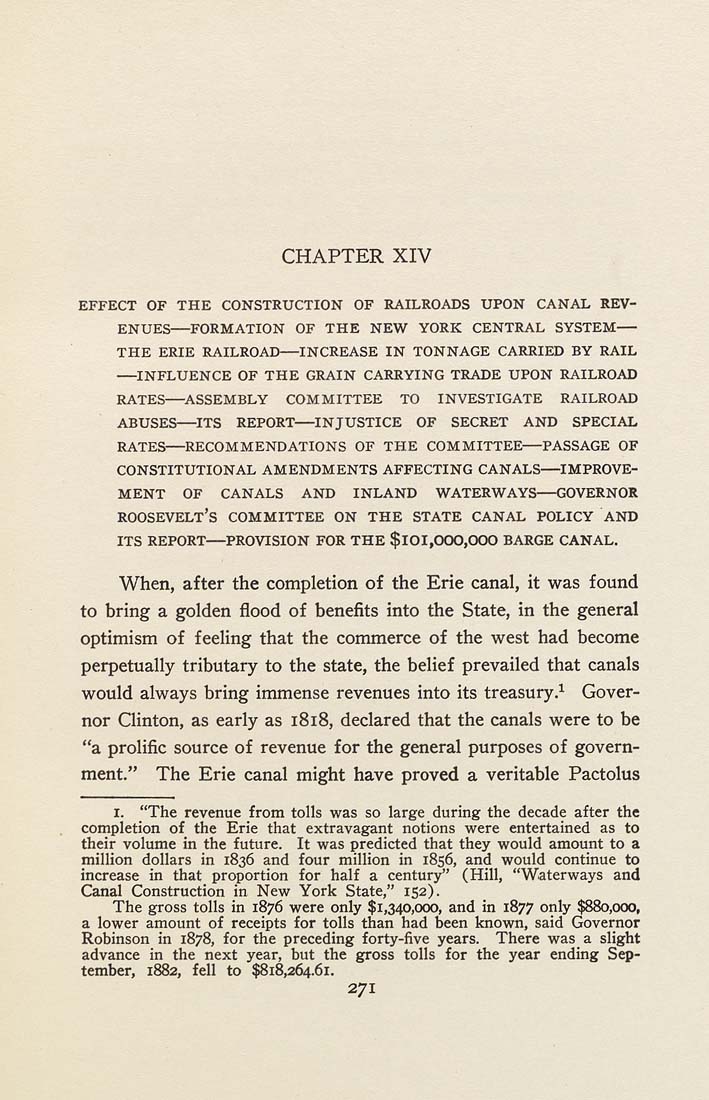
CHAPTER XIV effect of the construction of railroads upon canal rev¬ enues----formation of the new york central system---- the erie railroad—increase in tonnage carried by rail ----^influence of the grain carrying trade upon railroad rates----assembly committee to investigate railroad abuses----its report----injustice of secret and special rates----recommendations of the committee—passage of constitutional amendments affecting canals----improve¬ ment of canals and inland waterways----governor Roosevelt's committee on the state canal policy and its report----provision for the $101,000,000 barge canal. When, after the completion of the Erie canal, it was found to bring a golden flood of benefits into the State, in the general optimism of feeling that the commerce of the west had become perpetually tributary to the state, the beHef prevailed that canals would always bring immense revenues into its treasury.' Gover¬ nor Clinton, as early as 1818, declared that the canals were to be "a prolific source of revenue for the general purposes of govern¬ ment." The Erie canal might have proved a veritable Pactolus I. "The revenue from tolls was so large during the decade after the completion of the Erie that extravagant notions were entertained as to their volume in the future. It was predicted that they would amount to a million dollars in 1836 and four million in 1856, and would continue to increase in that proportion for half a century" (Hill, "Waterways and Canal Construction in New York State," 152). The gross tolls in 1876 were only $1,340,000, and in 1877 only $880,000, a lower amount of receipts for tolls than had been known, said Governor Robinson in 1878, for the preceding forty-five years. There was a slight advance in the next year, but the gross tolls for the year ending Sep¬ tember, 1882, fell to $818,264.61. 271 |
|
|
Page 271 |
|