

Chester, Alden, Legal and judicial history of New York (v.2)
(New York : National Americana Society, 1911.)
|
||

 Click here and hold to drag menu around
|





|
|
|
|

|
Page 334 | 
|
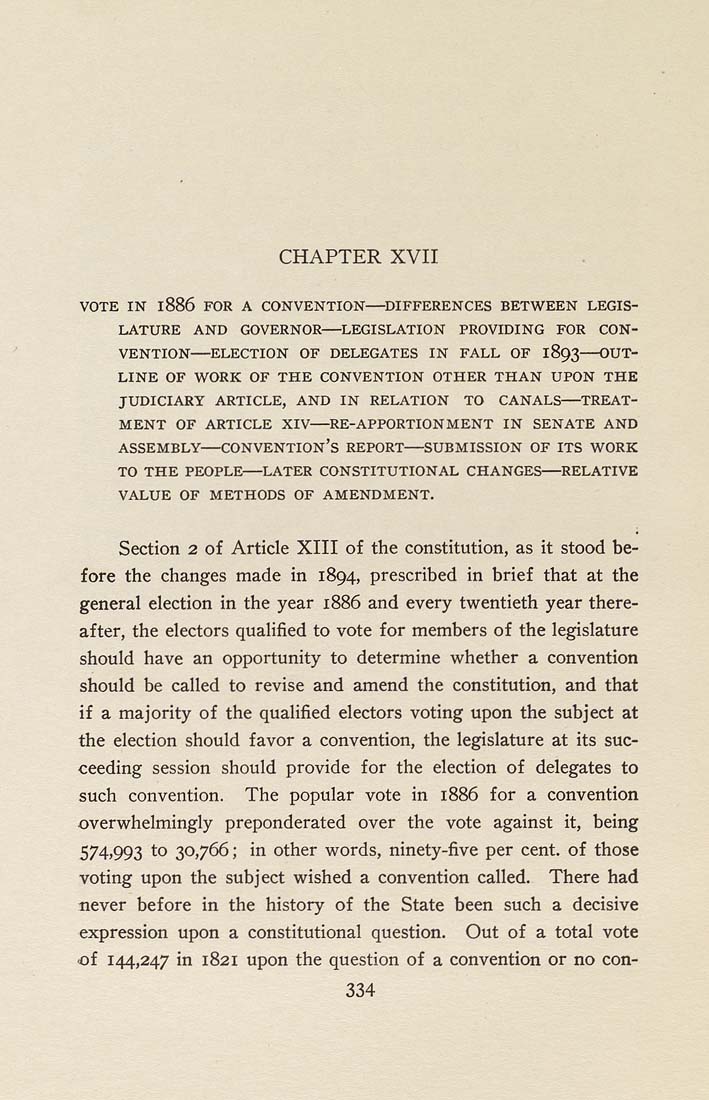
CHAPTER XVII VOTE IN 1886 FOR A CONVENTION----^DIFFERENCES BETWEEN LEGIS¬ LATURE AND GOVERNOR----LEGISLATION PROVIDING FOR CON¬ VENTION----ELECTION OF DELEGATES IN FALL OF I893----OUT¬ LINE OF WORK OF THE CONVENTION OTHER THAN UPON THE JUDICIARY ARTICLE, AND IN RELATION TO CANALS----TREAT¬ MENT OF ARTICLE XIV----RE-APPORTIONMENT IN SENATE AND ASSEMBLY----CONVENTION'S REPORT----SUBMISSION OF ITS WORK TO THE PEOPLE----LATER CONSTITUTIONAL CHANGES----RELATIVE VALUE OF METHODS OF AMENDMENT. Section 2 of Article XIII of the constitution, as it stood be¬ fore the changes made in 1894, prescribed in brief that at the general election in the year 1886 and every twentieth year there¬ after, the electors qualified to vote for members of the legislature should have an opportunity to determine whether a convention should be called to revise and amend the constitution, and that if a majority of the qualified electors voting upon the subject at the election should favor a convention, the legislature at its suc¬ ceeding session should provide for the election of delegates to such convention. The popular vote in 1886 for a convention overwhelmingly preponderated over the vote against it, being 574,993 to 30,766; in other words, ninety-five per cent, of those voting upon the subject wished a convention called. There had never before in the history of the State been such a decisive expression upon a constitutional question. Out of a total vote of 144,247 in 1821 upon the question of a convention or no con- 334 |
|
|
Page 334 |
|