

Sallust, Bellum catilinae
(Boston : D.C. Heath, 1908.)
|
||

 Click here and hold to drag menu around
|





|
|
|
|

|
Page 49 | 
|
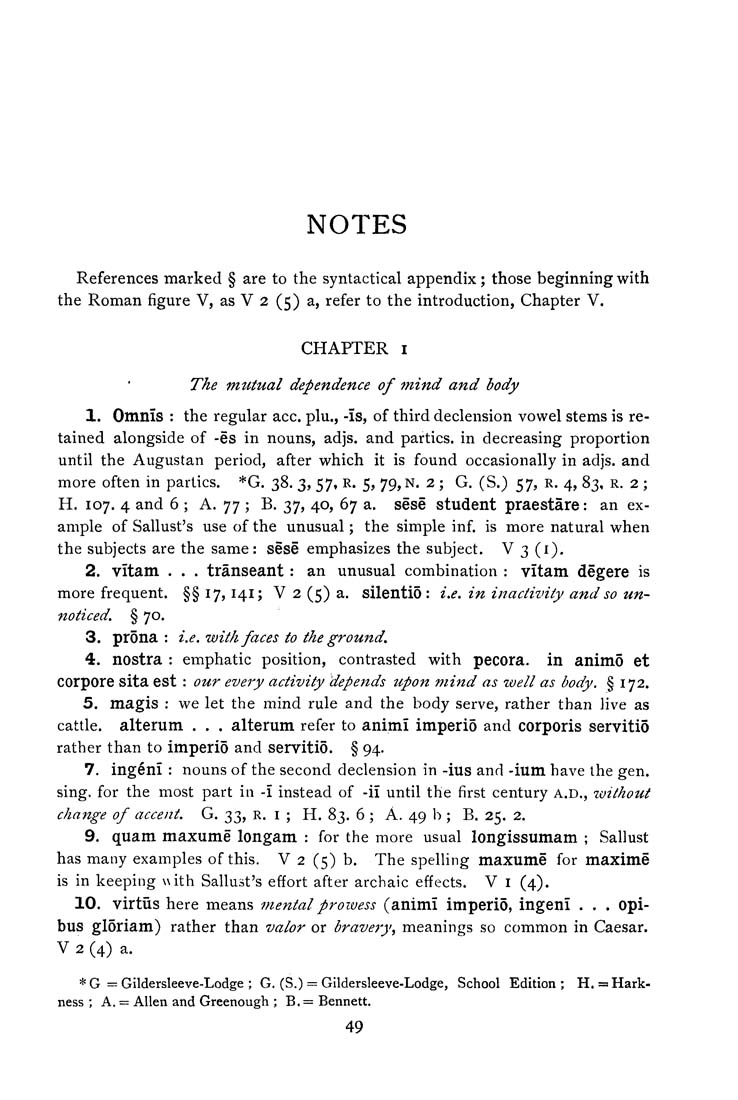
NOTES References marked § are to the syntactical appendix; those beginning with the Roman figure V, as V 2 (5) a, refer to the introduction, Chapter V. CHAPTER I The mtctual dependence of mind and body 1. Omnis : the regular ace. plu., -is, of third declension vowel stems is re¬ tained alongside of -es in nouns, adjs. and parties, in decreasing proportion until the Augustan period, after which it is found occasionally in adjs. and more often in parUcs. *G. 38. 3, 57, R. 5, 79, N. 2 ; G. (S.) 57, R. 4, %2>^ r. 2 ; H. 107. 4 and 6 ; A. 77 ; B. 37, 40, 67 a. sese student praestare: an ex¬ ample of Sallust's use of the unusual; the simple inf. is more natural when the subjects are the same: sese emphasizes the subject. V 3 (i). 2. vitam . . . transeant: an unusual combination : vitam degere is more frequent. §§ 17,141; V 2 (5) a. silentio: i.e. in inactivity and so un¬ noticed. § 70. 3. prona: i.e.with faces to the ground. 4. nostra : emphatic position, contrasted with pecora. in animo et corpore sita est : our every activity depends upon mind as tvell as body. § 172. 5. magis : we let the mind rule and the body serve, rather than live as cattle, alterum . . . alterum refer to animi imperio and corporis serviti5 rather than to imperio and servitio. § 94. 7. ingeni : nouns of the second declension in -ius and -ium have the gen. sing, for the most part in -i instead of -ii until the first century A.D., ivithout change of accent. G. "i^t^, R. I ; H. 83. 6 ; A. 49 b ; B. 25. 2. 9. quam maxume longam : for the more usual longissumam ; wSallust has many examples of this. V 2 (5) b. The spelling maxume for maxime is in keeping with Sallust's effort after archaic effects. V i (4). 10. virtus here means mental prowess (animi imperio, ingeni . . . opi¬ bus gloriam) rather than valor or bravery, meanings so common in Caesar. V 2 (4) a. * G = Gildersleeve-Lodge ; G. (S.) = GIldersleeve-Lodge, School Edition ; H. = Hark- ness -, A. = Allen and Greenough ; B. = Bennett. 49 |
|
|
Page 49 |
|