

Sallust, Bellum catilinae
(Boston : D.C. Heath, 1908.)
|
||

 Click here and hold to drag menu around
|





|
|
|
|

|
Page 81 | 
|
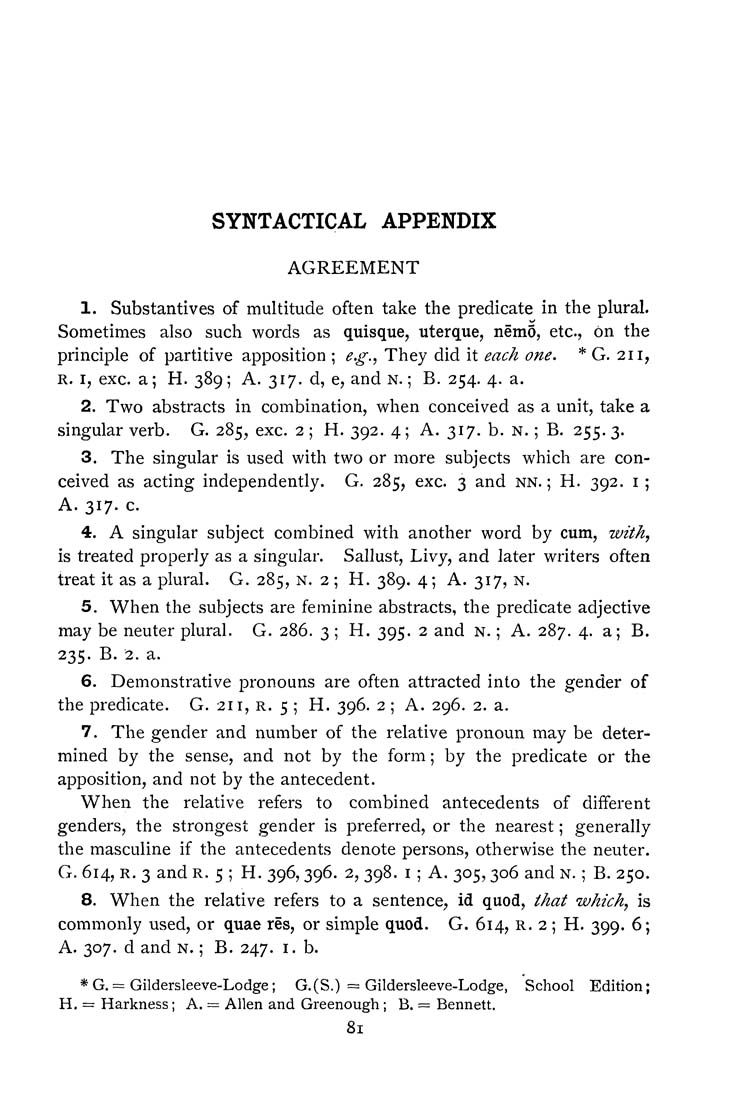
SYNTACTICAL APPENDIX AGREEMENT 1. Substantives of multitude often take the predicate in the plural. Sometimes also such words as quisque, uterque, nemo, etc., on the principle of partitive apposition ; e.g., They did it each one. * G. 211, R. I, exc. a; H. 389; A. 317. d, e, and N.; B. 254. 4. a. 2. Two abstracts in combination, when conceived as a unit, take a singular verb. G. 285, exc. 2 ; H. 392. 4; A. 317. b. N.; B. 255. 3. 3. The singular is used with two or more subjects which are con¬ ceived as acting independently. G. 285, exc. 3 and nn. ; H. 392. i ; A. 317. c. 4. A singular subject combined with another word by cum, with, is treated properly as a singular. Sallust, Livy, and later writers often treat it as a plural. G. 285, N. 2 ; H. 389. 4; A. 317, n. 5. When the subjects are feminine abstracts, the predicate adjective may be neuter plural. G. 286. 3 ; H. 395. 2 and n. ; A. 287. 4. a; B. 235. B. 2. a. 6. Demonstrative pronouns are often attracted into the gender of the predicate. G. 211, R. 5 ; H. 396. 2 ; A. 296. 2. a. 7. The gender and number of the relative pronoun may be deter¬ mined by the sense, and not by the form; by the predicate or the apposition, and not by the antecedent. When the relative refers to combined antecedents of different genders, the strongest gender is preferred, or the nearest; generally the masculine if the antecedents denote persons, otherwise the neuter. G. 614, R. 3 and R. 5 ; H. 396, 396. 2, 398. i ; A. 305, 306 and n. ; B. 250. 8. When the relative refers to a sentence, id quod, that which, is commonly used, or quae res, or simple quod. G. 614, R. 2 ; H. 399. 6; A. 307. d and n. ; B. 247. i. b. * G. = Gildersleeve-Lodge; G.(S.) = Gildersleeve-Lodge, School Edition; H. = Harkness; A. = Allen and Greenough ; B. = Bennett. |
|
|
Page 81 |
|