

Sallust, Bellum catilinae
(Boston : D.C. Heath, 1908.)
|
||

 Click here and hold to drag menu around
|





|
|
|
|

|
Page 163 | 
|
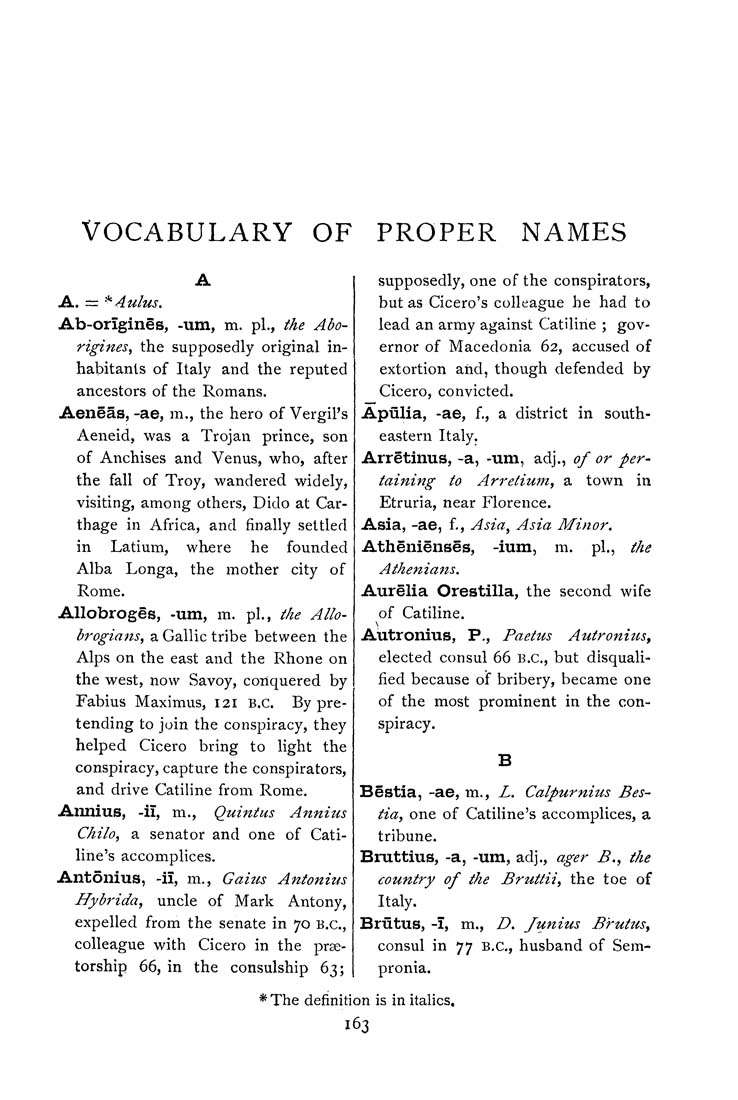
VOCABULARY OF PROPER NAMES A. = '^Aulus. Ab-origines, -um, m. pL, the Abo¬ rigines, the supposedly original in¬ habitants of Italy and the reputed ancestors of the Romans. Aeneas, -ae, m., the hero of Vergil's Aeneid, was a Trojan prince, son of Anchises and Venus, who, after the fall of Troy, wandered widely, visiting, among others. Dido at Car¬ thage in Africa, and finally settled in Latium, where he founded Alba Longa, the mother city of Rome. Allobroges, -um, m. pi., the Allo¬ brogians, a Gallic tribe between the Alps on the east and the Rhone on the west, now Savoy, conquered by Fabius Maximus, 121 B.C. By pre¬ tending to join the conspiracy, they helped Cicero bring to light the conspiracy, capture the conspirators, and drive Catiline from Rome. Aimius, -ii, m., Quintus Annius Chilo, a senator and one of Cati¬ line's accomplices. Antonius, -ii, m., Gaius Antonius Hyb7'ida, uncle of Mark Antony, expelled from the senate in 70 B.C., colleague with Cicero in the prae- torship 66, in the consulship 63; supposedly, one of the conspirators, but as Cicero's colleague he had to lead an army against Catiline ; gov¬ ernor of Macedonia 62, accused of extortion aiid, though defended by Cicero, convicted. Apulia, -ae, f., a district in south¬ eastern Italy. Arretinus, -a, -um, adj., of or per¬ taining to Arretiu7n, a town in Etruria, near Florence. Asia, -ae, f., Asia, Asia Minor. Athenienses, -ium, m. pi., the Athenia7ts. Aurelia Orestilla, the second wife of Catiline. Autronius, P., Paetus Autronius, elected consul 66 B.C., but disquali¬ fied because oif bribery, became one of the most prominent in the con¬ spiracy. Bestia, -ae, m., L. Calpurnius Bes¬ tia, one of Catiline's accomplices, a tribune. Bruttius, -a, -um, adj., ager B., the country of the Bruttii, the toe of Italy. Brutus, -i, m., D. funius Brutus, consul in 77 B.C., husband of Sem¬ pronia. •^The definition is in italics, 163 |
|
|
Page 163 |
|