

Mitchell, Benjamin W. The writing of narrative Latin
(New York ; Cincinnati [etc.] : American Book Co., [c1915])
|
||

 Click here and hold to drag menu around
|





|
|
|
|

|
Page 90 | 
|
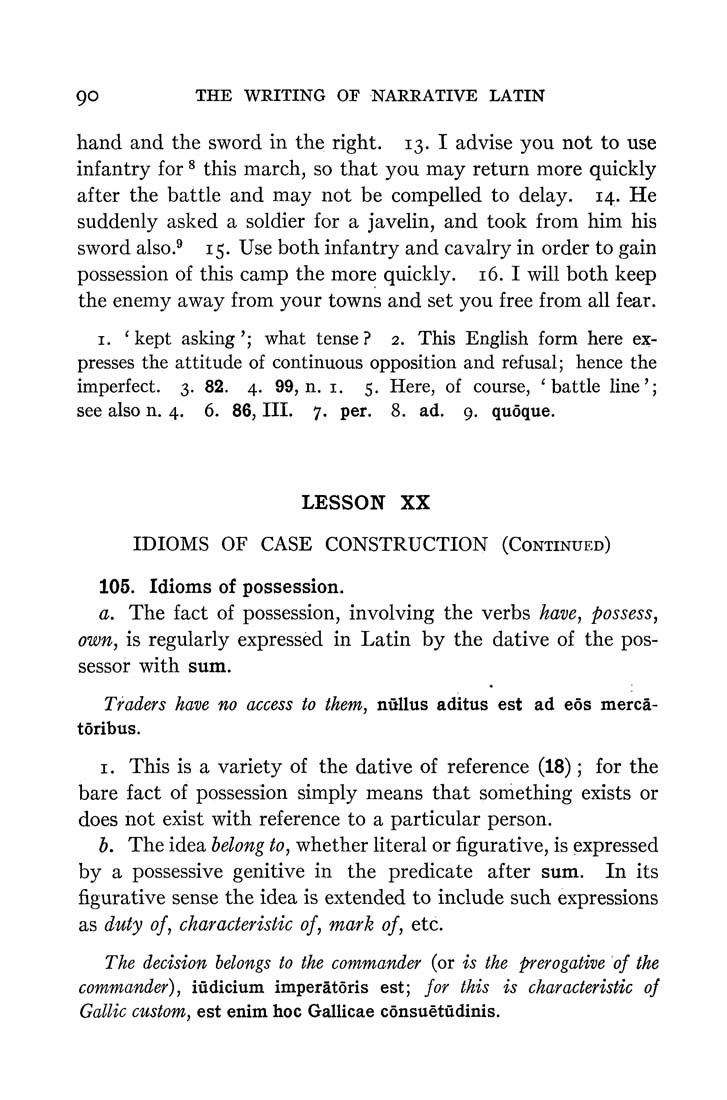
90 THE WRITING OF NARRATIVE LATIN hand and the sword in the right. 13. I advise you not to use infantry for ^ this march, so that you may return more quickly after the battle and may not be compelled to delay. 14. He suddenly asked a soldier for a javelin, and took from him his sword also.^ 15. Use both infantry and cavalry in order to gain possession of this camp the more quickly. 16. I will both keep the enemy away from your towns and set you free from all fear. I. ' kept asking'; what tense ? 2. This English form here ex¬ presses the attitude of continuous opposition and refusal; hence the imperfect. 3. 82. 4. 99, n. i. 5. Here, of course, ^battle line'; see also n. 4. 6. 86, III. 7. per. 8. ad. 9. quoque. LESSON XX IDIOMS OF CASE CONSTRUCTION (Continued) 105. Idioms of possession. a. The fact of possession, involving the verbs have, possess, own, is regularly expressed in Latin by the dative of the pos¬ sessor with sum. Traders have no access to them, nullus aditus est ad eos merca- toribus. I. This is a variety of the dative of reference (18); for the bare fact of possession simply means that something exists or does not exist with reference to a particular person. b. The idea belong to, whether literal or figurative, is expressed by a possessive genitive in the predicate after sum. In its figurative sense the idea is extended to include such expressions as duty of, characteristic of, mark of, etc. The decision belongs to the commander (or is the prerogative of the commander), iudicium imperatoris est; for this is characteristic of Gallic custom, est enim hoc Gallicae consuetudinis. |
|
|
Page 90 |
|