

The technograph (no. 7)
(Bloomington, Ill. : Pantagraph Print. and Stationery Co. )
|
||

 Click here and hold to drag menu around
|





|
|
|
|

|
Page 109 | 
|
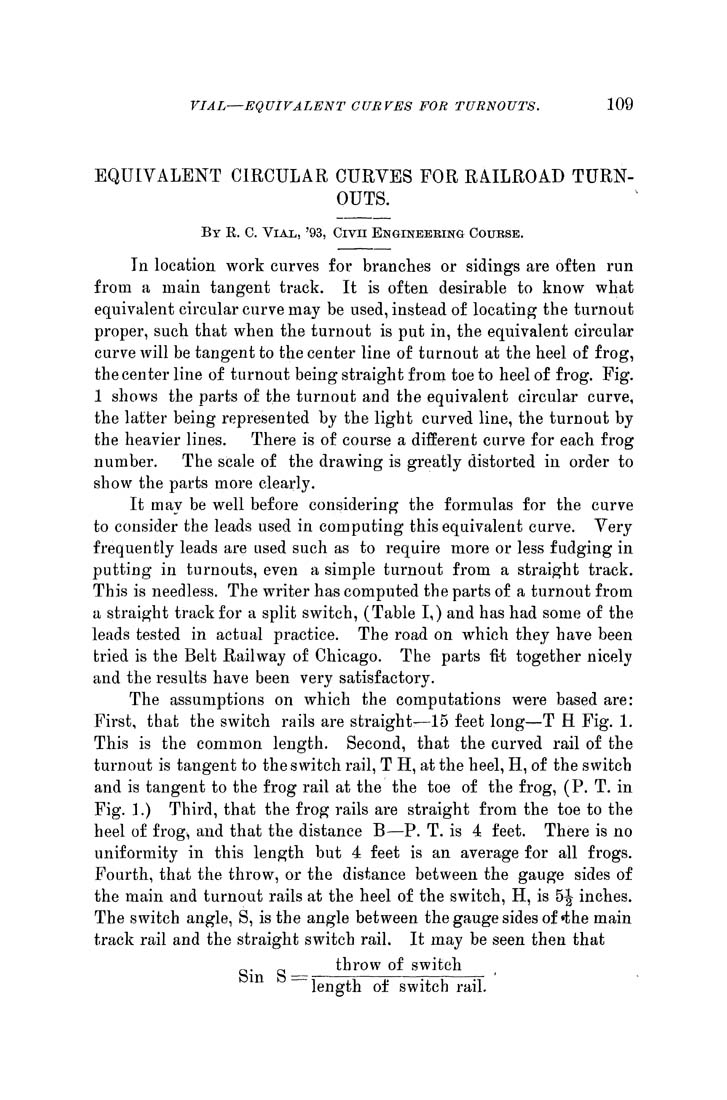
VIAL—EQUIVALENT CURVES FOR TURNOUTS. 109 EQUIVALENT CIRCULAR CURVES FOR RAILROAD TURN¬ OUTS. By R. C. Vial, '93, Givii Engineering Course. In location work curves for branches or sidings are often run from a main tangent track. It is often desirable to know what equivalent circular curve may be used, instead of locating the turnout proper, such that when the turnout is put in, the equivalent circular curve will be tangent to the center line of turnout at the heel of frog, the center line of turnout being straight from toe to heel of frog. Fig. 1 shows the parts of the turnout and the equivalent circular curve, the latter being represented by the light curved line, the turnout by the heavier lines. There is of course a different curve for each frog number. The scale of the drawing is greatly distorted in order to show the parts more clearly. It may be well before considering the formulas for the curve to consider the leads used in computing this equivalent curve. Very frequently leads are used such as to require more or less fudging in putting in turnouts, even a simple turnout from a straight track. This is needless. The writer has computed the parts of a turnout from a straight track for a split switch, (Table I,) and has had some of the leads tested in actual practice. The road on which they have been tried is the Belt Railway of Chicago. The parts fi-t together nicely and the results have been very satisfactory. The assumptions on which the computations were based are: First, that the switch rails are straight—15 feet long—T H Fig. 1. This is the common length. Second, that the curved rail of the turnout is tangent to the switch rail, T H, at the heel, H, of the switch and is tangent to the frog rail at the the toe of the frog, (P. T. in Fig. 1.) Third, that the frog rails are straight from the toe to the heel of frog, and that the distance B—P. T. is 4 feet. There is no uniformity in this length but 4 feet is an average for all frogs. Fourth, that the throw, or the distance between the gauge sides of the main and turnout rails at the heel of the switch, H, is 5J inches. The switch angle, S, is the angle between the gauge sides of *the main track rail and the straight switch rail. It may be seen then that throw of switch Sin S: length of switch rail. |
|
|
Page 109 |
|