

Budge, E. A. Wallis The Nile
(London ; Cairo : T. Cook & Son (Egypt) Ltd., 1901.)
|
||

 Click here and hold to drag menu around
|





|
|
|
|

|
Page 282 | 
|
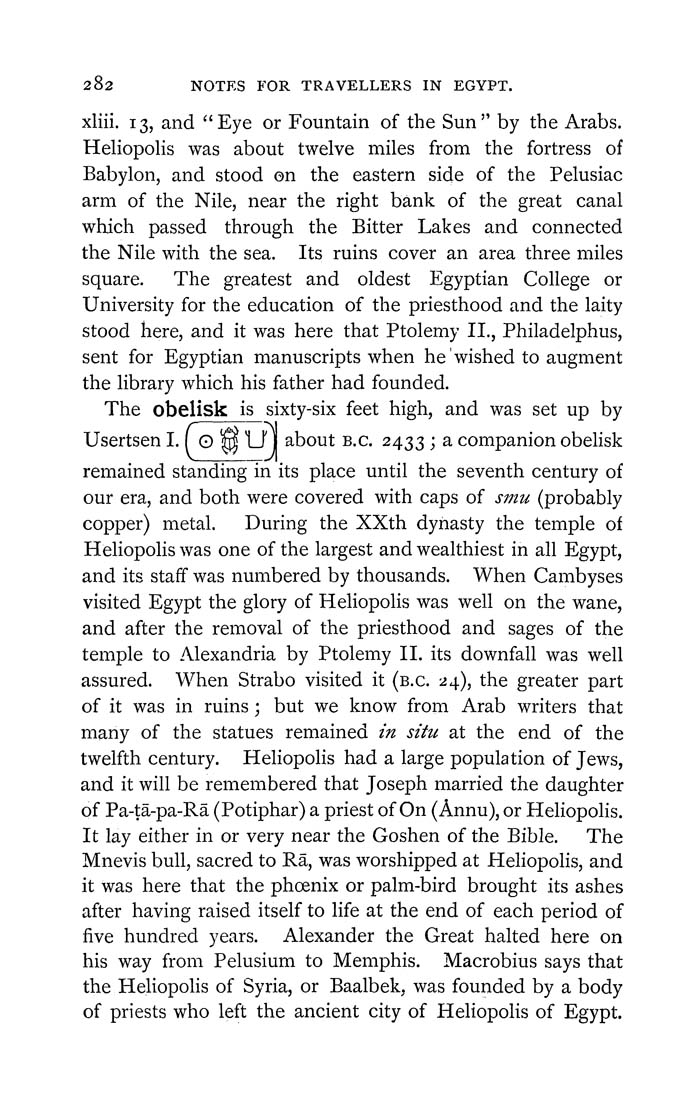
2Q2 NOTES FOR TRAVELLERS IN EGYPT. xlin. 13, and "Eye or Fountain of the Sun" by the Arabs. Heliopolis was about twelve miles from the fortress of Babylon, and stood on the eastern side of the Pelusiac arm of the Nile, near the right bank of the great canal which passed through the Bitter Lakes and connected the Nile with the sea. Its ruins cover an area three miles square. The greatest and oldest Egyptian College or University for the education of the priesthood and the laity stood here, and it was here that Ptolemy IL, Philadelphus, sent for Egyptian manuscripts when he wished to augment the library w^hich his father had founded. The obelisk is sixty-six feet high, and was set up by Usertsen I. ( O ^ U | about b.c 2433 ; a companion obehsk remained standing in its place until the seventh century of our era, and both were covered with caps of smu (probably copper) metal. During the XXth dynasty the temple of Heliopolis was one of the largest and wealthiest in all Egypt, and its staff was numbered by thousands. When Cambyses visited Egypt the glory of Heliopolis was well on the wane, and after the removal of the priesthood and sages of the temple to Alexandria by Ptolemy II. its downfall was well assured. When Strabo visited it (b.c. 24), the greater part of it was in ruins; but we know from Arab writers that many of the statues remained in situ at the end of the twelfth century. Heliopolis had a large population of Jews, and it will be remembered that Joseph married the daughter of Pa-ta-pa-Ra (Potiphar) a priest of On (Annu), or Heliopolis. It lay either in or very near the Goshen of the Bible. The Mnevis bull, sacred to Ra, was worshipped at Heliopolis, and it was here that the phoenix or palm-bird brought its ashes after having raised itself to life at the end of each period of fi^e hundred years. Alexander the Great halted here on his way from Pelusium to Memphis. Macrobius says that the Heliopolis of Syria, or Baalbek, was founded by a body of priests who left the ancient city of Heliopolis of Egypt. |
|
|
Page 282 |
|