

Young, Arthur. Nautical dictionary
(London : Longman, Green, Longman, Roberts, & Green, 1863.)
|
||

 Click here and hold to drag menu around
|





|
|
|
|

|
Page 143 | 
|
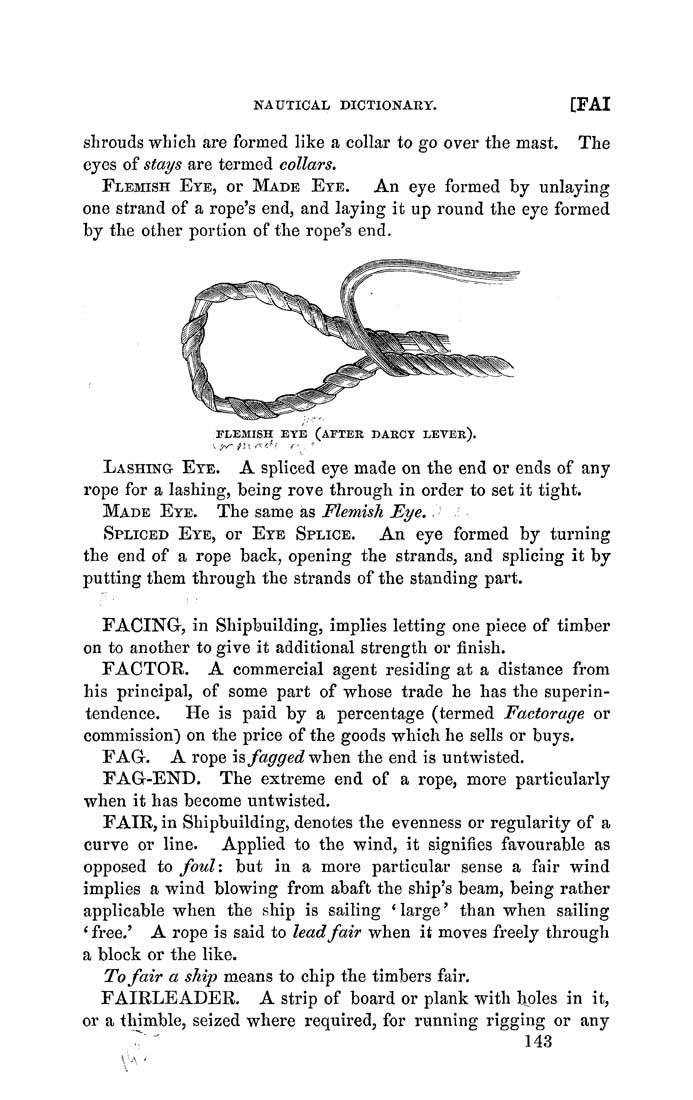
NAUTICAL DICTIONARY. [FAX shrouds which are formed like a collar to go over the mast. The eyes of stays are termed collars, Flemish Eye, or Made Eye. An eye formed by unlaying one strand of a rope's end, and laying it up round the eye formed by the other portion of the rope's end. FLEMISH EYE (AFTER DARCY LEVER). Lashing Eye. A spliced eye made on the end or ends of any rope for a lashing, being rove through in order to set it tight. Made Eye. The same as Flemish Eye, .'■ Spliced Eye, or Eye Splice. An eye formed by turning the end of a rope back, opening the strands, and splicing it by putting them through the strands of the standing part. FACING, in Shipbuilding, implies letting one piece of timber on to another to give it additional strength or finish. FACTOR. A commercial agent residing at a distance from his principal, of some part of whose trade he has the superin¬ tendence. He is paid by a percentage (termed Factorage or commission) on the price of the goods which he sells or buys. FAG. A rope is fagged when the end is untwisted. FAG-END, The extreme end of a rope, more particularly when it has become untwisted, FAIR, in Shipbuilding, denotes the evenness or regularity of a curve or line. Applied to the wind, it signifies favourable as opposed to foul: but in a more particular sense a fair wind implies a wind blowing from abaft the ship's beam, being rather applicable when the ship is sailing * large' than when sailing 'free.' A rope is said to lead fair when it moves freely through a block or the like. To fair a ship means to chip the timbers fair. FAIRLEADER. A strip of board or plank with toles in it, or a thimble, seized where required, for running rigging or any 143 |
|
|
Page 143 |
|