

Thucydides. Thucydides translated into English (v. 2)
(Oxford : Clarendon Press, 1881.)
|
||

 Click here and hold to drag menu around
|





|
|
|
|

|
Page [1] | 
|
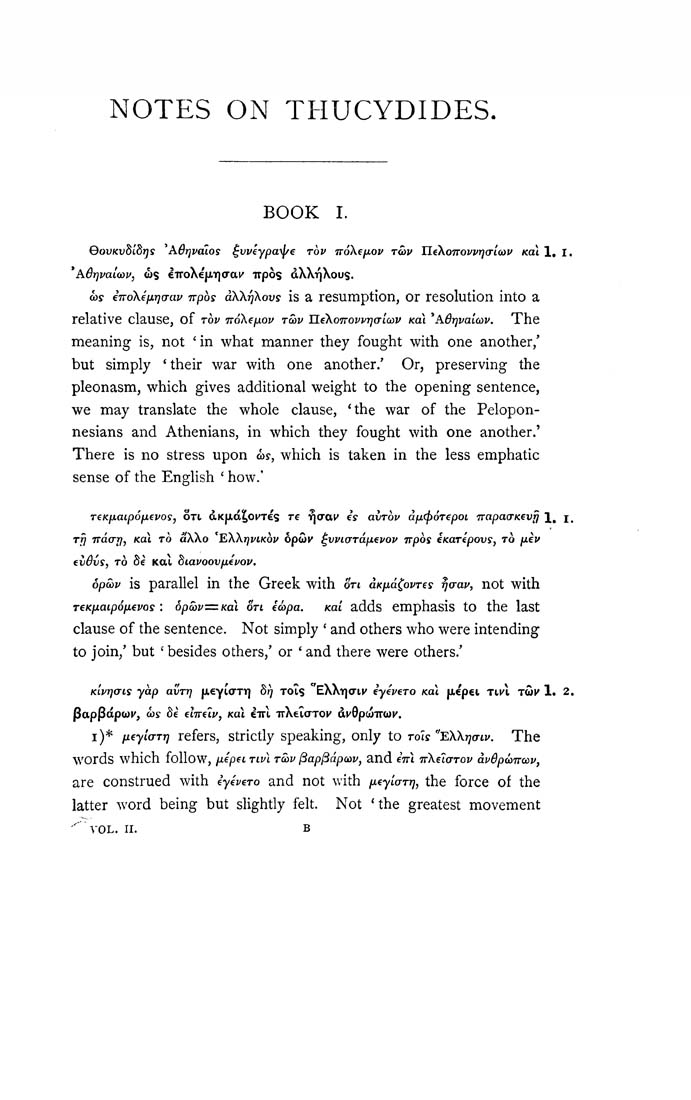
NOTES ON THUCYDIDES. BOOK I. QovKvbibrjs ABqpoLOs ^vveypaxj/e tov noXepov tcI>v UeXoTrovvqa-icov koX 1, i. *Adqvai<ov, ws eTroXeji.Tjcrai' irpos dXXii]Xous. cos iiroXep-qcrav npos dXXqXovs is a resumption, or resolution into a relative clause, of t6v rroX^pov tcou neXoTrovvqa-Lcov Koi *K6qvalu>v. The meaning is, not ' in what manner they fought with one another,' but simply 'their war with one another.' Or, preserving the pleonasm, which gives additional weight to the opening sentence, we may translate the whole clause, 'the war of the Pelopon- nesians and Athenians, in which they fought with one another.' There is no stress upon cos, which is taken in the less emphatic sense of the English ' how.' reKpaipopevos, on 6,Kp.dtfivri<s re Yi(rav es avTov dppoTcpoi irapacTKCvfj \^ i, Tji Trdcrj], Kol to aXXo ^EXXtjulkov opCiV ^vvidTapevov irpos eKarepovs, to peu €v6vs, TO §€ Kai biavoovpivov. opcov is parallel in the Greek with 6Vt aKpd^ovTes ^crav, not with TCKpaipopevos: opcov =: kol oti ea>pa. Kal adds emphasIs to the last clause of the sentence. Not simply ' and others who were intending to join,' but ' besides others,' or ' and there were others.' KLvqcris yap avrq jmeyiorTT] dq toTs EXX'»]<ni' iyevcTo Kal p.ipei tiki twi' 1. 2. ^ap^dpcov, cos fie etVeii/, Kal em irXetcrTOK aydpioircov. i)* peyia-Tq refers, strictly speaking, only to toIs ''FXXqa-iv. The words which follow, pepei tlv\ tcov (Sap^dpcov, and eVi TrXelcTTOv dvOpooncov, are construed with e'ye'z/ero and not with peyiarq, the force of the latter word being but slightly felt. Not 'the greatest movement 'vol. n. B |
|
|
Page [1] |
|