

Thucydides. Thucydides translated into English (v. 2)
(Oxford : Clarendon Press, 1881.)
|
||

 Click here and hold to drag menu around
|





|
|
|
|

|
Page [224] | 
|
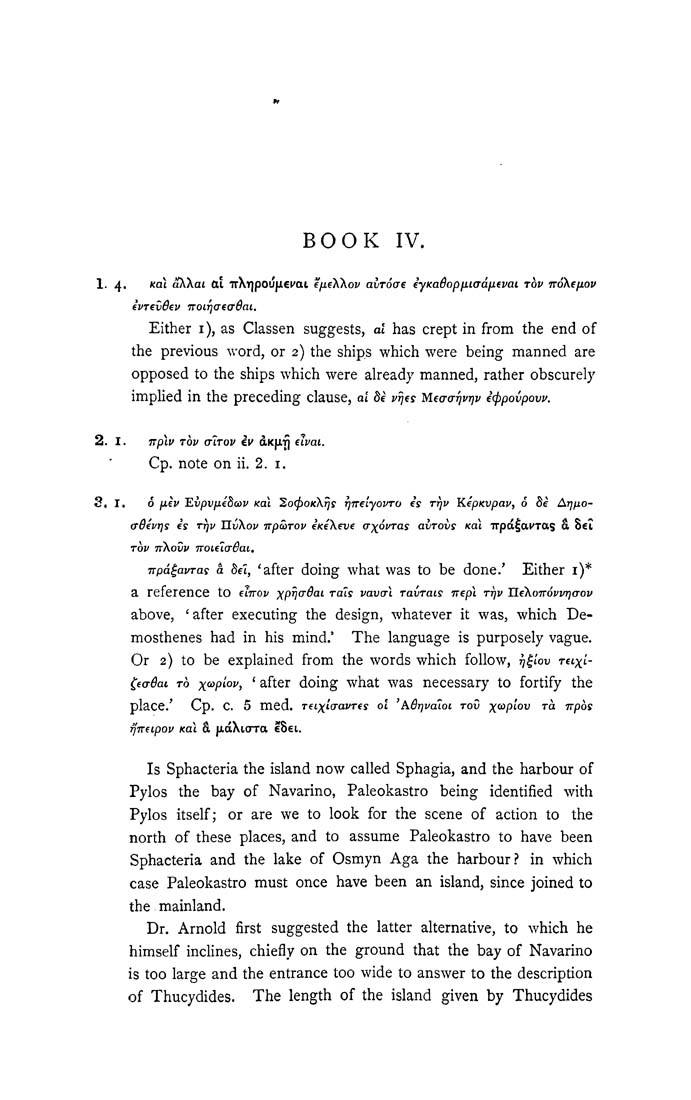
BOOK IV. 1. 4. Kal dXXai oX TrXT]pou|Jiei'ai epeXXov avrdae iyKaBoppiadpevai rdv ndXepov ivrevBev noiqaeaBai. Either i), as Classen suggests, at has crept in from the end of the previous word, or 2) the ships which were being manned are opposed to the ships which were already manned, rather obscurely impfied in the preceding clause, at be vrjes Meaaqvqv icppovpow. 2. I. nplv rdv alrov ev dKp,T] etVai. Cp. note on ii. 2. I. 3. I. 6 pev Evpvpebcov kcu 2o(pOKXfjs qneiyovro is rqv KipKvpav, d be Aqpo¬ aBivqs is rqv UvXov nphrov iKiXeve axdvras avrovs Kal Trpd|a»'Tas d Set rdv nXovv noielaBai, npd^avras a bel, 'after doing what was to be done.' Either i)* a reference to einov XPW^^*- "^^"^^ vaval ravrais nepl rqv UeXonovvqaov above, 'after execudng the design, whatever it was, which De¬ mosthenes had in his mind.' The language is purposely vague. Or 2) to be explained from the words which follow, q^iov reixi- (eaBai rd x^pi°^) ' ^^^^^ doing what was necessary to fortify the place.' Cp. C. 5 med. reixiaavres ol 'ABqvaloi rov ;(Q)piov rd Trpos qneipov Kal a p.d\icrra eSei. Is Sphacteria the island now called Sphagia, and the harbour of Pylos the bay of Navarino, Paleokastro being identified with Pylos itself; or are we to look for the scene of action to the north of these places, and to assume Paleokastro to have been Sphacteria and the lake of Osmyn Aga the harbour? in which case Paleokastro must once have been an island, since joined to the mainland. Dr. Arnold first suggested the latter alternative, to which he himself incfines, chiefly on the ground that the bay of Navarino is too large and the entrance too wide to answer to the description of Thucydides. The length of the island given by Thucydides |
|
|
Page [224] |
|