

Murchison, Roderick Impey, Siluria
(London : J. Murray, 1867.)
|
||

 Click here and hold to drag menu around
|





|
|
|
|

|
[No Page Number] | 
|
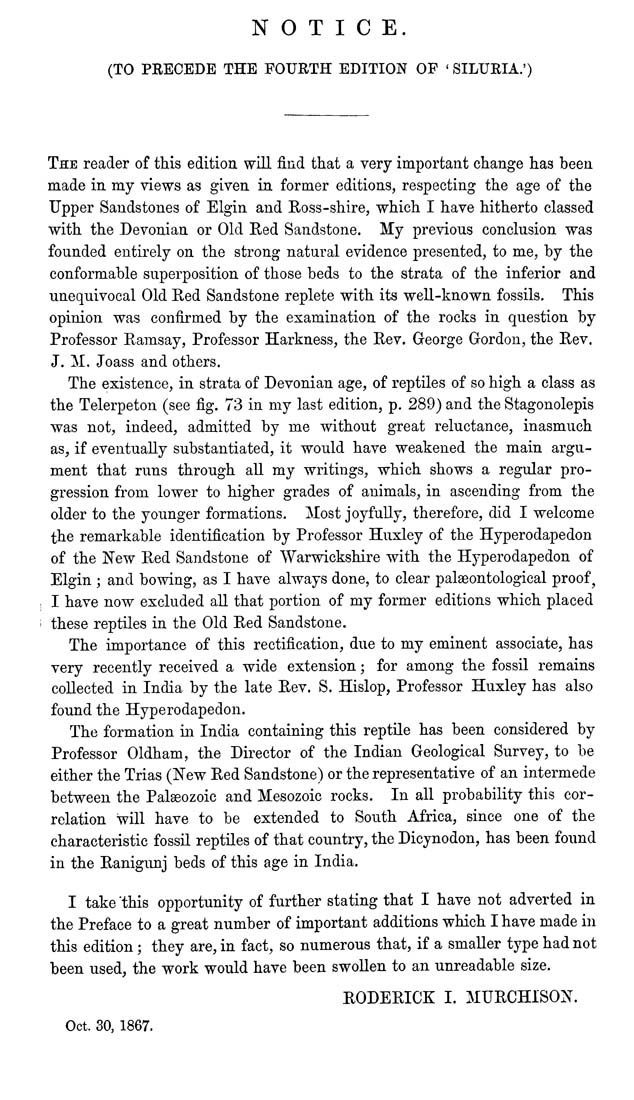
NOTICE. (TO PRECEDE THE FOURTH EDITION OF ' SILURIA.') The reader of this edition will find that a very important change has been made in my views as given in former editions, respecting the age of the Upper Sandstones of Elgin and Ross-shire, which I have hitherto classed with the Devonian or Old Red Sandstone. My previous conclusion was founded entirely on the strong natural evidence presented, to me, by the conformable superposition of those beds to the strata of the inferior and unequivocal Old Red Sandstone replete with its well-known fossils. This opinion was confirmed by the examination of the rocks in question by Professor Ramsay, Professor Harkness, the Rev. George Gordon, the Rev. J. M. Joass and others. The existence, in strata of Devonian age, of reptiles of so high a class as the Telerpeton (see fig. 73 in my last edition, p. 289) and the Stagonolepis was not, indeed, admitted by me without great reluctance, inasmuch as, if eventually substantiated, it would have weakened the main argu¬ ment that runs through all my writings, which shows a regular pro¬ gression from lower to higher grades of animals, in ascending from the older to the younger formations. Most joyfully, therefore, did I welcome the remarkable identification by Professor Huxley of the Hyperodapedon of the New Red Sandstone of Warwickshire with the Hyperodapedon of Elgin ; and bowing, as I have always done, to clear palaeontological proof^ I have now excluded aU that portion of my former editions which placed these reptiles in the Old Red Sandstone. The importance of this rectification, due to my eminent associate, has very recently received a wide extension; for among the fossil remains collected in India by the late Rev. S. Hislop, Professor Huxley has also found the Hyperodapedon. The formation in India containing this reptile has been considered by Professor Oldham, the Director of the Indian Geological Survey, to be either the Trias (New Red Sandstone) or the representative of an intermede between the Palaeozoic and Mesozoic rocks. In all probability this cor¬ relation will have to be extended to Soiith Africa, since one of the characteristic fossil reptiles of that country, the Dicynodon, has been found in the Ranigunj beds of this age in India. I take this opportunity of further stating that I have not adverted in the Preface to a great number of important additions which I have made in this edition; they are, in fact, so numerous that, if a smaller type had not been used, the work would have been swollen to an unreadable size. RODERICK I. MURCHISON. Oct. 30, 1867. |
|
|
[No Page Number] |
|