

Murchison, Roderick Impey, Siluria
(London : J. Murray, 1867.)
|
||

 Click here and hold to drag menu around
|





|
|
|
|

|
Page [1] | 
|
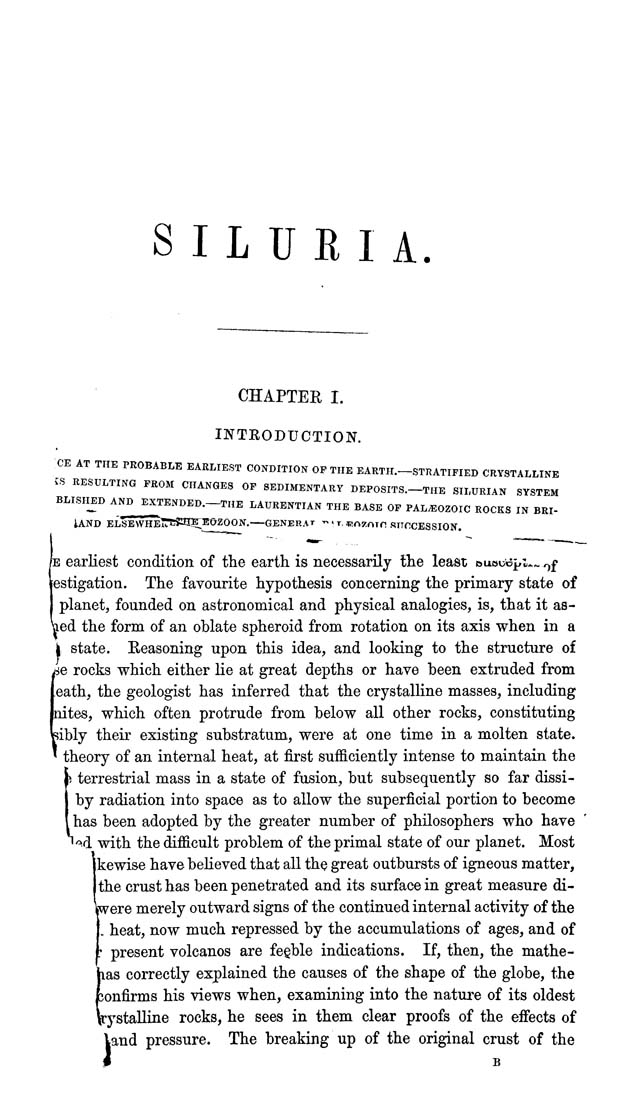
SILURIA. CHAPTER I. INTRODUCTION. CE AT THE PROBABLE EARLIEST CONDITION OF THE EARTH.-STRATIFIED CRYSTALLINE LS RESULTING PROM CHANGES OP SEDIMENTARY DEPOSITS.—THE SILURIAN SYSTEM BLISIIED AND EXTENDED.—THE LAURENTIAN THE BASE OP PALEOZOIC ROCKS IN BRI- iAND ELSEWHEITBS^S^EOZOON.—GENERAt " ' T. ip.nznTn iSnfiCESSION. earliest condition of tlie earth is necessarily the least iauisuopi^^ v^f estigation. The favourite hypothesis concerning the primary state of planet, founded on astronomical and physical analogies, is, that it as- aed the form of an oblate spheroid from rotation on its axis when in a i state. Reasoning upon this idea, and looking to the structure of ^e rocks which either lie at great depths or have been extruded from eath, the geologist has inferred that the crystalHne masses, including nites, which often protrude from below all other rocks, constituting sibly their existing substratum, were at one time in a molten state. ' theory of an internal heat, at first sufficiently intense to maintain the h terrestrial mass in a state of fusion, but subsequently so far dissi- I by radiation into space as to allow the superficial portion to become ! has been adopted by the greater number of philosophers who have I'^d. with the difiicult problem of the primal state of our planet. Most kewise have beheved that all the great outbursts of igneous matter, the crust has been penetrated and its surface in great measure di- Were merely outward signs of the continued internal activity of the . heat, now much repressed by the accumulations of ages, and of : present volcanos are fegble indications. If, then, the mathe- las correctly explained the causes of the shape of the globe, the confirms his views when, examining into the nature of its oldest jrj^stalline rocks, he sees in them clear proofs of the effects of J and pressure. The breaking up of the original crust of the B |
|
|
Page [1] |
|