

Murchison, Roderick Impey, Siluria
(London : J. Murray, 1867.)
|
||

 Click here and hold to drag menu around
|





|
|
|
|

|
Page 507 | 
|
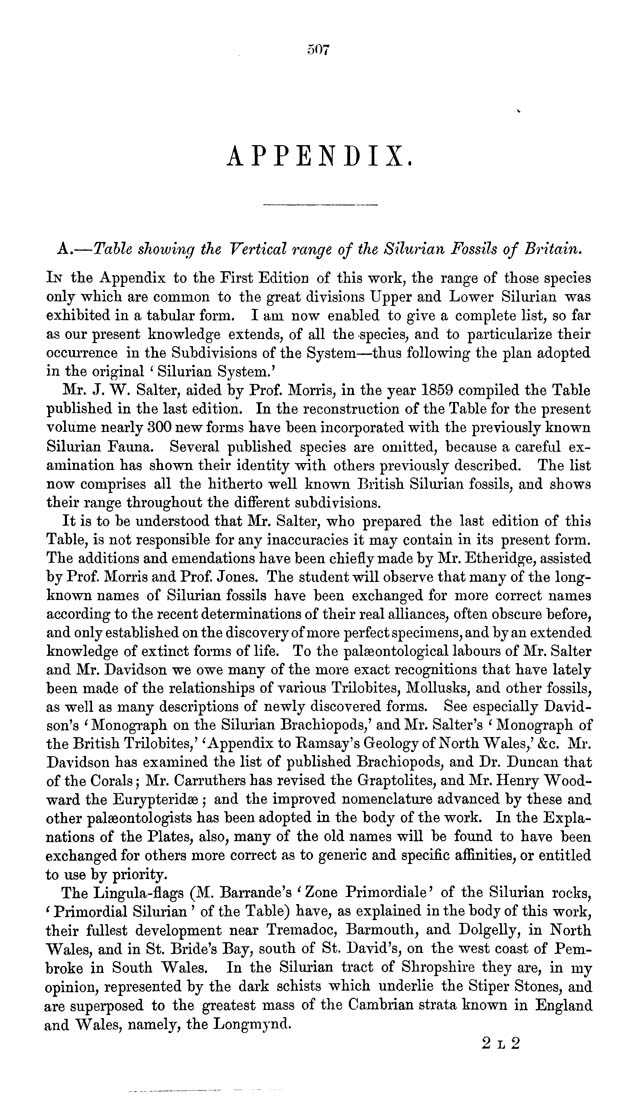
507 APPENDIX. A.—Table showing the Yertical range of the Silurian Fossils of Britain. In the Appendix to the Eirst Edition of this work, the range of those species only which are common to the great divisions Upper and Lower Silurian was exhibited in a tabular form. I am now enabled to give a complete list, so far as our present knowledge extends, of all the species, and to particularize their occm'rence in the Subdivisions of the System—thus foUowing the plan adopted in the original ' Silurian System.' Mr. J. W. Salter, aided by Prof. Mon-is, in the year 1859 compiled the Table published in the last edition. In the reconstruction of the Table for the present volume nearly 300 new forms have been incorporated with the previously known Silurian Eauna. Several published species are omitted, because a careful ex¬ amination has shown their identity with others previously described. The list now comprises all the hitherto well known British Silurian fossils, and shows their range throughout the different subdivisions. It is to be understood that Mr. Salter, who prepared the last edition of this Table, is not responsible for any inaccuracies it may contain in its present form. The additions and emendations have been chiefiy made by Mr. Etheridge, assisted by Prof. Morris and Prof Jones. The student will observe that many of the long- known names of Silurian fossils have been exchanged for more correct names according to the recent determinations of their real aUiances, often obscure before, and only estabhshed on the discovery of more perfect specimens, and by an extended knowledge of extinct forms of life. To the palaeontological labours of Mr. Salter and Mr. Davidson we owe many of the more exact recognitions that have lately been made of the relationships of various TrUobites, Mollusks, and other fossils, as well as many descriptions of newly discovered forms. See especially David¬ son's ^ Monograph on the Silmian Brachiopods,' and Mr. Salter's ^ Monograph of the British Trilobites,' 'Appendix to Eamsay's Geology of North Wales,' &c. Mr. Davidson has examined the list of published Brachiopods, and Dr. Duncan that of the Corals; Mr. Carruthers has revised the Graptolites, and Mr. Henry Wood¬ ward the Eurypteridae ; and the improved nomenclature advanced by these and other palaeontologists has been adopted in the body of the work. In the Expla¬ nations of the Plates, also, many of the old names wiU be found to have been exchanged for others more correct as to generic and specific affinities, or entitled to use by priority. The Lingula-fiags (M. Barrande's ' Zone Primordiale' of the Silurian rocks, ' Primordial Sihman ' of the Table) have, as explained in the body of this work, their fullest development near Tremadoc, Barmouth, and DolgeUy, in North Wales, and in St. Bride's Bay, south of St. David's, on the west coast of Pem¬ broke in South Wales. In the Silurian tract of Shropshire they are, in my opinion, represented by the dark schists which underlie the Stiper Stones, and are superposed to the greatest mass of the Cambrian strata known in England and Wales, namely, the Longmynd. 2 l2 |
|
|
Page 507 |
|