

Murchison, Roderick Impey, Siluria
(London : J. Murray, 1867.)
|
||

 Click here and hold to drag menu around
|





|
|
|
|

|
Page 543 | 
|
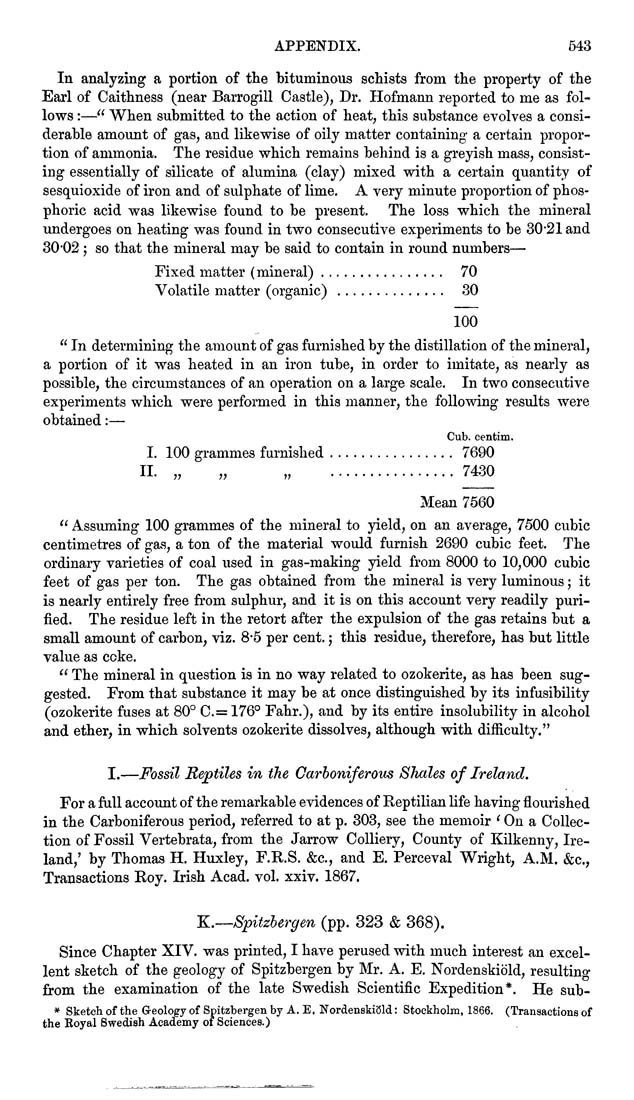
APPENDIX. 543 In analyzing a portion of the bituminous schists from the property of the Earl of Caithness (near Barrogill Castle), Dr. Hofmann reported to me as fol¬ lows :—" When submitted to the action of heat, this substance evolves a consi¬ derable amount of gas, and likewise of oily matter containing a certain propor¬ tion of ammonia. The residue which remains behind is a greyish mass, consist¬ ing essentially of silicate of alumina (clay) mixed with a certain quantity of sesquioxide of iron and of sulphate of lime. A very minute proportion of phos¬ phoric acid was likewise found to be present. The loss which the mineral imdergoes on heating was found in two consecutive experiments to be 30-21 and 30*02 ; so that the mineral may be said to contain in round numbers— Fixed matter (mineral)................ 70 Volatile matter (organic) .............. 30 100 " In determining the amount of gas furnished by the distillation of the mineral, a portion of it was heated in an iron tube, in order to imitate, as nearly as possible, the circumstances of an operation on a large scale. In two consecutive experiments which were performed in this manner, the following results were obtained:— Cub. centim. I. 100 grammes furnished................ 7690 II- „ ,> V ................ 7430 Mean 7560 " Assuming 100 grammes of the mineral to yield, on an average, 7500 cubic centimetres of gas, a ton of the material would furnish 2690 cubic feet. The ordinary varieties of coal used in gas-making yield from 8000 to 10,000 cubic feet of gas per ton. The gas obtained from the mineral is very luminous; it is nearly entirely free from sulphur, and it is on this account very readily puri¬ fied. The residue left in the retort after the expulsion of the gas retains but a small amount of carbon, viz. 8-5 per cent.; this residue, therefore, has but little value as coke. " The mineral in question is in no way related to ozokerite, as has been sug¬ gested. From that substance it may be at once distinguished by its infusibility (ozokerite fuses at 80° C.= 176° Fahr.), and by its entire insolubility in alcohol and ether, in which solvents ozokerite dissolves, although with difficulty." I.—Fossil Reptiles in the Carboniferous Shales of Ireland. For a full account of the remarkable evidences of Reptilian Ufe having flourished in the Carboniferous period, referred to at p. 303, see the memoir ' On a Collec¬ tion of Fossil Vertebrata, from the Jarrow Colliery, County of Kilkenny, Ire¬ land,' by Thomas H. Huxley, F.R.S. &c., and E. Perceval Wright, A.M. &c.. Transactions Roy. Irish Acad. vol. xxiv. 1867. K.—Spitzbergen (pp. 323 & 368). Since Chapter XIV. was printed, I have perused with much interest an excel¬ lent sketch of the geology of Spitzbergen by Mr. A. E. Nordenskiold, resulting from the examination of the late Swedish Scientific Expedition*. He sub- * Sketch of the G-eology of Spitzbergen by A. E. NordenskiiJld: Stockholm, 1866. (Transactions of the Koyal Swedish Academy of Sciences.) |
|
|
Page 543 |
|