

Andreas, A. T. History of the state of Kansas (History of Kansas)
(Chicago : A.T. Andreas, 1883.)
|
||

 Click here and hold to drag menu around
|





|
|
|
|

|
Page 179 | 
|
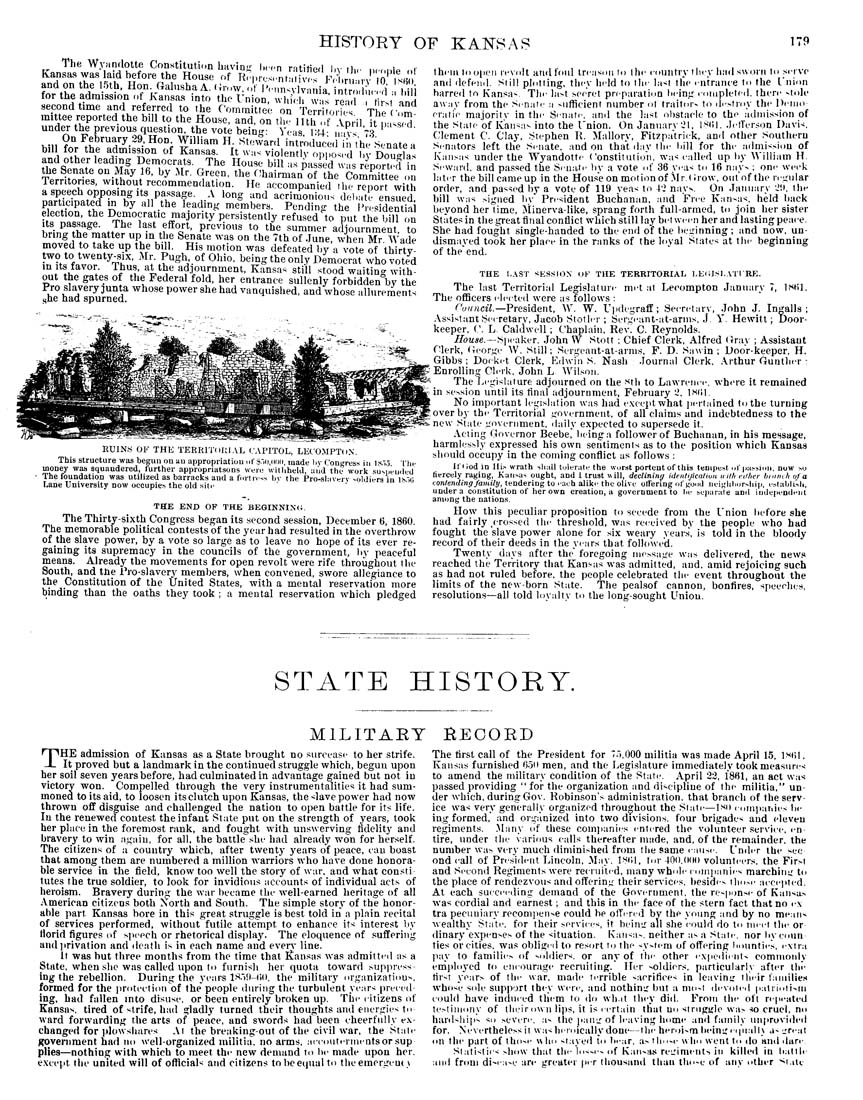
HISTORY OF KANSAS 179 The Wyandotte Constitution haviuL' hcen mtitiorl )„• n. . i r Kansas was laid before the House of Rep s nt a nVef F ,r rv o' r.«o for^he Ih' '-■ Ho-,«al,ishaA. Grow, o'f Pe.insvlva, ia, n | ,c d , i for the admission of Kansas into the Union, which was read i firs and second time and referred to the Committee on Territories The 'om mittee reported the bill to the House, and, on tlie Ilth of Vpril 111^^ under the previous question, the vote being: Yeas l:i4- n ivs 7S ' * "' hill 0° Feb-ruary 39, Hon William H. Ste^?ard introduced in ,h Senate a bill for the admission of Kansas. It was violentiv opposed bv Douglas and other leading Democrats. The House bill as rjassed was renorterl in the Senate on May 16, by Mr. Green, the f)hairmanT he ComSe , n Territories, without recommendation. He accompanied the re.™r wi a speech opposing Its passage. A long and acrinToniotis debate ensued participated m by all the leading members. Pending the Presidential election, the Democratic majority persistently refused to put the bill on hrin^fKnttT^' last effort, previous to the summer adjournment o bring the matter up in the Scmate was on the 7th of June, when Mr. Wade moved to take up the bill. His motion was defeated by a vote of thirtv- two to twenty-six, Mr. Pugh of Ohio, being the only Democrat who voted in Its favor Thus, at the adjournment, Kansas still stood waiting with¬ out the gates of the Federal fold, her entrance sullenly forbidden bv the Pro slavery junta who.se power she had vanquished, and whose allureinents she had spurned. them loo|ieii revolt anil IViiil treason lo Ihc country they htul sworn to serve and defend. Slill plotting, they held to the last tlie entrance to the I'nion barred to Kansas The last secret preptiration being coiiipletcd. there stole a^vay from the Senate a sufficient number ot traitor^ to iji-stroy the Demo cratic majority in thi' Senate, and the last obstacle to the admission of the State of Kansas into the Union. On January 21, l''«il. Jclferson Davis. Clement C. Clay, Stephen R. Mallory, Fitzpatrick, and other Southern Sentitors left the Senate, and on that day the hill for the tidmissiou of Kansas under the Wyandotte Constilution. was called up by William H. Seward, and pa.s.sed the Senate by a vote of 36 yeas to 16 nays ; one week later the bill came up in the House on motion of Mr (irow. oul ofthe regular order, and passed by a vote of 119 yeas to 42 nays. On Janiitiry 29, the bill was signed by President Buchanan, and Free Kansas, held back beyond her time, Minerva-like, sprang forth full-armed, to join her sister States in the great final conflict which still lay bet ween her and lasting peace. She had fought single-handed to the end of the beginning ; and now, un¬ dismayed took her place in the ranks of the loyal Slates at the beginning of the end. THE I..\ST SESSION OF THE TERRITORIAL LEOISl..VTrRE. The last Territorial Legislature met al Lecompton Jiinuary IKHl. KUINS OF THE TERRFl'l IKl.VL CAPITOL, LEt'OMPTOX. This structure was begun on an appropriation of }5i),lin(i, made bv Congress in l,s.-i.5 I'lie money was squandered, iurther appropriatsons were withheld, and the work suspended The foundation was utilized as barracks and a fortress bs- the Pro-shiwrv soldiers in is",!; Lane University now occupies the old site THE END OP THE BEGINNINO, The Thirty-sixth Congress began its second session, December 6, 1860. The memorable political contests of the year had resulted in the overthrow of the slave power, by a vote so large as to leave no hope of its ever re¬ gaining its supremacy in the councils of the government, by peaceful means. Already the movements for open revolt were rife throughout Uie South, and the Pro-slaverj' members, when convened, swore allegiance to the Constitution of the United States, with a mental reservation more binding than the oaths they took ; a mental reservation which pledged The officers elected were as follows : Cuitncil.—President, W. W. L^jidcgraff; Secretary, John J. Ingalls; Assistant Secretarv, Jacob Stotler ; Sergeant-at-arms, J, Y, Hewitt; Door¬ keeper, C. L Caldwell ; Chaplain, Rev! C. Reynolds. i?b«««.—Speaker. John W Stolt ; Chief Clerk, Alfred Gray ; Assistant Clerk, George W. Still; Scrgeant-at-arnis, F. D. Siiwin ; Door-keeper, H. Gibbs ; Docket Clerk, Edwin S. Nash .Journal Clerk, Arthur Guntlicr : Enrolling Clerk, John L Wilson. The LegisUiture adjourned on the ■'^tli to Lawrence, where it remained in session until its final adjournment, February 2, IMlil. No important legislation was had except what jicrtained tothe turning over by the Territorial government, of all claims and indebtedness to the new Sttite government. dail\' expected to super.sede it. Acting Governor Beebe, being a follower of Buchanan, in his message, harmlessi}' expressed his own sentiments as to the position which Kansas should occupy in the coming conflict as follows : Ifirodin lli.s wrath shall tolerate the worst portent of this tempest .if passion, now so tiercely raging, Kansas ought, and 1 trust will, declining identification with eillicr bioneh of a contending family, tendering to each alike the olive ollering of good neiglihorsliip, establish, under a constitution of her own creation, a government to I.e separate and independent among the nations. How this peculiar proposition to secede from the Union before she had fairly crossed the threshold, was received by the people who had fought the slave power alone for six weary years', is told in the bloody record of their deeds in the years that followed. Twenty days after the foregoing message was delivered, the news reached the TeiTitory that Kansas was admitted, and, amid rejoicing such as had not ruled before, the people celebrated the event throughout the limits of the new-born State. 'The pealsof cannon, bonfires, speeches, resolutions—all told loyalty to the long-sought Union. STATE HISTORY. MILITAET nEGORD THE admission of Kansas as a State brought no surcease to her strife. It proved but a landmark in the continued struggle which, begun upon her soil seven years before, had culminated in advantage gained but not in victory won. Compelled through the very instrumentalities it had sum¬ moned to its aid, to loosen its clutch upon Kansas, the slave power had now thrown off disguise and challenged the nation to open battle for its life. In the renewed contest the infant Sttite put on the strength of years, took her place in the foremost rank, and fought wdth unswerving fidelity and bravery to win again, for all, the battle she had already won for herself. The citizens of a country which, after twenty years of peace, can boast that among them are numbered a million warriors who have done honora¬ ble service in the field, know too well the story of war, and what consti tutes the true soldier, to look for invidious accounts of individual acts of heroism. Bravery during the wtir became the well-earned heritage of all .Vmeriean citizens both North and South. The simple story of the honor¬ able part Kansas bore in this great struggle is best told in a plain recital of services performed, without futile attempt to enhance its interest by florid figures of spi>ech or rhetorical display. The eloquence of suffering and privation and death is in each name aud evers" line. ll was but three months from the time that Kansas was admitted as a State, when she was called upon to furnish her quota toward suppress ing the rebellion. During the 3-ears l!^59-(!(l. the military organizatious. formed for the jirotcction of the people during the turbulent years preced ing, had fallen into disuse, or been entirely broken up. The citizens of Kansas, tired of strife, htid gladly turned their thoughts and energies to ward forwarding the arts of peace, and swords had been cheerfully ex¬ changed for plowshares Al the breaking-out of the civil war, the Stale Jfovernraent had no well-organized militia, no arms, arcoiitermentsorsup plies—nothing with which to meet the new demand to be made upon her. except the united will of officials and citizens to be equal to theemcrgenn The tirst call of the President for 7."),000 militia was made April 15, \>*M. Kansas furnished 650 men, and the Legislature immediately took measures to amend the military condition of the Stall'. April 22, 1861, an act was passed providing "for the organization and discipline of the militia," un¬ der Avhich. during Gov. Robin-son's administration, that branch of the serv¬ ice was very generally organized throughout the Slati—l^<il eompanies be ing formed, and organized into two divisions, four brigades and eleven regiments. .Many of these comjianies entered the volunteer .servire, en¬ tire, under the various calls thereafter made, and, of the remainder, the number was verv much diminished from the same i aiise. Under the sec ond call of Pre's'ident Lincoln, May. 1861, tor 400.(111(1 volunteers, the First and Second Regiments were recruited, many whole lomiianies marchiiio to the place of rendezvous and offering their sers-ices. besides those accepted. At each succeeding demand of the Government, the response of Kansas was cordial and earnest ; and this in the face of the stern fact that no ex tra pecuniary recompense could be offered by the young and by no means wealth}' Stale, for their services, it beiuL' all she could elo to meet the or dinary expenses of the situation. Kansas, neither as a Stale, nor by coun ties or cities, was obliged to resort to the system of offering hounties. exira pay to families of soldiers, or any of the other ixpedienls commonly employed to encourage recniiling. Her soldiers, particularly after thi- first years of Ihe war, made terrible sacrifices in leaving their I'aniilie.s whose sole support they were, and nothing but a mo-1 devoled ptilrioii^m could have induced them lo do wh.il lliey did. From the oft repeated lesliinony of their own lips, il is eerttiin that no struggle was so cruel, no hardsliips so severe, as tlie paii^'of leaving home and family unprovidi'd for. Nevertheless it wasliemically dom—the heroism lieinge.piall) a- L'real on the part of those who slaved to betir. as tln.^e who went to do and dare Slatisties show that the losses of Kansas reirimcnts in killed In hatlb and from disease are greater per thousand than tlio-e of any other Si.iu |
|
|
Page 179 |
|