

Dorsey, James Owen, The Cegiha language
(Washington [D.C.] : G.P.O., 1890.)
|
||

 Click here and hold to drag menu around
|





|
|
|
|

|
Page 368 | 
|
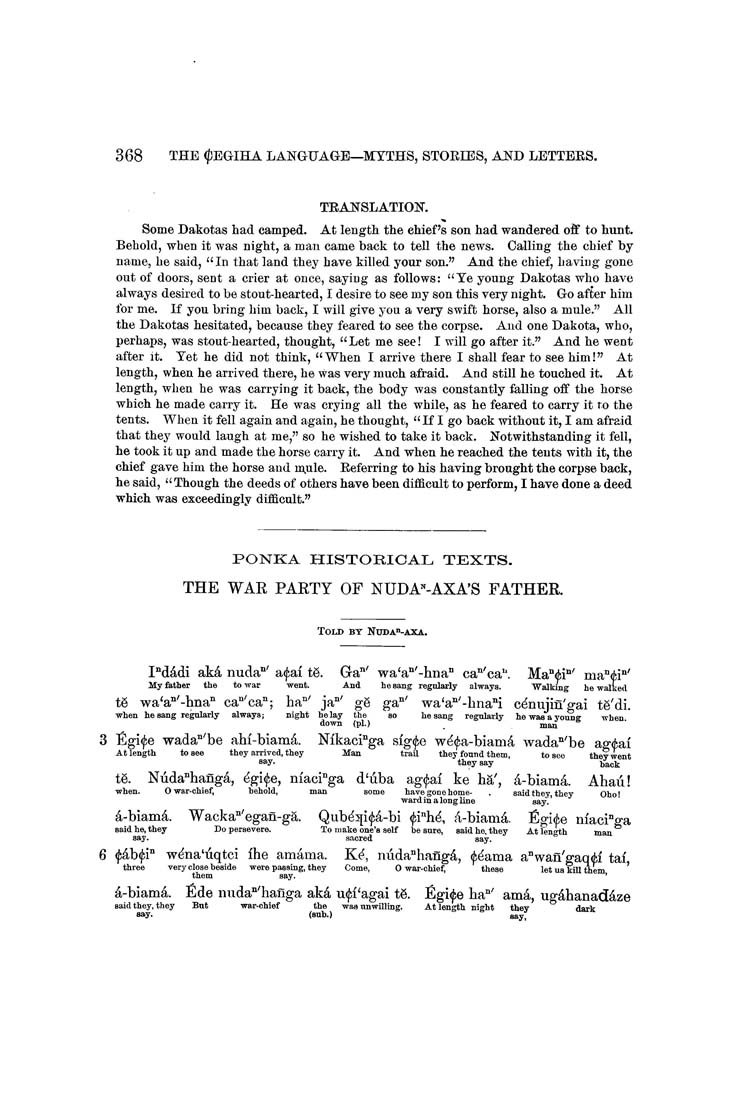
368 THE (pBGlKA LANGUAGE—MTTHS, STOEIES, AND LETTEES. TEANSLATION. Some Dakotas had camped. At length the chief's son had wandered off to hunt. Behold, when it was night, a man came back to tell the news. Calling the chief by name, he said, "In that land they have killed your son." And the chief, having gone out of doors, sent a crier at once, saying as follows: "Ye young Dakotas who have always desired to be stout-hearted, I desire to see my son this very night. Go after him for me. K you bring him back, I will give you a very swift horse, also a mule." All the Dakotas hesitated, because they feared to see the corpse. Aud one Dakota, who, perhaps, was stout-hearted, thought, "Let me see! I will go after it." And he went after it. Tet he did not think, "When I arrive there I shall fear to see him!" At length, when he arrived there, he was very much afraid. And still he touched it. At length, when he was carrying it back, the body was constantly falling off the horse which he made carry it. He was crying all the while, as he feared to carry it to the tents. When it fell again and again, he thought, " If I go back without it, I am afraid that they would laugh at me," so he wished to take it back. Notwithstanding it fell, he took it up and made the horse carry it. And when he reached the tents with it, the chief gave him the horse and luule. Eeferring to his having brought the corpse back, he said, "Though the deeds of others have been difficult to perform, 1 have done a deed which was exceedingly difficult." PONKA HISTORICAL TEXTS. THE WAR PARTY OF NUDA'^-AXA'S FATHER. Told by Nuda^-axa. I"dddi akd nuda"' afai td. Ga"' wa'a"'-hna" ca"'ca". Ma"<fi"' ma"(fi"' My father the to war went. And he sang regnlarly always. Walking he walked td wa'a"'-hna" ca"'ca"; ha"' ja"' gd ga"' wa'a"'-hna"i cdnujin'gai td'di. when he sang regularly always; night belay the so he sang regularly he was a young when down (pi.) man 3 Egife wada"'be ahi-biamd. Nikaci"ga sig^e wd(fa-biamd wada"'be agfai Atlength to see they arrived, they Man traU tbey found them, to see thev went say. they say back td. Niida"hafigd, igife, niaci"ga d'iiba agfai ke ha', d-biamd. Ahaii! when. O war-chief, behold, man some have gone home- . said they they Oho' ward in a long line say.' d-biamd. Wacka"'egafi-ga. Qubdi[i^d-bi fi"hi, d-biamd. figi(fe niaci"ga said be, they Do persevere. To make one's self be sure, said he, they Atlenoth man say. sacred say. 6 (fdb(fi" wdna'iiqtci ihe amdma. Kd, nuda"hafigd, (fdama a"wafi'gaq(fi tai three very close beside were passing, they Come, 0 war-chief, these let us kill Uiem ' them say. ' d-biamd. £de nuda"'hafiga akd u(fi'agai td. £gi(fe ha"' amd, ugdhanaddze said they, they Bnt war-chief the waa unwilling. Atlength night they dark say- (sub.) aay, |
|
|
Page 368 |
|