

Ellis, Charles Edward, An authentic history of the Benevolent and protective order of Elks
(Chicago : The author, 1910.)
|
||

 Click here and hold to drag menu around
|





|
|
|
|

|
Page 449 | 
|
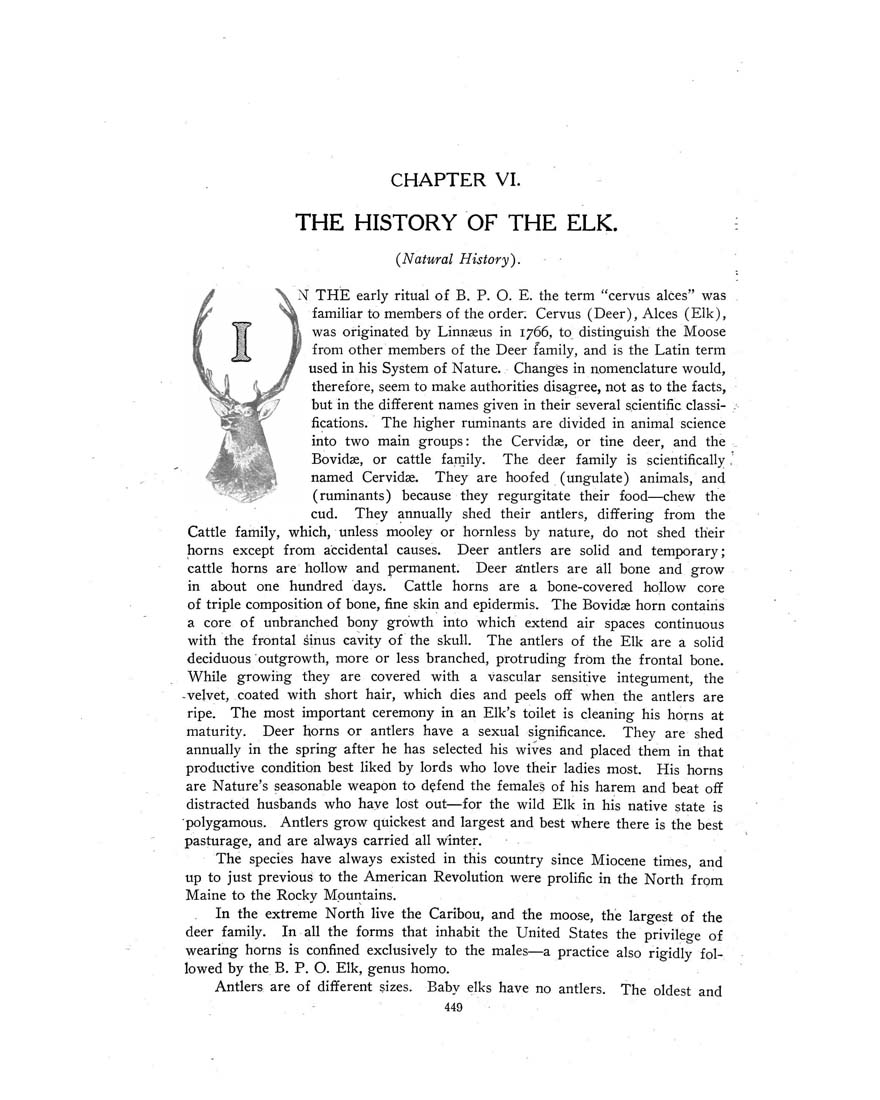
CHAPTER VI. THE HISTORY OF THE ELK. (Natural History). N THE early ritual of B. P. O. E. the term "cervus alc€s" was familiar to members of the orden Cervus (Deer), Alces (Elk), was originated by Linnaeus in 1766, to. distinguish the Moose from other members of the Deer family, and is the Latin term used in his System of Nature. Changes in nomenclature would, therefore, seem to make authorities disagree, not as to the facts, but in the different names given in their several scientific classi¬ fications. The higher ruminants are divided in animal science into two main groups: the Cervidae, or tine deer, and the Bovidae, or cattle farnily. The deer family is scientifically . named Cervidae. They are hoofed (ungulate) animals, and (ruminants) because they regurgitate their food—chew the cud. They annually shed their antlers, differing from the Cattle family, which, unless mooley or hornless by nature, do not shed their horns except from accidental causes. Deer antlers are solid and temporary; cattle horns are hollow and permanent. Deer antlers are all bone and grow in about one hundred days. Cattle horns are a bone-covered hollow core of triple composition of bone, fine skin and epidermis. The Bovidae horn contains a core of unbranched bony growth into which extend air spaces continuous with the frontal sinus cavity of the skull. The antlers of the Elk are a solid deciduous outgrowth, more or less branched, protruding frOm the frontal bone. While growing they are covered with a Vascular sensitive integument, the -velvet, coated with short hair, which dies and peels off when the antlers are ripe. The most important ceremony in an Elk's toilet is cleaning his horns at maturity. Deer horns or antlers have a sexual significance. They are shed annually in the spring after he has selected his wives and placed them in that productive condition best liked by lords who love their ladies most. His horns are Nature's seasonable weapon to defend the females of his harem and beat off distracted husbands who have lost out—for the wild Elk in his native state is •polygamous. Antlers grow quickest and largest and best where there is the best pasturage, and are always carried all winter. The species have always existed in this country since Miocene times, and up to just previous to the American Revolution were prolific in the North frgm Maine to the Rocky M.ountains. In the extreme North live the Caribou, and the moose, the largest of the deer family. In all the forms that inhabit the United States the privilege of wearing horns is confined exclusively to the males—a practice also rigidly fol¬ lowed by the B. P. O. Elk, genus homo. Antlers are of different sizes. Baby elks have no antlers. The oldest and 449 ■ |
|
|
Page 449 |
|