

Gundert, Hermann, A Malayalam and English dictionary
(Mangalore : London : Basel : C. Stolz ; Trübner & Co. ; Missionhaus, 1872.)
|
||

 Click here and hold to drag menu around
|





|
|
|
|

|
Page 755 | 
|
(erxjofurro Jo — rs«<&iOtb


755


(6YX)afi1fnio — rSaftrai^laJ


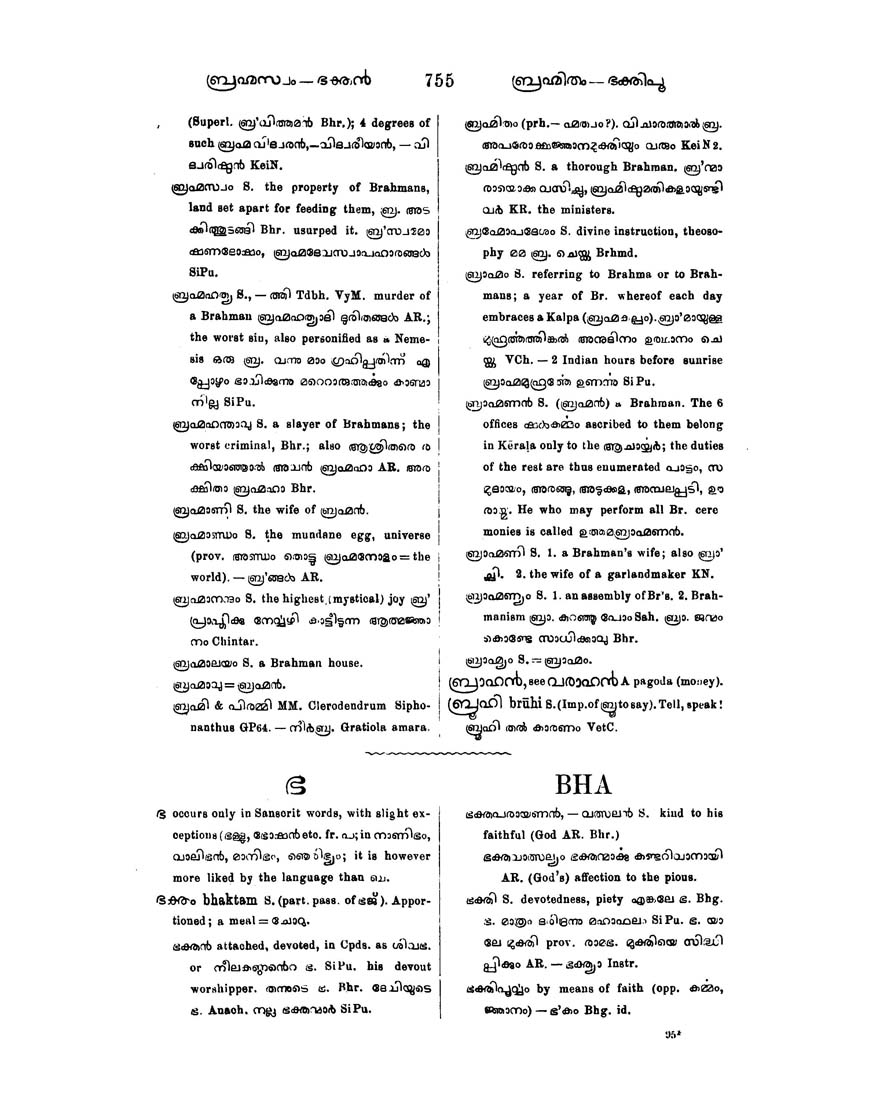
(Superl. (snj'Qjl(Bi3ianb Bhr,); 4 degrees of
snch (9a)aa cu'aarenb,—afleariflcBionb, — cul
aarol(^nb KeiN.

|ga)a2croao S, the property of Brahmans,
land set apart for feeding them, ;6ia), (Bras
aBlnaasssal Bhr. usurped it, (snj'ntiajao
caosmBeocaao, (6ii)a03eajcroaga.joogro«B8do
SIPu,

(SOjoaon'mj 8,, — ronfl Tdbh, VyM. murder of
a Brahman (sojoanOigjoel §r3lim«Bado AR,;
the worst siu, also personified as » Neme¬
sis arra (go), cuma aoo ^/jacflgarmlrm o®
Bgjo^o (so.ijlaama aaooorra.uioiaao Aosrao
rn'gj SiPu,

IgnjojaoOnmoQj 8, a slayer of Brahmans; the
worst criminal, Bhr.; also m^(/^mam m
afiflco'osioiQa.'al (Braajnb (soja^aoo AB, israro
afnlimo (611)0:0.100 Bhr.

(SOjaaosTrfl S, the wife of mjoanb.

Ig^laaosrruio S, the mundane egg, universe
(prov, (Brasnxuo armog (gijaaamoao= the
world). — (Siij'ssBcV) AR,

(gojaiaomoao S, the highest,(mystical) joy (Soj'
(o^oojaa amc3|i!pl a.oglgon (Biairorassiroio
mo Chintar.

(sajojagaicBio S, a Brahman house.

(fflijojagaj = igojoanb,

(sniaal ft oalrozal MM. Clerodendrum Sipho¬
nanthus GP64. — orfl(b|ri]. Gratiola amara.


(gojoalroio (prh.— oaiBiao?). Qjljiigrorooioialiga).
(Braoaerogfifi^easingm^araiic^o currao KeiN a,

(6raja0l(^nb S, a thorough Brahman, i^'nag
regarsgasi cuoul^, igajojzl(^aro>lAaac%srsl
cU(b KR. the ministers.

^Ba0gaaSeo9o S. divine Instruction, theoso¬
phy aa (SO), ajii^ Brhmd.

(sa|go£io S. referring to Brahma or to Brah¬
mans; a year of Br. whereof each day
embraces a Kalpa (i6iija£ia.gjo).^g'ao(^aa
iij(aD(Bi3i(Bia)lA(al (Bracraslmo ©(cir.omo ajii
^ VCh. — 2 Indian hours before sunrise
(sajOojag(oQa5(31 gsmma SiPu.

I6n{ga0smnb S. (isojo^inb) a Brahman. The 6
offices <s:)(X}Aaao ascribed to them belong
in Kerala only to the (Si^jiig^ib; the duties
of the rest are thus enumerated oaggo, cru
^Bawo, (Brarossig, (sragasia, (8raauaig_)sl, a'a
reg:n. He who may perform all Br, cere
monies is called a'Siaia^gaiasmnb,

igoigo^srrfl S, 1, a Brahman's wife; also (gojg'
jyl.   2, the wife of a garlandmaker KN,

;Qn)gai2i5rn,o S, 1. an assembly of Br's, 2, Brah-
mnnism i^g. Aosm^ Boago Sah, (grijg. mnio
aAgasns crooculasiooj Bhr.

(6a)Oo0jo 8. —(snjooao.
(61(aJ3nDOfU,8eeajfD3QOOfbA pagoda (money).
(erXJciOl bruM S.(Imp,ofi6mtosay),Tell,speak!


(g^,


lacfl rmrii Aorosmo YetC.


rg occurs only in Sanscrit words, with slight ex¬
ceptions (rsg^, a(§o.-fi3nbetc, fr, oa;in mosnfliso,
cuoejlsnb, aonrfliSc, asraalgjo; it is however
more liked by the language than sixi.

iS^C^o bhaktam S. (part. pass, of rsn). Appor¬
tioned; a m«al = BjiIOC^.

(SoSTOinb attached, devoted, in Cpds, as oalairs,
or erflaiAs^anbo s. SiPu, his devout
worshipper, (mmoas c:, Bhr, aaulri^as
(S. Anaoh, mgj (sara)rv3a(b SiPu,


BHA

(gfl9ro)oaroocii)smnb, — curaruenb S,   kind to his

faithful (God AR. Bhr,)

saro)U0(aTuai)O isaroinaoas Asngcflcuomgcnil
AR, (God's) affection to the pious,
i^Acoi) 8. devotedness, piety <i®ABai s. Bhg.

s. ag®" eolecna aaogociai.i SIPu, s. cnig

aai <^<B<oi) prov.  mazs. ^<B<£)aw crulsxfl

gjlago AR. — saiaig Instr,
(ga<iklo^^o by  means of faith (opp,   Aaao,

Bfcioiomo) — is'Ao Bhg, id.
|
|
|
Page 755 |
|