

Selleck, Charles Melbourne. Norwalk
(Norwalk, Conn. : The author, 1896.)
|
||

 Click here and hold to drag menu around
|





|
|
|
|

|
Page 340 | 
|
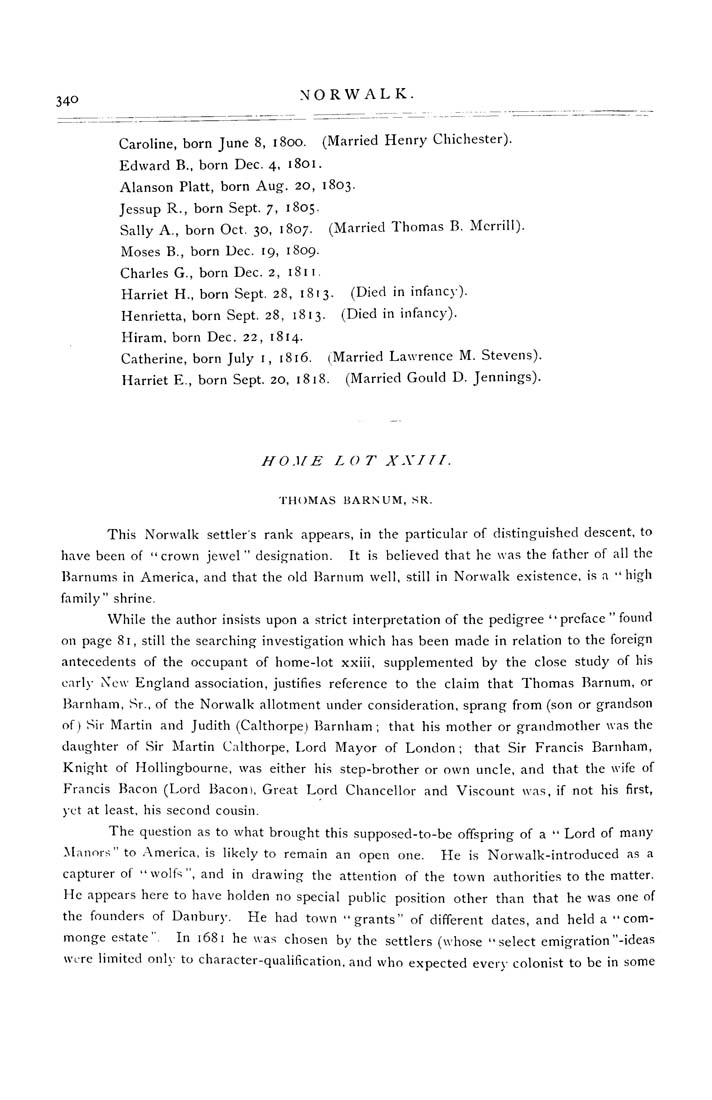
340 NORWALK. Caroline, born June 8, iSoo. (Married Henry Chichester). Edward B., born Dec. 4, 1801. Alanson Platt, born Aug. 20, 1803. Jessup R., born Sept. 7, 1805. Sally A., born Oct. 30, 1807. (Married Thomas B. Merrill). Moses B., born Dec. 19, 1809. Charles G., born Dec. 2, 1811. Harriet H., born Sept. 28, 1813. (Died in infancy). Henrietta, born Sept. 28, 1813. (Died in infancy). Hiram, born Dec. 22, 1814. Catherine, born July i, 1816. (Married Lawrence M. Stevens). Harriet E., born Sept. 20, 18 18. (Married Gould D. Jennings). HOME LOT XNITI. THOMAS BARNUM, SR. This Norwalk settlers rank appears, in the particular of distinguished descent, to have been of "crown jewel" designation. It is believed that he was the father of all the Barnums in America, and that the old Barnum well, still in Norwalk existence, is a " high family" shrine. While the author insists upon a strict interpretation of the pedigree "preface " found on page 81, still the searching investigation which has been made in relation to the foreign antecedents of the occupant of home-lot xxiii, supplemented by the close study of his early New England association, justifies reference to the claim that Thomas Barnum, or Barnham, Sr., of the Norwalk allotment under consideration, sprang from (son or grand.son of) Sir Martin and Judith (Calthorpe) Barnham; that his mother or grandmother was the daughter of Sir Martin Calthorpe, Lord Mayor of London ; that Sir Francis Barnham, Knight of Hollingbourne, was either his step-brother or own uncle, and that the wife of Francis Bacon (Lord Bacon), Great Lord Chancellor and Viscount was, if not his first, yet at least, his second cousin. The question as to what brought this supposed-to-be offspring of a " Lord of many Manors" to .America, is likely to remain an open one. He is Norwalk-introduced as a capturer of "wolfs", and in drawing the attention of the town authorities to the matter. He appears here to have holden no special public position other than that he was one of the founders of Danbury. He had town "grants" of different dates, and held a " com- monge estate". In 1681 he was chosen by the settlers (whose ".select emigration "-ideas were limited only to character-qualification, and who expected every colonist to be in some |
|
|
Page 340 |
|