
Electrical Engineering Department Adds Two New Professors
by John Wong

| |
Electrical Engineering Department Adds Two New Professors
by John Wong
|
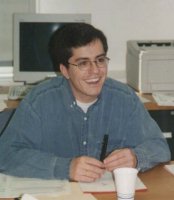
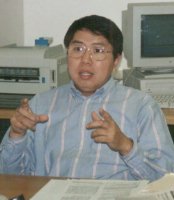
| Two new professors, Alexandros Eleftheriadis and Q.Y. Ma, are teaching in the
Department of Electrical Engineering of the School of Engineering and Applied Science
(SEAS) this semester. Professor Eleftheriadis is originally from Athens, Greece, and did
his undergraduate work at the National Technical University of Athens. He earned his
Master's and Ph.D. in Electrical Engineering at Columbia prior to his appointment to
professorship in July 1995.
| |
 
|
|
|
Professor Eleftheriadis is interested in the field of video compression, which is a way to
reduce the information required to store video information. The practical aspects of this
field is made more important, due to the widespread appeal of the Internet. With the
advance of video compression, internet video will be much faster and more efficient.
Information will transmit over the network more easily. One of the most popular platforms
of compression is MPEG 4, a later version of the MPEG format. Recently, Professor Eleftheriadis spoke about his current research interests from his sunlit office in the Schapiro building. "Columbia is very digital," he declares. He has been conducting research on the transmission of compressed digital video over heterogeneous time-varying networking environments. What does that mean? The goal is to improve the transmission time and quality for digital video segments. "There is a misconception that electrical engineers deal only with circuits, antennae, and power production. But that is simply not true." While traditional study of circuits lies within the analog realm of electrical engineering, the digital realm deals primarily with computers. "Not only computer science people deal with computers." In fact, virtually all of Professor Eleftheriadis' work is done on his "analytical machine." For undergraduate students, the first priority is to master the core of electrical engineering--circuits--before undertaking study of digital systems. Professor Eleftheriadis spoke of a possible restructuring in the electrical engineering department. He would like to see some of the engineering "core" moved to the freshman- sophomore program. This would enable upperclass students to take elective courses in the study of digital systems. Professor Q. Y. Ma is a new professor at Columbia who is interested in the interdisciplinary approach of the Electrical Engineering department. The direction of the department is veering towards collaboration with many departments within the University. The department is currently working with the Radiology Center of the medical center to develop new and innovative techniques to improve image engineering. | |

|
|
|
New techniques in medical imaging aim at improving image quality as well as reducing
imaging time. Magnetic imaging is particularly promising because it is a non-invasive
method of getting information about bodily functions, such as tracing the electrical activity
of the brain, or tracking the iron flow in the blood. Another practical application of
medical imaging is the use of the fetal cardiogram, which distinguishes the mother's
heartbeat from the infant's heartbeat. Each of these activities generate magnetic fields,
which can be discerned with modern techniques of magnetic imaging. Currently, the
Electrical Engineering department is trying implement a program devoted exclusively to
medical imaging at Columbia. Professor Ma encourages undergraduates to get involved in research at Columbia. He observes that beginning in the 1990's, scientists and engineers have collaborated increasingly with industry to solve practical problems rather than demystify areas in the pure sciences. Experience in research also enhances interpersonal communications and teamwork, skills that are not found in textbooks or lecture halls.
| |

|
Video Compression for Practical Uses (Moment Article) SEAS Dept. of Electrical Engineering Info Page |
 |
 |
 |
 |
| Moment Home Page |
Current Article Index |
Search |
Back Issues |