
Columbia to Take Over Biosphere 2 As Earth Lab
by Isabella Chow

| |
Columbia to Take Over Biosphere 2 As Earth Lab
by Isabella Chow
|
|
Biosphere 2, the artificial human colony that fascinated popular
imagination and garnered scorn from academia, is to be managed by
Columbia University for a period of five years. The announcement
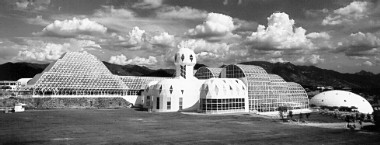
was made on November 12. The Biosphere is a three-acre greenhouse replete with simulated rain forest, ocean, desert, and marshland, originally built as a testing grounds for human survival in enclosed, Earth-like environments on other planets. (Founders consider the "original" biosphere to be Earth itself). The million-gallon saltwater ocean even contains a coral reef. It was initially sponsored by Texas billionaire Edward P. Bass. However, after an unsuccessful "settlement" and charges of financial mismanagement, the focus of Biosphere 2 shifted towards laboratory studies rather than trial colonization. Further missions with crew living inside the complex were ruled out. Instead, the complex will serve as a huge scientific laboratory for a consortium of major universities, research institutes and national laboratories. It will also continue to be a site-of- interest for tourists. Bass will remain the primary funding for the $15 billion to $17 billion budget. It is located in Oracle, Arizona, about 30 miles north of Tucson.
| |
 
|
|
|
Problems Befall "Settlement" The first Biosphere 2 inhabitants entered the enclosed ecosystem in September 1991, amidst unprecedented hyperbole and media hoopla. Their goal was to live for two years entirely within the confines of the giant greenhouse. They planned to raise their own food and rely on perpetually-renewed air and water sources, just as a human colony on Mars would have to do. However, pressured by leaks to the media, management admitted to reneging on the promise of "self-sufficiency." Crew members produced only 80 percent of their food supply and turned to stockpiles. Sixteen months into the venture, an "air-scrubbing" system had to be installed in order to keep the carbon dioxide levels in balance. A fresh supply of oxygen was pumped in from the outside. When members of the crew emerged in September 1993, they were 25 pounds slimmer than they had been 2 years ago. More detrimental to biosphere were the allegations of financial mismanagement and non-cooperation that arose in 1993. An independent panel of 10 scientists helping to oversee the project was disbanded after members cited a lack of cooperation from the management. Top managers Margret Augustine and John Allen were eventually fired by Bass in March 1994 for financial mismanagement. It has been said that while the concept of Biosphere 2 is grounded only weakly in scientific principles--not to mention reality--it's hidden value was in sparking a renewed interest of the environment in the general public. New Identity: Laboratory and Family Attraction A joint venture between Columbia's Lamont-Doherty Earth Observatory and Biosphere 2 initiated in August 1994 to write a long-term scientific plan for the complex evolved into the agreement to transfer management to Columbia for five years. The consortium formed to direct Biosphere 2 activity comes under Columbia's Global Systems initiative. It includes Scripps Institute's Ocean Systems Consortium, the Earth Policy Center, and the Center for Environmental Conservation and Research. The research group includes a science committee chaired by Michael McElroy, chairman of Harvard's department of earth and planetary scientists. Studies will be overseen by an executive committee of four: Michael Crow, vice provost at Columbia; Wallace Broecker, Newberry Professor of Geology at Columbia; Stephen K. Bannon, acting CEO; Bruno D.V. Marino, the new director of science and research. Research will be conducted in three loosely organized fields of study: biogeochemical cycles, ecology and plant biology, and modeling of simple and complex systems. The committee plans to award three post-doctoral fellowships for research on-site, as well as make available a "study abroad" program for Columbia University students. There was a time when Biosphere 2 was touted as a flashy tourist attraction, complete with billboards, an adjacent hotel, tacky souvenirs, and NASA-inspired jumpsuits. The pitch now has shifted to an emphasis on the site as a major educational and family-trip destination. Banker Stephen Bannon, a specialist in corporate turnarounds, said that Biosphere 2 was "totally in disarray" when he arrived to act as CEO; Now, he promises, "We're going to have fewer gift shops than biomes."
| |

|
Columbia Integrates Biosphere 2 Biosphere 2 Web Page |
 |
 |
 |
 |
| Moment Home Page |
Current Article Index |
Search |
Back Issues |