
Uncertainties of Innovative Technologies
by John Wong

| |
Uncertainties of Innovative Technologies
by John Wong
|
|
"Space Travel will never work. The power generate by kerosene (or any available fuel) simply cannot offset the immense force of gravity. Therefore, an engine cannot be built to get anything in space." Such is popular conception prior to the advent of the rocket, in the 1960's. Many people didn't realize that it would be possible to come up with a better fuel to propel an object into space. This example, used by John Rennie, editor-in-chief of Scientific American in a discussion on November 30, 1995 at 214 S.W. Mudd, shows that forecasting future impact technologies is difficult, as well as unpredictable. Mr. Rennie started by telling a story about young Thomas Edison, who walked in the offices of Scientific American back in the 1800's. Mr. Edison had a few patents under his belt at the time, but he was a relatively obscure figure. He walked into the editors' office with a black box around the arm, looking for the editors' help in helping him obtain a patent for it. (Scientific American , in addition to publishing the scientific magazine, helped inventors obtain patents.) The editors asked what the invention was. Mr. Edison was rather secretive about his black box, until the editors agreed to help him. Suddenly, he opened the box, turned a crank on the side, and the box uttered "Hi, I am the talking box!" This demonstration marked the first time the phonograph was tested outside of the laboratory bench. The editors knew that this invention was about to change the world. In retrospect, it is interesting to study how the important technologies evolve through time, as well as why other technologies flounder. The military thought that the "JetPak", a engine which can propel a person into the air, would revolutionize warfare strategy. JetPak were then considered to be impractical because its pilots would be too prone to attack. Or take the example of the space station. In the 1980's, many people were excited by the prospect of having a manufacturing station in space. Many products would be made with much higher quality given the lack of gravity and atmosphere. For example, perfectly shaped ball-bearings could be made. However, the costs associated with such a process has far exceeded the returns, making production is space impossible (so far).
| |
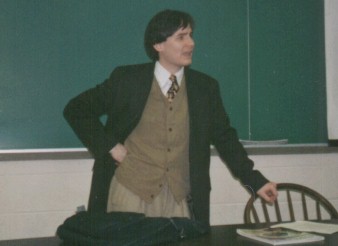
 Editor In Chief Rennie looking casual. 
|
|
|
O
n the other hand, consider the advent of the computer. How did this vital technology
evolve? This evolution stems from a sequence of innovations that eventually led to the
availability of our Intel Pentium processors today. Computing started with the invention of
the vacuum tubes. And then, the transistor can into existence, which could replace the big,
expensive, troublesome vacuum tubes. Many innovations questioned whether they could
replace ALL of the vacuum tubes with transistors. Then, the integrated circuit was
invented to further decrease both the size and expense of computers. However, the
widespread use of computers was not realized until software was developed to make the
machine more "user-friendly". In the 1970's, computers were basically for hobbyists and
researchers. By the 1980's, with the invention of the spreadsheet, industry started to
become interested with business applications of the computer.
Another technology that is immensely popular today is email. Email was available even back in the 1970's, even though the main users were the military and government researchers. To these groups, email is not a buzzword today. But during the last two years, email, the Internet, and the World Wide Web has caught on like wildfire among businesses, as well as ordinary people for recreational purposes. To forecast new impact technologies of the 21st century, we must first look at how the popularization of new technology take place. Integrated circuits virtually overhauled the structure of the computer. Moreover, other industries looked at this technology and saw a potential revolution from using this technology. Innovators constantly ask, "What else can we use this for?" Small steps in innovations eventually lead to an immense impact. As the integrated circuit started the electronic revolution, the widespread use of the internet is beginning to shape the information revolution. Where do we begin to look for the technology which will change the next 20 years? Some technologies are actually in development in laboratory benches right now. Will artificial intelligence change manufacturing systems to the point that all processes will be run by robots? Or is such an idea a far-fetched one, with too many complications to make its realization impractical? | |

|
Scientific American: The Legacy Continues for 150 Years (The Moment, Dec. 1995) Table of Contents of current and past Scientific American magazines |
 |
 |
 |
 |
| Moment Home Page |
Current Article Index |
Search |
Back Issues |