






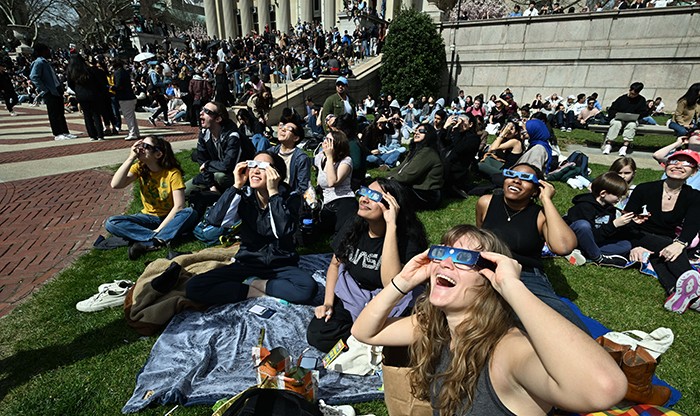








Low Plaza

Spring Mosquito Prevention Plan Yields Results: Fewer Mosquitoes on Campus

By Lauren Marshall

While New York City is well into the mosquito season, the area surrounding Columbia is relatively mosquito free. University officials point to an early mosquito prevention plan that the University began almost five months ago to help reduce risk of the mosquito-borne West Nile virus this summer. Columbia's plan avoids aggressive chemical treatments and blanket spraying and focuses instead on preventative measures for mosquito control.

"Our efforts to control the microclimate of mosquito-breeding areas early on has proven to be a wise move," said Loretta Greenholtz, director of Environmental Health and Radiation Safety, whose office oversees the treatment of Columbia's green spaces. "Essentially we have created a sort of bubble over the campus where few mosquitoes are living and breeding as evidenced by our monitoring of mosquito traps."

Mosquito prevention has been a multi-phased, long-term project at Columbia. In April, densely foliated areas on the Morningside campus and all of Baker Field were treated with a one-time ground application of pyrethrum, a naturally occurring insecticide derived from the chrysanthemum flower or synthetically reproduced, which is relatively non-toxic to humans, dogs, cats and other mammals. But the bulk of mosquito control has been accomplished without the use of insecticides.

As early as February, Facilities Management staff began to survey and monitor buildings and grounds in an effort to locate and remove standing water, the primary breeding ground for mosquitoes. In addition to monitoring areas where water is likely to collect, such as clogged drains, gutters and roof-tops, University arborists with Save A Tree began a massive effort to cut back densely foliated areas, large overgrown shrubs and prune trees this spring. The objective was to eliminate prospective mosquito breeding grounds by allowing sunshine to dry out areas that would otherwise say moist in the shade. These efforts have continued through the spring and summer months.

Late this spring a dozen mosquito traps were set in densely foliated areas around Journalism, Lewison, Butler Library, John Jay and other locations on campus and regularly monitored. To date six mosquitoes a week on average have been caught during the trapping periods.

According to Kevin Wyatt of Save A Tree, the mosquito population on campus is very low. "If we had trapped 20 mosquitoes within a trapping period, we would recommend treatment. But with the current population, the probability of getting bitten is miniscule and the probability of that mosquito carrying the West Nile virus is even smaller," said Wyatt. "The campus is not a territory conducive to mosquito breeding."

Columbia officials are carefully monitoring the mosquito population to determine if additional methods of mosquito prevention or treatment will be required this summer. By reducing the mosquito population on Columbia's campuses, the University is supporting New York City's efforts in reducing West Nile virus risk in the metropolitan area.

But according to Dr. Jane Bedell, medical director for Columbia University Health Services, there are very few people who are truly at risk. "People with underlying health issues and the elderly are the ones actually at some risk for West Nile virus. For most of us though, West Nile virus exposure has caused anxiety but is not, in fact, a major health risk," said Dr. Bedell, whose staff is available to provide additional advice on West Nile virus and mosquito control.

New York City has begun to ground-spray Anvil, a pyrethrum-based insecticide in its efforts to combat West Nile virus this summer. Columbia will continue to monitor the mosquito population on campus. If there is an increase in the mosquito population, the University will consider another targeted application of pyrethrum. But at present, evidence shows that mosquitoes in the area are under control.

For more information about West Nile Virus go to the Health and Related Services website. For more information on pyrethroids and Columbia's mosquito-treatment plan, go to the Office of Environmental Health and Radiation Safety website. Updates on spraying and mosquito prevention in New York City are available through the Mayor's Office of Emergency Management.

For additional protection from mosquitoes individuals may wish to follow New York City's recommendations:

  • Wear long pants, long-sleeved shirts and socks during evening, nighttime and dawn, when mosquitoes are likely to bite
  • Use and insect repellant containing 10 percent or less DEET for children, no more than 30 percent for adults

Published: Aug 29, 2000
Last modified: Sep 18, 2002


Search Columbia News    Advanced Search  Help

Phone: 212.854.5573    Office of Public Affairs