

 |
|
Roxanne Varzi
|
November 4th marks the 21st anniversary of the capture of the U.S. embassy in Iran. The storming of the embassy resulted in the capture of Americans, most of whom were then held hostage for 444 days. The taking of the hostages and the 1979 revolution, characterized by the overthrow of Shah Mohammed Reza Pahlavi and the rise of the Ayatullah Ruhollah Khomeini to power, led the path to strained relations between Iran and the United States.
As a result, ties between American and Iranian citizens during the Shah's tenure, which began in 1953, were hurled into uncertainty.
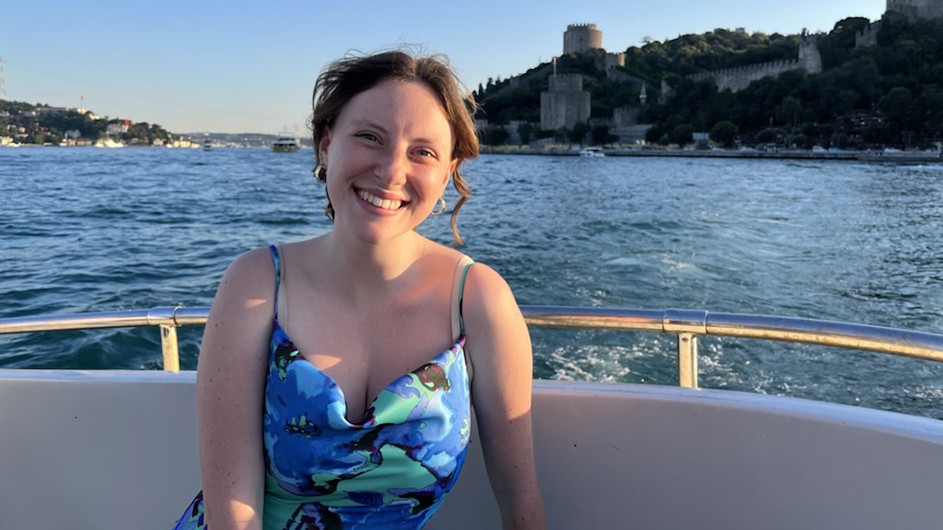
No one knows this better than Roxanne Varzi, a Columbia doctoral candidate. Varzi was born in 1971 to an American mother and Iranian father in Tehran and lived there until the time of the revolution.
"While there was excitement in the air," said Varzi, who is working on a doctorate in anthropology at Columbia, "it was a scary time."
Varzi's parents met while her mother was teaching chemistry at a Tehran women's college on a Fulbright teaching fellowship. Her mother, Charlotte Klein, rented an apartment from an Iranian couple who suggested that she meet their son, Massoud. After returning to the United States, Klein received a few letters from Massoud, including a proposal of marriage. She agreed to return to Iran and marry Massoud on the condition that they raise their children Catholic. The two married and remained in Iran until 1979, when they relocated to the United States. From 1979 to 1981, the family divided their time between the United States and Germany, waiting for opportunities to return to Iran.
"My parents moved back and forth a lot because we always thought things would get better in Iran," said Varzi. "It isn't easy being from two countries that are in conflict." In 1981, Varzi and her family finally settled in Michigan.
Yet Varzi's ties to Iran were not severed. She has since made five trips back to Iran, the most recent this year as a Fulbright-Hays fellow. The program was established in 1962 by an executive order from President John F. Kennedy. The fellowship program is intended to train future faculty members for research in less-prominent modern languages and area studies. Varzi was the first Fulbright-Hays fellow to conduct research in Iran since the 1979 revolution.
"I'm half Iranian and I saw how poorly represented Iran was in the U.S. media," said Varzi, explaining the motivation for her subsequent trips to Iran. "I wanted to know what Iran was really like. The topic of Iran had become shrouded in mystery growing up." In her visits, Varzi increasingly found a much different Iran than the one that existed at the dawn of the 1979 revolution.
The country has become more urban, with a majority of the population now residing in cities. The proportion of women at Tehran's university is now at 55 percent, up from 25 percent in 1979. And, according to Time magazine, the country's urban youth comprise a plurality of the population and tend to back reformist candidates. Its current president, Mohammed Khatami, who vowed to normalize relations with the West and democratize Iran, captured 70 percent of the vote in defeating the conservative candidate in 1997.
Reforms have come in the form of greater press and religious freedom. But these changes still often result in governmental crackdowns.
"Democracy in Iran is literally being born in [the country's] newspapers," CNN's Christine Amanpour, who like Varzi was born in Iran, reported in February. "But, of course, democracy is coming at a very high price. Journalist Hami Drezar Jelaiapur has been arrested, imprisoned and even threatened for criticizing hard-line conservatives, his opponents in the fight for freedom."
During her seven-year study, Varzi analyzed Islamic culture-everything from the mass media to dress codes-under the Islamic Ministry of Guidance, which seeks to promote strict adherence to Islamic religious traditions. Many of these cultural elements were ignored by Iran's youth or interpreted in ways that the ministry did not intend; for example, while skiing, many women tied bandanas around their heads in place of a longer scarf. They did so not because of religious teaching, which urges women to cover their heads in public, but because they wanted to keep warm.
Varzi's observations of her native homeland have revealed much about changes in Iran. But her experiences have also offered insight into her own identity and that of other immigrants.
"I think one's national identity is tricky because it's fluid," Varzi said. "Changes among immigrants are rapid and intense, which shows that identity is not fixed."
Varzi plans to complete her doctoral dissertation, which focuses on Iran and post-Revolution cultural production, in 2002.
|