








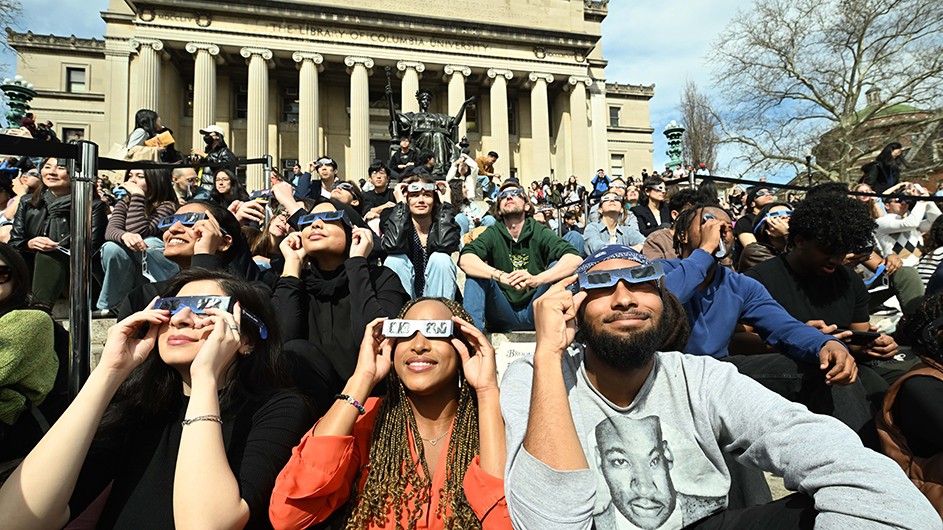






Low Plaza

Seidel's Double Play: Insight on Joe DiMaggio's Streak and James Joyce's Ulysses

By James Devitt

Michael Seidel

If you find yourself struggling to understand James Joyce's Ulysses, consulting Professor of English Michael Seidel would be a safe bet. But what if you wanted to know about the intricacies of Joe DiMaggio's 56-game hitting streak or how Ted Williams managed to hit .406 in 1941?

Seidel would still be a wise choice. He's written books on DiMaggio's remarkable hitting streak during the 1941 season (Streak: Joe Dimaggio and the Summer of '41, Penguin) and a biography of Williams (Ted Williams: A Baseball Life, Bison). The Williams book, reviewed by columnist George Will for the New York Times in 1991, has been reprinted this year with a new afterward.

"I don't think there's a day in my life when I haven't thought about baseball," said Seidel, whose passion for the game made writing these two books a labor of love. "DiMaggio occupied my mind for most of my childhood," explained Seidel, who lived in the Bronx until age 6, when his family moved to southern California in 1950, a year before DiMaggio retired. "I sort of extrapolated from DiMaggio to Williams."

The evolution was a logical one as both DiMaggio's streak and Williams' .406 milestone occurred during the 1941 season.

A life-long Yankee fan, Seidel welcomed the 2000 World Series between two New York teams, the first "Subway Series" since 1956. However, he noted a Subway Series was almost taken for granted in the immediate post-World War II period.

"From 1947 to 1956, there were seven Subway Series , and 1948 was the only year in which no New York team played in the World Series," said Seidel, who labeled this period as the last decade of baseball's "Golden Age."

"The great baseball years were really in the middle of the 20th century," said Seidel. "These years were the culmination of baseball in America. Everybody knew the players, even the position players, not just the stars."

Seidel's passion for baseball runs parallel to his academic pursuits. He is the author of Epic Geography: James Joyce's Ulysses (Princeton Press), Satiric Inheritance: Rabelais to Sterne (Princeton Press), Exile and the Narrative Imagination (Yale Press) and Robinson Crusoe: Island Myths and the Novel (Twayne), among other works.

While Seidel's research on major league baseball may have been the continuation of a life-long interest, it was driven, in part, by the reality of academic publishing 15 years ago.

"In the 1980s, academic publishing just slowed down and my feeling was I'd write for a larger audience," said Seidel.

However, he adds that taking an interest in an area outside of one's academic field is part of a New York tradition, especially at Columbia.

"It's something New York academics have done for years," Seidel said. "One of the key things about Columbia is that the academic experience is not separate from thinking about real life. That's always been one of the attractive features of Columbia. You don't thrive in this city unless you're connected to the real world of culture, art, politics, or sports."

Yet, Seidel notes that Joyce did not have such a connection with sports.

"Joyce was not a team sports fan. He preferred the loneliness of the long distance runner‹indeed, he was one as a youth," Seidel said. "But if he had to choose between the Yanks and the Mets, he would choose the Yanks. I have absolutely no basis for knowing why except that I would want him to."

Published: Nov 08, 2000
Last modified: Sep 18, 2002


Search Columbia News    Advanced Search  Help

Phone: 212.854.5573    Office of Public Affairs