



 |
|
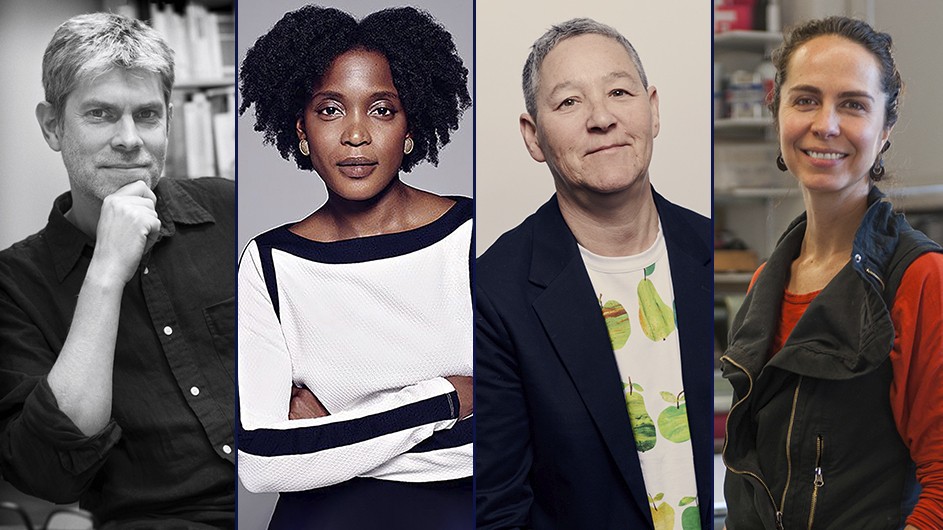
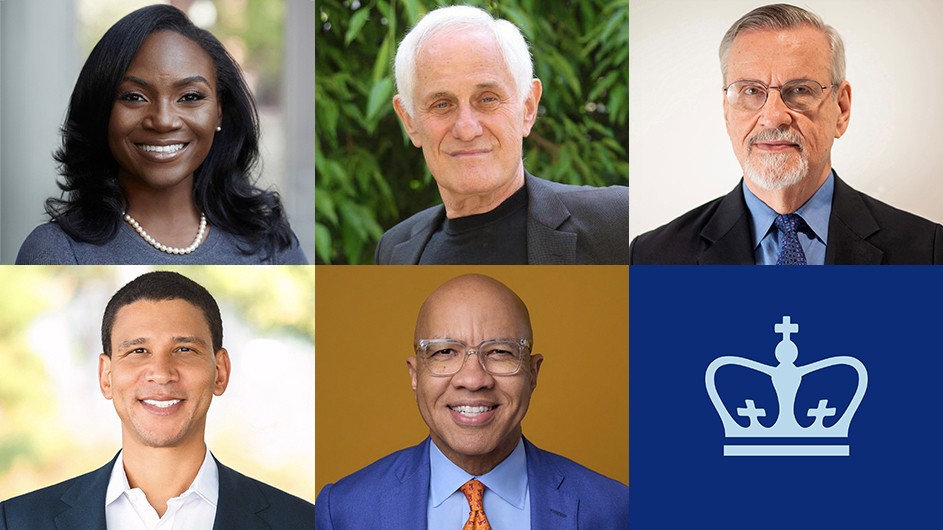
From left: Michael Boriskin, Ronald Breslow, and Bruce Saylor.
|
In celebration of his 70th birthday, the esteemed chemist, Ronald Breslow, was honored on Saturday evening, March 24, by colleagues and students at a banquet-symposium at Columbia that featured the world premiere of a piano solo commissioned as a tribute and composed by Bruce Saylor, the noted contemporary composer. The title of the musical score, "Liberating Chemistry from the Tyranny of Functional Groups," refers to Breslow's pioneering research on artificial enzymes.
Breslow, a music lover and pianist himself who was recently named one of the top 75 contributors to the field of chemistry in the last 75 years by Chemical and Engineering News, was feted in the Rotunda of Low Memorial Library on the Columbia campus. The pianist, Michael Boriskin, who has performed worldwide and has recorded on numerous labels, performed "Liberating Chemistry…" before an audience of 200 invited guests, including leading chemists nationwide, some of whom studied under Breslow, and colleagues and students from Columbia and other leading academic institutions.
Describing the occasion as an "unbelievable and fantastic honor," Breslow said the commissioning of a contemporary piano piece was particularly exciting because in his research he has tried to move chemistry into a "modern idiom," much as Saylor has composed a score that interprets Bach in a contemporary way. "This is quite unusual," he said, "and I could not be more grateful."
Breslow, who has been a Columbia faculty member for more than four decades, has received many of the top prizes in his field, including the U.S. National Medal of Science and the Priestley Medal of the American Chemical Society, its highest honor. His research has focused on the design and synthesis of new molecules with interesting properties, and the study of these properties. Breslow has achieved Columbia's highest academic designation, the University Professorship.
Saylor's compositions have been performed by major orchestras and soloists, including the soprano Jessye Norman, who performed several of his works at President Clinton's second inaugural.
He based the Breslow composition on successive transformations of the cadential material that closes the great adagio from Bach's C Major Sonata for solo violin. The score unfolds from these few measures. "One will scarcely recognize Bach," Saylor wrote in an e-mail from Italy where he has been on sabbatical from his teaching position at Queens College. "From the beginning, I have pulled the material apart rhythmically, reordered the original pitches into an incipient octatonic scale, interrupted it with musical interjections, allowed the ever-evolving melodic and harmonic source material successively to transform and reinvent itself, and cook up a head of steam. Then in a final oblique reference to the great master's original, the clouds of minor tonality burst out into sunshine-splashed C major."
Saylor, who was back in New York for Saturday's Breslow celebration, said the intent of the score is "to take something old and make it new --- free it from a previous thought or intention."
Saylor wrote that he was not consciously thinking of Breslow's seminal contributions in chemical research when he began to compose. "But about half-way through, I realized how appropriate the form and content of the music was for this happy occasion. To celebrate a man's love of music in this way is really just so sweet and, of course, it is something that echoes through music history."
The idea for the commission was developed by a committee that wanted to do something musical for the milestone event and called on Saylor, whose many previous commissions include a piece for the reopening of Grand Central Station.
The composition is intended to "liberate" music from the previous restrictions imposed by classical musical structure with its heavy emphasis on the key in which music is played.
The title comes directly from Breslow's accomplishments in chemistry. Traditionally, molecules can be transformed based on their "intrinsic" properties, or their specific functional groups. In the chemistry of living systems, these reactions are performed without regard to the natural reactivity of the molecule. Breslow and his research group have developed reactions independent of functional groups by using large synthetic catalysts called artificial enzymes.
Modern compositions have liberated music from these restrictions and thus the composition is parallel to what Professor Breslow has been doing in chemistry – liberating music from the tyranny of a particular key structure.
|