






 |
|
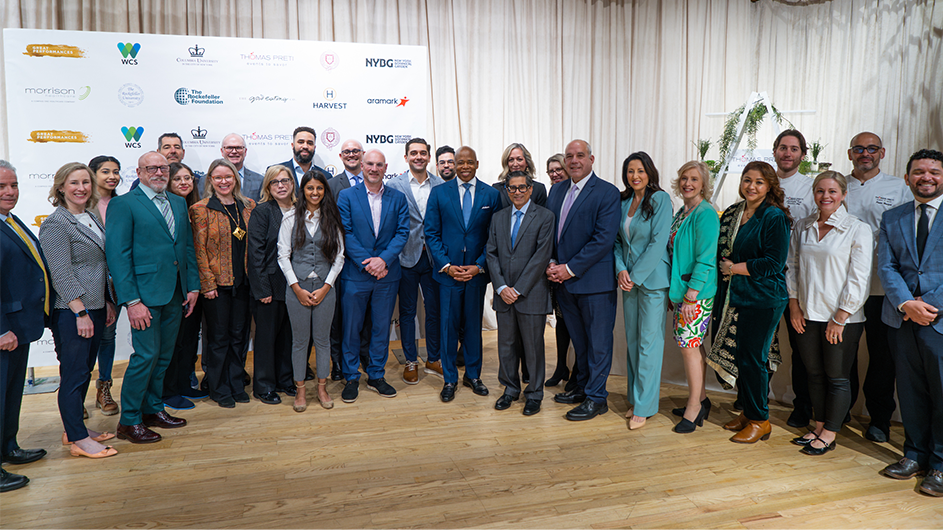
From left: Lily Parshall, CC '01, Rick Peltier, Mailman School of Public Health, Alison Pearsall, CC'99
|
With the United States unlikely to sign the Kyoto global warming treaty, which calls for industrialized states to reduce greenhouse gases to 5.2 percent below 1990 levels by 2012, state and local governments are seeking alternatives to reduce greenhouse gas emissions, the major cause of the predicted global warming.
Three former and current Columbia students are involved in such an effort as part of the Cities for Climate Protection Program (CCP). CCP is part of the International Council for Local Environmental Initiatives (ICLEI), an international environmental agency that works with cities, towns and counties to reduce local greenhouse gas emissions. New York City joined the program in June.
Lily Parshall, CC '01, Alison Pearsall, CC '99 and SIPA'01, and Rick Peltier, a student in the Mailman School of Public Health, are conducting emissions inventories in local communities to establish a target for reductions.
"The inventory is a good way for a participant city to get a sense of the major emissions sources and to pinpoint areas in which the greatest increases in efficiency and savings can be achieved," said Parshall, a graduate of the Department of Earth and Environmental Science, who is measuring emissions in New Rochelle.
After the three-month inventory is completed, emissions-reduction targets will be established, and subsequently the creation and implementation of an action plan to reduce emissions. CCP uses existing regulatory and economic tools within local governments to help communities reach reduction targets.
"The Cities for Climate Control Program is a highly interdisciplinary campaign, drawing from different academic and professional resources," said Rick Peltier, who is measuring emissions in Portland, Maine. "My graduate program, which offers a master's degree in public health with a focus on environmental health, has provided the tools for data collection and analysis to undertake a project such as CCP in Portland."
In dismissing the Kyoto treaty as unlikely to reduce emissions, the Bush administration has proposed pursuing an alternative path that focuses on research, market-based solutions and technology transfers to developing countries with serious pollution problems.
Pearsall downplayed the significance of the United States' decision on the international treaty, noting that local communities play a greater role in environmental matters than does the federal government.
"Emissions reductions are ultimately undertaken at the local level," said Pearsall, who is gauging emissions for Westchester County. "Even if the federal government were to eventually sign on to a re-negotiated version of the Kyoto Protocol, it won't necessarily lead to a reduction in emissions unless local communities take action. In the United States, many communities have made progress in this area, but often their efforts elude national attention because it's done locally."
Pearsall acknowledged the challenges that face advocates seeking to reduce global warming, but expressed optimism that their message will have an impact.
"What's difficult about the impact of global warming is that it's in the future--but not that far in the future," Pearsall said. "In addition, passing legislation to reduce emissions is challenging because most current elected officials will not be in office when the effects of global warming are truly felt."
"We're trying to personalize the effects in the region where we're working," she added. "For instance, New Rochelle, which borders the Long Island Sound, could suffer severe storms and flooding that would damage its coastline. It's less effective to say there will be a grand climatic effect and more effective to focus on what could happen to your community."
|