















 |
|
Kevin Zucker painting, shown at LFL Gallery this summer
|
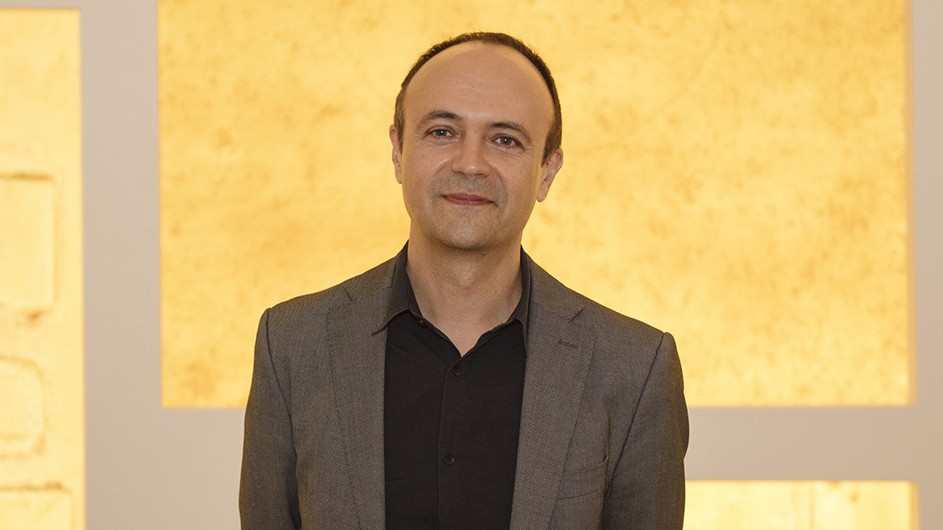
Kevin Zucker still has a year to go for his MFA in Visual Arts from Columbia's Graduate School of the Arts, but he's already made the leap into the art world. Zucker had his first solo show this past summer at LFL (Lawrence/Feuer/LaMontagne) Gallery in Chelsea and is already hard at work on paintings for another show at the Mary Boone Gallery also in Chelsea.
The 25-year old painter met the prominent gallerist Mary Boone through his two instructors at the School of the Arts, Ross Bleckner and Peter Halley, and is now represented by Boone, where his show will open in January.
Zucker's paintings are all interiors. Although they're furnished -- sparingly -- they are not rooms, or even spaces. They are abstract mappings of space. Computer-generated grids surround the few objects in view, just barely providing coordinates for a hypothetical place. With no surfaces to rest on, the objects seem lost in the space of these coordinates.
Zucker characterizes the settings in his paintings as "showrooms for ideas of things." These things are all familiar, even domestic, objects – a circle of aluminum chairs, a stereo, a girl's bedroom set. There's an obvious tension between the mundane, everyday nature of these objects and the pure abstraction of their settings. Yet, curiously, the objects look almost at home in the spaces. Computer-rendered with stiff geometric precision, these objects have been stripped of their human associations.
The drafting style calls to mind blueprints or construction plans. But a pink four-poster with matching dresser does not really belong in a blueprint. Do the objects represent the memory of habitation? Or, as in a blueprint, do they suggest the anticipation of habitation?
Although the paintings do not represent physical places, they do not represent pure thought either. They suggest a place where the ideal and the real collide. And the collision leaves physical traces –smudged marks on the surface of the painting, gaps in the images.
Zucker says that he draws inspiration from the seventeenth-century painter Pieter Saenredam's church interiors for "their insistence on certain systemic conventions, to the exclusion of pretty much anything else." Like Saenredam, Zucker adheres rigidly to a two-point perspective, but unlike Saenredam he does so in order to expose the contrived nature of conventions of representation. Zucker's perspective lines show through objects. His perspective, like his computer rendering, creates illusion only to collapse it immediately.
At first, the schematic, simplified world in Zucker's pale, neutral-colored paintings seems far removed from human life and emotion. But, with a closer look, the paintings' irregular patchy surfaces (created by Zucker's transfer process) undermine the mathematically perfect world that Zucker has initially established. As the random and the imperfect intrude on Zucker's sterile computer-rendered images, the real intrudes on the ideal. These rough, worn patches are reminders of the very thing that Zucker's precise computer imagery appears to deny—humanity.
|