

 |
|
Dennis Dalton
|
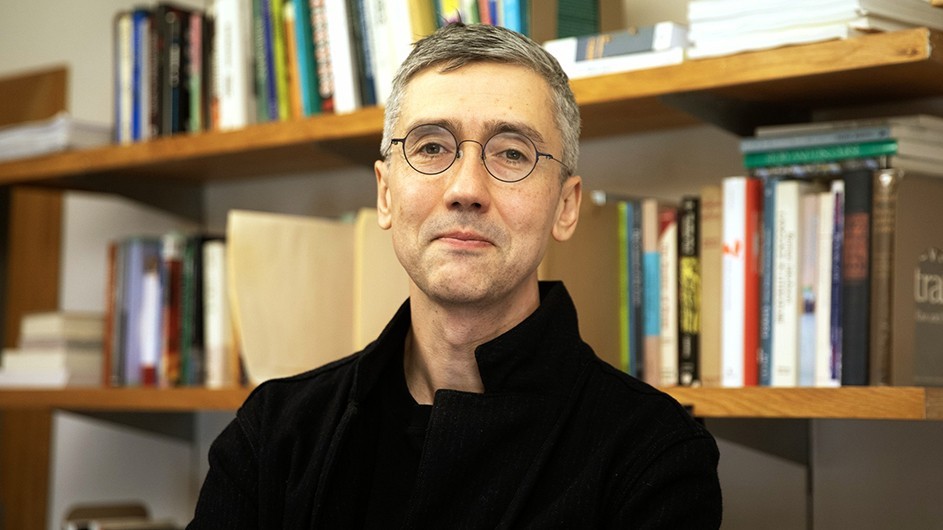
Dennis Dalton, political science professor at Barnard College, has studied and researched the great non-violence movements of the 20th century and even witnessed and participated in a few. If you were to visit him, he would invite you in with a smile and explain Gandhian political philosophy while pulling book after book from the floor to ceiling bookcase that circles his office, each a chronicle of a successful movement of non-violence borne from Gandhi's theories that later spread to Europe, then to the United States.
Dalton would give the small details that engrain a story to memory, such as the 2,000 gentile women who rescued their Jewish husbands from a Nazi prison camp after one week of screaming for their release. He would give the non-violence movement context, explaining its roots and how through Mahatma Gandhi, it was transformed into satyagraha, passive resistance, which became a proven political force across cultures and situations. And he would discuss Martin Luther King, Jr., who, as one of the world's leading example of non-violent leadership, employed Gandhian non-violent tactics during the Civil Rights Movement to begin the journey toward equal rights for all races in the United States. He would engage you in learning and there would be no denying the power of non-violence when he said: "It is historically true that this (non-violence) is a greater power than violence."
But there is no need to knock on his office door for a conversation. And for those who can't enroll in his colloquium on the non-violence movement, you can still have a one-on-one learning experience akin to the scene above. Simply click onto one of three e-seminars on non-violent power in action, which became available through Columbia Interactive in November.
The three e-seminars entitled Nonviolent Power in Action—Gandhi: Discovering the Power of Nonviolence, An American Gandhi, and Gandhi's Disciples, which are free to Columbia students, faculty and staff, offer online learners access to Dalton's lectures in an interactive, multimedia format. And it is perhaps the most innovative way that Dalton has had to reach more students than ever before.
Each seminar contains as many as 15 video clips and transcripts of Dalton explaining a certain topic or idea and a number of primary resources, such as photos, biographical data, scholarly articles and excerpts from seminal works such as Dalton's own book Mahatma Gandhi: Non-Violent Power in Action, writings by Gandhi himself and Martin Luther King, Jr.'s Stride Toward Freedom. There are also online chat rooms for students to ask questions and elaborate on points made.
While learners get access to a scholar who has spent thirty years at Barnard teaching political theory, Dalton, the teacher gets a new way to reach and teach more people.
"The classroom is "the" place for me to be," said Dalton. "While the e-seminar can't possibly replicate the dynamics of the classroom experience, it does provide a great advantage-- allowing me to reach a much wider audience than I would through the classroom alone."
Dalton is no stranger to an audience beyond academia. Over the years, he has received letters from hundreds of learners who bought his audiotapes on political non-violence produced by Teaching Company, a company that produces and sells tapes of experts discussing scholarly topics. As a scholar and teacher, the questions and comments have inspired him. In one case a number of physicians responded to a passage he discussed in Plato's Republic-- our politicians, so harmful in their policies, should be more like physicians, required to talk the Hippocratic oath—first to do no harm--requesting direction to the passage. And more recently, he received a letter from a senior high school group from Iowa requesting more information on non-violence. "This is the kind of response I want to get with the e seminars. The more people we can catch with the message of non violence the earlier, the better," said Dalton, who estimates he has received 20 to 40 times more letters from people who heard his tapes than from students having taken his courses or from readers of his books.
Back in the classroom, Dalton sees the e-seminars as a tool that he didn't have before. "I'd like to be able to have these references in the classroom. I'd like to be able to say to the students in my courses---for more information click here," said Dalton.
The e-seminars were developed by Vivian Ducat, senior editor with Columbia DKV, in collaboration with Dalton. With over 20 years of experience as a filmmaker producing scholarly documentaries and TV series for the BBC, PBS and ABC News, Ducat brought her own scholarship and research to the project. She added a number of resources, such as photos of King scanned from original prints uncovered by photo researcher and rights manager Kathryn Pope, and developed new resources such as an interactive timeline mapping the non-violence movement. The materials complement Dalton's teaching and enrich the e-seminar. Ducat likens the e-seminars to a TV series. "But there is so much more here than there is a film, which takes one single narrative line. With the web, there are many paths that can be taken, depending on your interest," said Ducat.
|