




|
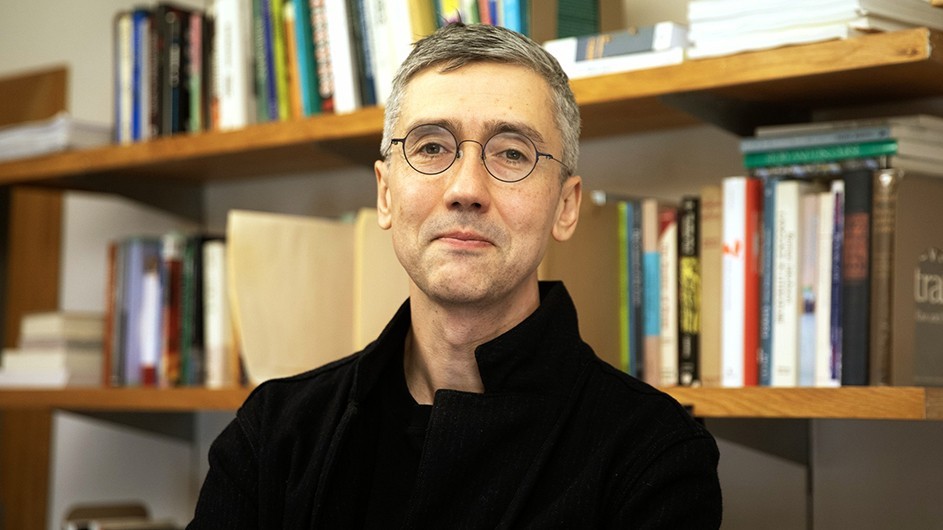
Sheldon Pollock was at Columbia University once before -- as an undergraduate. He did not receive a Columbia degree, however. A student of the classics, he developed a passion for Sanskrit, the language that played the same role in India that Latin played in Europe. To pursue this new-found interest, he decided to transfer to Harvard, which had, at the time, a venerable Sanskrit program.
What a difference a few decades make. After completing a Ph.D. in Sanskrit and Indian studies at Harvard and spending 16 years as a professor at the University of Chicago, Pollock has now returned to Columbia as its first senior Sanskrit scholar. He occupies the William B. Ransford chair of Sanskrit and South Asian Studies in the Department of Middle East and Asian Languages (MEALAC). He found the offer of the chair irresistible because, as he puts it, the University is "poised to become the leading center for South Asian studies in the United States and maybe in the world."
Pollock pays tribute to Lee C. Bollinger and Arts and Sciences dean Nicholas Dirks for rebuilding Columbia's South Asian studies program. Thanks to their efforts, Columbia now has a "critical mass of scholars in the social sciences and humanities who respect each other and are committed to a new approach to the creation of non-Western knowledge," Pollock says.
A small, yet telling, example of Columbia's progressiveness is that Ph.D. students are allowed to pursue joint degrees in Sanskrit and comparative literature -- which would not be possible at Chicago, Pollock says, adding that "good things can flow out of that, both intellectually and job-wise."
Curiously, Pollock became fascinated with ancient Sanskrit texts not because he was attracted to India as a country but because he was profoundly interested in classical languages and their afterlife. " India is a particularly rich place to study ancient languages and texts in their historical and cultural context," he explains. "It's at once a very old place, and one with a very present past."
For Pollock, Sanskrit provides a gateway not only into premodern Indian thought and practice but also into alternative ways of thinking about the world. He specializes in non-religious Sanskrit texts -- both classical literature and philosophy. As most Sanskrit specialists focus on religious texts (Sanskrit is, after all, the "language of the Gods"), he hopes to "restore the balance."
Secular Sanskrit texts can shed light, for example, on India's unique concept of pluralism, which runs counter to European notions of singularity -- that ethnic groups, for example, must eventually evolve into a nation with a single national identity. "There is no historical record of nationalism developing in India before the arrival of colonialism and capitalism," Pollock states.
Likewise, Indians had no concept of a "mother tongue." People in India would have multiple mother tongues," he says, "and think nothing of it."
These and other insights are encapsulated in Pollock's new book, The Language of the Gods in the World of Men: Sanskrit, Culture, and Power in Premodern India ( U. of California Press).
At Columbia, Pollock is teaching courses on Sanskrit texts, the intellectual history of India in the early modern period, and comparative literature and society. One of his first ventures as a faculty member will be joining a trip to India in January. He hopes to advance the cause of an international research project he is leading that aims to shed new light on Indian systematic thought -- from aesthetics to astronomy -- on the eve of the colonial encounter.
He and several other South Asia scholars have identified manuscript materials they'd like to see stored in an online digital archive as well as mined for a sophisticated interactive database, guaranteeing that scholars everywhere will have access to important texts that might not otherwise be preserved as well as a deeper understanding of the social history of Indian intellectuals.
Upon his return to campus after the research trip, Pollock looks forward to hosting, along with other MEALAC faculty, a February conference on the problem of modernity in India. It is notoriously difficult to obtain information on late pre-colonial India, he explains -- reiterating that it's because scholars here are willing to tackle such difficult questions that he is back where he started.
Sheldon Pollock joined the MEALAC faculty in September. For more on his Sanskrit Knowledge Systems project, go to http://dsal.uchicago.edu/sanskrit/index.html.
|