|
|
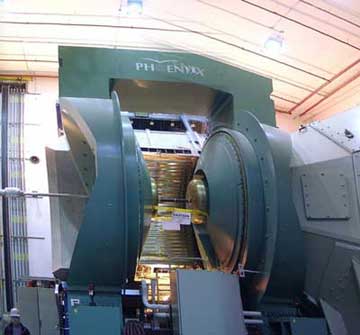
One project within the Relativistic Heavy Ion Collider is PHENIX, led by Columbia Professor William Zajc and housed at Brookhaven National Laboratories on Long Island, NY.
|
With the intent of re-creating a form of matter that existed for a fraction of a second after the birth of the universe in the Big Bang, scientists at Columbia are preparing start-up procedures for the world's most powerful nuclear accelerator--the Relativistic Heavy Ion Collider at Brookhaven National Laboratories, slated to begin running March 15.
The new matter, a gas called "quark-gluon plasma," will be the hottest, densest matter ever formed on earth. Quarks and gluons are the building blocks of ordinary protons and neutrons that make up all the atoms in the universe today. The universe was so hot and dense after the Big Bang that quarks and gluons floated freely in the gas before combining into protons and neutrons 10 millionths of a second later.
Columbia physicists are leading the experiments on one of two large projects of the ion collider, called the Pioneering High Energy Nuclear Interaction eXperiment, or PHENIX. It has three huge magnets designed to detect, identify and measure the momentum of each of the particles produced when the ion collider smashes the nuclei of gold atoms together. By measuring the speed and angle of those particles, scientists can tell if the quark-gluon plasma was created in the collision.
"PHENIX measures a somewhat smaller region of the collision, but with much greater precision than other experiments," said William Zajc, Columbia professor of physics and scientific leader on the project. "We also look specifically at electrons and photons because these lighter particles can tell us a lot about the plasma's interior--for instance, its temperature."
Zajc has been working on PHENIX for almost 10 years, and was joined by Columbia professors Brian Cole, James Nagle, researcher Cheng-Yi Chi and graduate student Mickey Chiu. The Columbia team has collaborated with over 430 physicists and engineers from 11 countries.
The ion collider itself is a 2.4-mile circular tunnel that will send gold ions hurtling toward each other at nearly the speed of light and at a cost of nearly $600 million. Although the actual collisions are extremely hot, in excess of a hundred million times the temperature of the sun, they are also inconceivably brief, lasting only a few trillionths of a trillionth of a second.
The Columbia scientists say that they will spend the first few months calibrating the machines and making sure everything works smoothly. Stable running conditions and the first data should be achieved by mid-May.
"It's exhilarating to be at the point where we can see results from all our years of experiments," said Cole, who has worked on PHENIX since he joined Columbia in 1992. "The minute we start taking data, we have a significant job ahead of us to understand all of the physics, but it's good to be here."
Physicists have wanted to recreate that primordial matter since they discovered its existence several decades ago, and European scientists may have accomplished something similar early this year, but their findings are not conclusive, according to Zajc. RHIC is 10 times more powerful than the European machine, and the physicists are confident that the added energy will bring the desired results: incontestable evidence of the quark-gluon plasma.
"I think in the next few years we will have the results we are looking for," said Nagle, who recently won an Alfred P. Sloan Research Fellowship for his work in high energy nuclear physics. "These experiments have posed real challenges to the physics world for many decades, and that's why people are so excited about finally seeing the answers."
|
