|
|
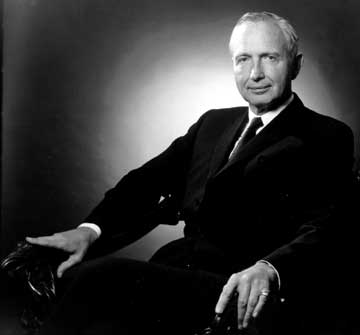
William Clements Warren
|
William Clements Warren, whose tenure as dean of Columbia Law School from 1952-70 transformed the institution into a modern law school with the programs and building projects he initiated, died on Monday of congestive heart failure. He was 91.
"No figure has had more impact in so many different ways on a major American law school as Bill Warren," said Columbia Law School Dean David W. Leebron. "Among individuals who affected American law schools in the last half of this century, there were few who come close to Bill."
Mr. Warren, who as recently as this spring remained active in his role as a trusted advisor to his many clients at the firm of Roberts & Holland, also served until his death on the boards of directors of the Guardian Life Insurance Company of America, Sterling National Bank, and Barnwell Industries. He was born in Paris, Texas, on February 3, 1909. He graduated from the University of Texas with undergraduate and master's degrees. After graduating from Harvard Law School in 1935, he went to work as an associate at two firms in New York before going to Cleveland, where he practiced law and was an instructor at Case Western Reserve University Law School. He eventually returned to New York and, in 1943, was commissioned as a captain in the U.S. Army.
He spent two years in Europe and the Middle East procuring and distributing lend-lease material and was an editor of the War Department's treatise on lend-lease, for which he received the U.S. Legion of Merit and the Italian Order of the Crown. He left the service in 1945 as a lieutenant colonel and returned to his New York tax practice at Millbank, Tweed and Hope.
He served as a tax consultant to the Secretary of the Treasury of the United States from 1947 to 1949 and was a member of a fiscal mission to Japan in 1949 and 1950. In 1948 he became the associate reporter for the American Law Institute's Income Tax Project. In that position he drafted income tax provisions for the proposed model Internal Revenue Code.
Mr. Warren was invited to teach at Columbia Law School in 1948. Four years later, he was appointed dean by Columbia University President Grayson Kirk. Hiring a dean from outside the ranks of longtime Columbia faculty was seen as unorthodox, but the move served the Law School well. One of Mr. Warren's first projects was raising the money to get a new building erected to replace the Law School's cramped quarters at Kent Hall, its home since 1910. When completed in 1960, the new building, located at Amsterdam and 116th Street, was praised for its spacious classrooms, large library, and ample office space. Its interior amenities soon became a model for facilities being built by other law schools.
Mr. Warren's tenure is known for more than bricks and mortar: He established the admissions and placement offices, worked with faculty to seek and hire distinguished scholars, diversified the student body, improved the scholarship offerings, and deepened the School's financial resources. His many duties did not keep him from the classroom, where he continued to teach tax law. He brought to his students an intimate knowledge of how the commercial and political worlds operated and how the laws of taxation, corporations, and accounting could meet the needs of the nation's expanding economy. After leaving Columbia, Mr. Warren returned to his career as a tax attorney. For many years, and up until the time of his death, he was a member of the law firm of Roberts & Holland.
Even though he was not on campus, Mr. Warren continued to play an important role in Law School affairs. He was a close adviser of his successors as Dean, and one of the school's most important supporters. His substantial financial gifts helped bring to reality two buildings: William C. Warren Hall, which houses classrooms, the offices of the Columbia Law Review, and the Center for Public Interest Law, and William and June Warren Hall which, in addition to its state-of-the-art classrooms, houses the Office of Development and Alumni/ae Affairs, Admissions, and International Programs and Graduate Studies.
A long-time resident of Ridgewood, N.J., Mr. Warren was a member of West Side Presbyterian Church and served on the board of directors of many organizations, including the CSS Industries, Aston-Martin La Gonda Group, and Aladan Corporation. For many years he was the chairman of the Sandoz Corporation. Mr. Warren was a member of the North American Advisory Board for Swissair and was a trustee of Montclair State University and the Institute of International Education. In 1969 he received Columbia Law School's Medal for Excellence.
He is survived by his wife, June Peel Warren, a British actress he married on January 13, 1945; three children, Robert Peel Warren of Potomac, MD; Larissa Warren Gibson of Caldwell, NJ; and William Liversidge Warren of New York City; and four grandchildren.
Burial services will be private, and a memorial service will be held at Columbia Law School later this fall. In lieu of flowers, donations may be sent to the Dean William C. Warren Scholarship Fund at Columbia Law School, 435 West 116th Street, New York, NY 10027.
|
