
Contact:	Bob Nelson						For immediate release
		(212) 854-5573					May 19, 1997
		[email protected]


Columbia Physicist Builds Gamma-Ray Telescope
To See an Invisible, Unexplored Universe


	Gamma rays are showing scientists a side of the universe no one has seen,
with new views of binary stars, black holes, pulsars and other phenomena.
	Many dense stars, especially black holes, radiate more energy in gamma
rays - high-energy electromagnetic radiation - than in visible light.  Only with
recent gamma ray observations have scientists recognized how violent the
universe can be, with frequent stellar explosions in our own galactic
neighborhood, and data from such radiation may soon tell how and where the 100-
or-so naturally occurring elements were created.
	Such observations have been made with the Compton Telescope, a fairly
primitive instrument launched by NASA in April 1991 and still orbiting 250 miles
above Earth.  The telescope, the only instrument so far to gather data in medium-
range gamma rays, detected a plume of antimatter streaming from the core of the
galaxy, news that made the front pages just weeks ago.
	One day in early June, a highly sensitive new instrument joins the thin
ranks of gamma-ray telescopes.  A clear polyethylene balloon carrying
Columbia's Liquid Xenon Gamma Ray Imaging Telescope will float skyward
from a NASA facility in Texas.  Data it collects will tell scientists the
temperatures, direction and speed of movement of gamma-ray sources,
information that will add to what is known from visual and other observations.
The Columbia telescope might eventually confirm, for example, the idea that an
enormous black hole sits at the center of our galaxy.
	"It's a new, emerging field," said Elena Aprile, associate professor of
physics at Columbia, who has spent the last four years perfecting the telescope.
"When we look at cosmic gamma rays in this range, we will be charting new
territory that nobody has measured."
	The telescope that NASA will launch from its National Scientific Balloon
Facility in Palestine, Texas, about halfway between Dallas and Houston, is an
oblong metal box about two feet tall and three feet on a side.  The box is filled with
the rare gas xenon, which, when liquefied with liquid nitrogen to about  -150oF, is
an exquisite detector of high-energy gamma rays.  It will capture radiation from a
 field of view of about 45 degrees, and its aperture is a square opening, without any
lens, atop the metal box.  Data produced by the gamma rays' interactions with
xenon can be translated into a three-dimensional image that shows the intensity
of the radiation over a given area of the sky.
	Though several research groups have tried to build xenon-based gamma-
ray detectors, Professor Aprile's group will be the only one to launch such an
instrument above the layer of ozone high in the Earth's atmosphere that shields
the surface from gamma rays, which in high doses are fatal.  Xenon is an
expensive gas that is difficult to handle; on any day the detector is being tested, the
staff in Professor Aprile's lab arrives at 5 A.M., because it takes hours to liquefy
and filter the 5000 liters of xenon gas the detector uses.
	The instrument will measure a range of gamma rays between 300,000 and
30 million electron-volts, well below the highest-energy gamma rays.  "In our
view, this is the energy band in which some of the most exciting discoveries in
gamma-ray astronomy remain to be made," Professor Aprile said.
	The naturally-occurring elements, such as oxygen, carbon and iron, were
probably formed in the core of extremely dense stars that eventually explode.
Much of the matter formed in this way was originally radioactive and has decayed
to the stable forms we recognize today.  When radioactive elements decay, they
emit gamma rays, and Professor Aprile's team expects to see tell-tale gamma-ray
concentrations that will show how and where in the universe certain elements
are being created.  Among the candidates for element production are red giant
stars, thermonuclear explosions known as novae or supernovae and giant
molecular clouds, such as the one in the Orion constellation.
	They will study in particular the distribution of aluminum-26, an isotope of
aluminum and tracer of galactic radioactivity, which, contrary to expectations, is
not concentrated in the millions of stars at the center of the Milky Way galaxy.
	The Compton Telescope, on board the Compton Gamma-Ray Observatory,
relies on large crystals of sodium iodide, table salt, which emit flashes of light
when struck by gamma rays.  The system is not as sensitive as more recent
technology, so the telescope has difficulty distinguishing gamma rays generated
by stellar sources from background radiation.
	"New technology is badly needed to make progress in this field," Professor
Aprile said.  "Liquid xenon imaging is one approach toward better telescopes."
	NASA has never launched a liquified rare gas before, so the flight is as
much about ironing out engineering problems as it is about scientific observation.
There is risk, too; a parachute failure would mean the loss of a valuable and
delicate instrument.  Presuming the telescope is recovered, Professor Aprile
plans to refurbish it, fly it again on a NASA balloon in 1998 or 1999 and prepare for
an opening on a satellite launch sometime after 2000.  Instruments carried on the
space shuttle and other NASA flights are usually tested first on a balloon.
	The balloon and its gondola, which together will be about 1,000 feet tall, will
ascend nearly 25 miles, high enough to ride above 99.7 percent of the Earth's
atmosphere.  During its flight, which will take two days, the telescope will spend
10 to 12 hours at the observing height, then will be brought back to Earth.  It will
land several hundred miles west of the launch site, probably on a cattle ranch in
 central Texas.  NASA personnel will recover it within hours.
	The National Aeronautics and Space Administration supported the
research.  Collaborating scientists include Edward Chupp and Philip Dunphy of
the University of New Hampshire, who modified the gondola and provided shields
to reduce background radiation, and Tadayoshi Doke of Waseda University in
Japan and Gerry Fishman of NASA's Marshall Space Flight Center in
Huntsville, Ala., who provided electronic equipment used in the telescope.

This document is available at http://www.columbia.edu/cu/pr/.  To regularly receive science and technology press releases via e-mail,
 send a message to [email protected].

5.19.97			     						19,125
Contact:	Bob Nelson
For immediate release
		(212) 854-5573
		[email protected]


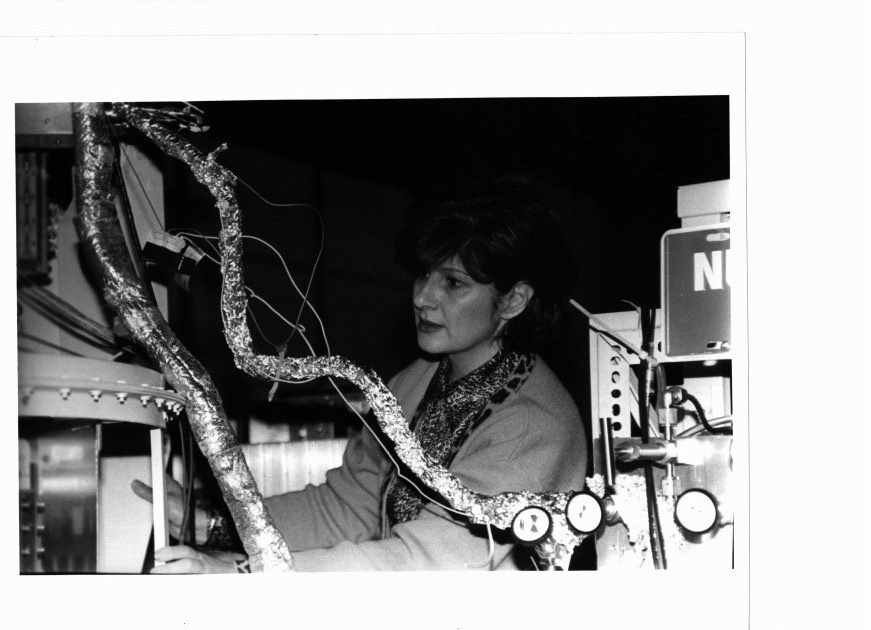
	Elena Aprile, associate professor of physics at Columbia
University, with the Liquid Xenon Gamma Ray Imaging Telescope, which she has
labored to perfect for four years.  Liquid xenon is being injected into the
telescope via the aluminum-foil-wrapped tubes shown in the photograph.
	The gamma-ray telescope, to be launched on a NASA balloon in Texas
the first week of June, will tell scientists the temperatures, direction and
speed of movement of gamma-ray sources, information that will add to what is
 known from visual and other observations.

CREDIT:  Bob Nelson/Columbia University

This document is available at http://www.columbia.edu/cu/pr/.  To
regularly receive science
and technology press releases via e-mail, send a message to
[email protected].