|
|
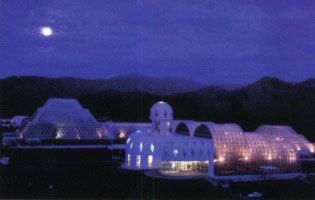
Night view of the Biosphere 2 facility in Oracle, Ariz
|
Columbia will expand its Biosphere 2 Center campus in Tucson, Arizona to accommodate 350 students and will continue its partnership for managing the Biosphere 2 Laboratory research facility, Columbia's Board of Trustees announced Dec. 15. Plans call for Columbia to expand the size of program offerings at the campus, to continue developing Biosphere 2's capability as a research center, and to increase public programs and initiatives.
Among the new programs and initiatives, Biosphere 2 will: create a masters program focused on earth systems science and management policy built around hands-on experience with science and policy; expand further the capabilities of the laboratory to understand the future of this planet; develop new biodiversity programs outside the Biosphere 2; create new programs between industry and government to share these activities with the public; and develop an enhanced experience for visitors with respect to the ocean underwater viewing area by providing them with an opportunity to view and understand the importance of coral reefs.
"With this action, the Columbia Board of Trustees has agreed to continue its historic partnership with Mr. Edward P. Bass, the founder of Biosphere 2," said Columbia President George Rupp. "We look forward to creating a western campus for Columbia University and building Biosphere 2 into a renowned center for learning and research into earth systems science."
Said Dr. Michael Crow, Columbia's executive vice provost for research, "Our goal is to develop Biosphere 2 into a world center for discourse on earth systems science, policy and management issues. Biosphere 2's growing reputation as a research institute, combined with its excellent academic and conference facilities, make it a perfect place for leaders from government, industry and the academic world to come together to address the key issues of the next century."
Since 1996 Columbia has invested several million dollars to develop the Biosphere 2 campus. The university recently built a new astronomy observatory that features a 24-inch research-grade reflecting telescope, which will be used as a teaching tool in the new undergraduate astronomy program offered at Biosphere 2. It will also provide visitors from around the world an opportunity to enjoy stargazing under the clear Arizona night skies.
New dormitories have been built, and several buildings have been renovated to support the growing number of students and faculty. A new student center, which was recently completed with support from the Bert W. Martin Foundation, features a computer lab, workout area, health services facilities, student union, and a reading room.
"Biosphere 2 now has three clear goals," said Dr. William Harris, president and executive director of Biosphere 2 Center. "With the support of Columbia University, we will create an outstanding undergraduate education program for students from around the world. With the support of the research community and organizations like the Packard Foundation, we will use the Biosphere 2 facility to conduct groundbreaking research in a variety of areas. Finally, with the national interest in Biosphere 2 and the support of the local community, we will develop Biosphere 2 into a center of learning for people of all ages and all walks of life."
The master plan approved by the Board of Trustees calls for Columbia to expand the undergraduate education program to 300 students by the spring of 2003. One hundred students currently study earth systems science and astronomy at Biosphere 2. Columbia will grow the campus by expanding current programs and creating new academic programs that take advantage of the unique Biosphere 2 campus, by developing partnerships with other universities, and by creating more opportunities for organizations like the Volvo Corporation to partner with Biosphere 2 to teach the leaders of tomorrow "real world" science and policy.
The Biosphere 2 facility offers unparalleled opportunities to study earth systems science. The Packard Foundation recently awarded Biosphere 2 a nearly $1 million grant for research inside the Biosphere 2 Laboratory to study the effects of varying temperature and CO2 levels on rainforests and oceans.
In addition to becoming a world-renowned research and academic center, Biosphere 2 remains one of the world's best-known symbols for learning about the future of the earth. By developing new public outreach programs, Biosphere 2 will remain a center for educating the public about issues that affect the future of the earth. Biosphere 2 recently unveiled "Passport to Learning," a program for school-aged children that uses the unique resources of the Biosphere facility to teach young minds about the earth. Biosphere 2 also sponsors public astronomy programs at the new observatory, as well as workshops and seminars at the hotel and conference center.
With the extension of this partnership, the Board of Trustees has taken the final step toward creation of a "western campus" of Columbia University, a campus committed to being a world center for learning and public discourse on earth systems science.
|
