


































 |
| VOL. 23, NO. 6 | OCTOBER 10, 1997 |
|
Lecture Series Begins with Chaos Theory Applied to Meteorology
By Hannah M. Fairfield
dward Lorenz held a piece of paper above the stage and gently let it go, watching it leisurely float down to the ground. More than two hundred people noted where it fell. Lorenz repeated the experiment, and the paper fell again, landing in a different place on the ground. Lorenz smiled. He had just illustrated the theory of chaos.
Lorenz, M.I.T. Professor Emeritus of Meteorology, opened the 1997-98 International Research Institute for Climate Prediction (IRI) lecture series on Sept. 30 with "How Well Can We Predict Climate Change?" in the Shapiro Center for Engineering and Physical Sciences. He has been studying irregularities in the atmospheric energy cycle at M.I.T. since 1948, and his research in dynamic atmospheric systems led to his development of the chaos theory and his 1993 book, The Essence of Chaos.
He defined chaos as "a system that has two states that look the same on separate occasions, but can develop into states that are noticeably different." In an example of a non-chaotic system, he referred to a golf ball dropped twice from the same height above a fixed point. The golf ball, he said, will fall to the same point both times. He distinguished this from a very different system illustrated by the meandering path of the sheet of paper.
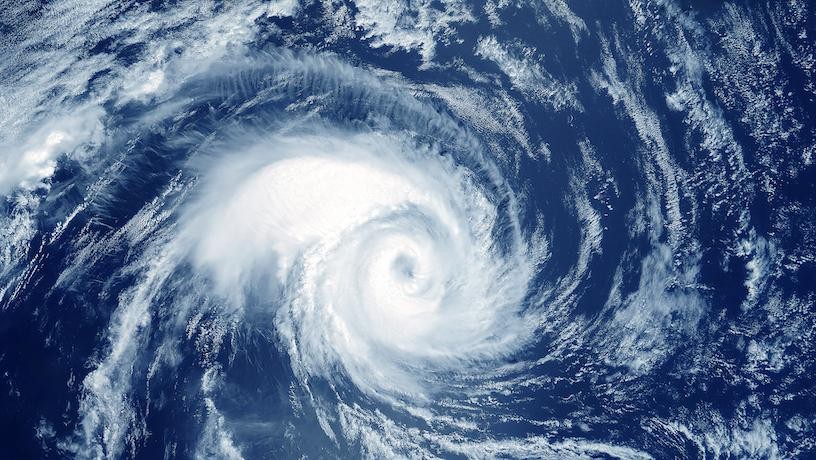
Weather forecasting, like the fall of a golf ball, has short-range accurate predictability. Lorenz asked, "Can we then continue weather forecasting to reach desired climate prediction?" The audience waited. "It's not that simple," he said, "because climatic systems are inherently chaotic."
IRI was created in 1996 as a consortium of the National Oceanic and Atmospheric Administration (NOAA), Columbia's Lamont-Doherty Earth Observatory (L-DEO), and Scripps Institution of Oceanography, U.C.-San Diego.
IRI, which is headquartered at L-DEO in Palisades, NY, focuses on climate monitoring, prediction, and information dissemination.
The lecture series is titled "Applications of Seasonal-to-Interannual Climate Predictions" and is sponsored by IRI and the Columbia Earth Institute. See Calendar for details on the next lecture.
|