















 |
| VOL. 23, NO. 8 | OCTOBER 31, 1997 |
|
FROM THE SENATE
Senate Discusses Libraries, Salary Equity & 2110 Strike
By Tom Mathewson
n Oct. 24, the University Senate discussed a report from its Libraries Committee, as well as an update from Emily Lloyd, executive vice president for administration, on the strike by clerical workers in Local 2110, then in its seventh day. Forty-four of 79 senators were present during the meeting.
Lloyd expressed optimism that discussions with Local 2110 would resume during the following week, with the help of a federal mediator. She said that the fraction of union members who were at work had risen to just under half, and that some 14 percent of classes had been held off campus a few days earlier, but some of those were now returning.
Lloyd said that the University had offered the same wage package that it had negotiated in its last contract with the campus local of the Transit Workers Union3 percent per year over 38 months. She added that the University would take a flexible approach to the other items in the negotiations, except for onethe demand that the University add 100 union jobs in each of the next two years to accompany any increase in the number of officer positions. "We have said that is something that we will not do," Lloyd said, "and that is still an area where we are very far apart."
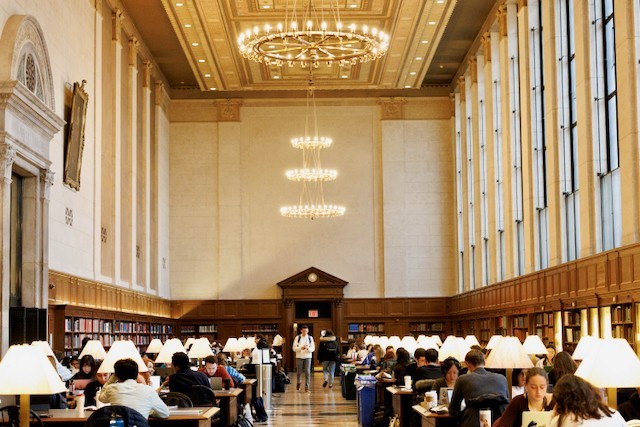
Sen. William Harris, chairman of the Libraries Committee, spoke of a "crisis" in the libraries, a perception corroborated by a review conducted last spring by an external committee chaired by Dr. Billy Frye of Emory University. Harris said that while that group had praised the staff of the libraries and of Academic Information Systems (AcIS), "it is hard to imagine how the University could have received worse grades than the visiting team gave it. Everywhere the committee looked they found the very grave results of budget cutting imposed from above." He praised Provost Jonathan R. Cole for efforts he was making to address these problems.
Among problems identified by the external committee were AcIS salaries that were falling behind the market, library staffers whose duties were covered by three or four people at peer institutions, slow progress with Butler renovations, the unmet space needs of some branch libraries, inadequate book acquisition programs, antiquated cataloging and insufficient attention in the University's capital campaign.
Harris seconded the visiting committee's emphasis on the need for symbolic action by Columbia's leaders to demonstrate the importance of the libraries.
"Finally," Harris said, "we believe that this is mainly about money. Of course a lot of other things are needed too, in particular intelligent planning. Some important capital expenditures are urgent. Still more urgent in our view is a commitment on the part of the administration to drastic increases in the operating budget, increases which need to go on cumulatively over the next several years."
Harris announced that his committee will hold an open hearing on the libraries on Nov. 18.
Provost Cole responded that the external report was part of a review process that the University had initiated. He said he preferred to stick to an orderly progression of consideration of the report by representative committees, along with an action plan that the administration was preparing in response, before beginning wider discussions.
President George Rupp added a cautionary note about solutions based on pumping more money into the libraries. He said that Columbia was already in the midst of a $75 million renovation of Butler Library, and that the libraries' materials budget had maintained an annual growth rate of 8 percent.
As for the conclusion of the external review that the operating budget of the libraries should be treated not like those of administrative units but like those of academic units, with faster annual growth rates, Rupp said: "That's the kind of issue we're going to have to work through. I just want to alert all of us: the money has to come from somewhere."
Finally, Provost Cole reported on the findings of a committee on salary equity chaired by Prof. Casey Ichniowski of the Business School. It had studied the salaries of faculty and librarians on the Morningside campus in search of inequities based on age, gender, or ethnicity. Only one academic unit had shown statistically significant discrepancies, and these were based on gender. Salary adjustments were made.
The Provost had already sought salary adjustments in that unit, and had sought a further adjustment for the present academic year. The disparity would be eliminated, he said. The committee would be reporting later in the year on a study of possible salary inequities resulting from promotional practices.
|