















































 |
| VOL. 23, NO. 12 | JANUARY 23, 1998 |
|
Analogy in Chimp, Human Brains
BY BOB NELSON
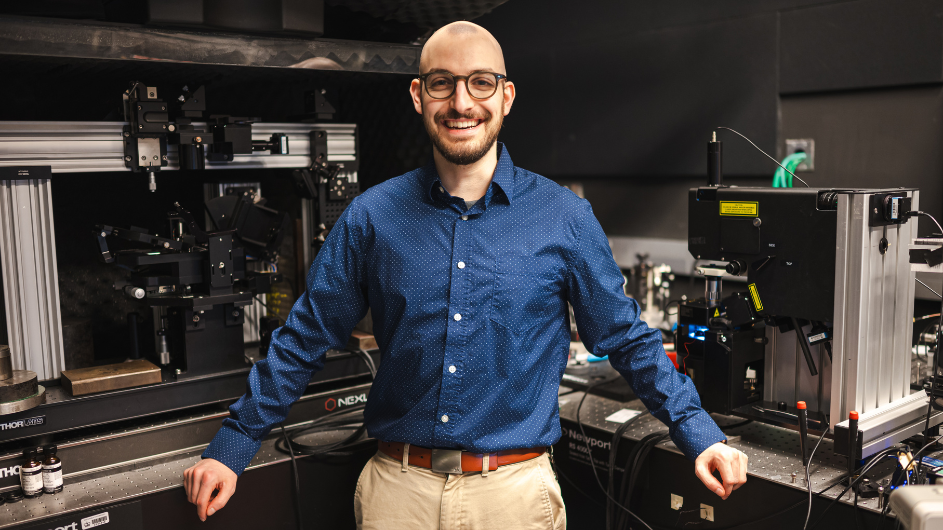
 | | Ralph Holloway. Record Photo by Eileen Barroso. |
|
esearchers at Columbia, Mount Sinai School of Medicine and the National Institutes of Health have found that a region of the brain thought to control language is larger in one hemisphere in both chimpanzees and humans, disproving a theory that the brain section was asymmetrical only in humans.
The discovery, reported in the Jan. 9 issue of the journal Science, throws into question the role of the planum temporale, a part of the brain's temporal cortex that is located beneath the parietal cortex. The planum temporale of the left hemisphere is normally larger than in the right hemisphere in humans, but 94 percent of the chimpanzee brains studied demonstrated the same asymmetry.
Could the research result be interpreted to mean that chimpanzees have some kind of language?
"I don't think they have a language, but I do agree that they have some kind of communication system that might be more complex than we have heretofore thought," said Ralph Holloway, professor of anthropology and co-author of the Science paper. He believes chimps may converse using a sophisticated array of facial, body and hand gestures, perhaps augmented with grunting or other vocalizations.
Patrick Gannon, assistant professor and director of the Paleoneurology Research Laboratory in the department of otolaryngology at Mount Sinai, first suspected that chimpanzee brains might show the same asymmetry as those of humans. He sought the collaboration of Holloway, who then assisted in measuring the planum temporale, which is not an obvious anatomical feature, on his collection of 18 chimpanzee brains.
The authors of the paper proposed several possible interpretations of the work, in addition to the possibility of chimp communication.
If both chimps and humans have an enlarged planum temporale, their common ancestor probably had the feature as well, though the brain region may not have acquired its language functions until humans split off from other primates 6 to 8 million years ago.
Finally, it may well be that the planum temporale is not involved in language in either chimps or humans.
The research was supported by the NSF and the NIH.
|