




























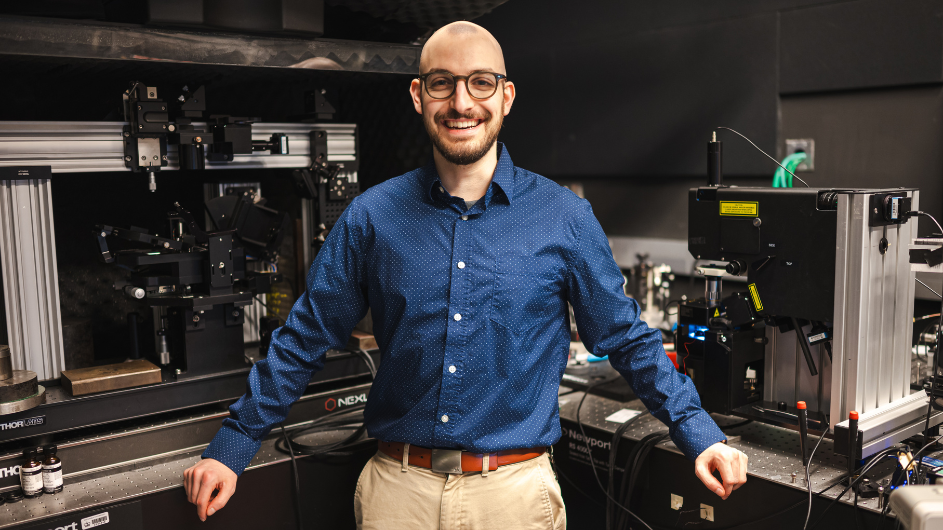
















 | Columbia mobile journalist terminal uses Global Positioning System technology to orient images and text viewed through a head-worn display.
|
|
Research Will Change the Nature of Communication in 21st Century
The Columbia New Media Technology Center (CNMTC) is developing innovative multimedia technologies that will change the nature of communication in the 21st century. These new technologies will bring unprecedented power and versatility onto desktops and into living rooms, and create exciting new tools that allow computer users to become producers of their own multimedia content.
The Center is strategically located in New York City, the "Silicon Alley" of the rapidly growing new media industry. It was founded to create new tools that can acquire, manipulate, represent and distribute multimedia information, to develop ease of access to the technology of image, sound and text. Visually, instead of working with codes and pixels, new object-oriented technology allows users to "handle" whole objectsa tree, a building, a figureand order them to a purpose.
Appropriate text and sound should be integrated simply, Columbia researchers say. The full digitally encoded and compressed product should be transmitted with speed and efficiency.
Columbia has brought together engineers, journalists, business authorities and educators from its faculties to accomplish these goals. And it has reached out to the world of commerce for perspective on priorities and needs. The Center has established an office at the New York Information Technology Center at 55 Broad Street to offer technical and educational support to new media firms and to keep an ear to the ground for needed innovations. And it has established partnership links with the City and State of New York. All are working to fulfill the vision of a seamless network of users who can also produce their own multimedia, tying the nation together as telephones do today.
CNMTC's significant accomplishments include:
The MPEG-2 digital video compression standard, which allows the transmission of high-quality video and audio over limited bandwidth. The standard, using digital compression algorithms developed at Columbia, is driving high-definition television, digital versatile disks (DVD), direct broadcast by satellite and a host of other digital video applications. Columbia is the only academic institution in a patent pool with eight companies that has been approved to license it.
Columbia's Internet protocols, which allow improved real-time Internet teleconferencing and are available in current versions of Microsoft NetMeeting and Netscape Conference.
The radically new Omnicam-era, which has a 360-degree hemispherical field of view that can be transformed instantly into an infinite number of undistorted linear perspective images and is being manufactured by a start-up firm, CycloVision Inc.
The CNMTC is developing new techniques that make possible digital editing that incorporates the new object-oriented technology and simplified computer searches using information attached to multimedia files. Other new media tools include editing and search tools such as WebClip, WebSEEk, Visual-SEEk and the Columbia Digital News System as well as a network operating system called xbind and "augmented reality" systems that overlay instructions and other information on human vision.
The success that CNMTC researchers have had in providing technology to industry, particularly in journalism and communications, is evidence of the Center's dedication to cooperation with government, education and business, says Dimitris Anastassiou, professor of electrical engineering at Columbia and director of the Center.
Working with Columbia's Graduate School of Journalism, he envisages developing a wireless tool that can take information from a 360-degree camera, search and manipulate it with object-based editing software and distribute it with text and sound using new protocols connected to the next-generation Internet.
"We will keep working in traditional technology research areas such as signal processing and coding, computer vision, computer graphics and networking," Anastassiou says. "But we will do so within a synergistic partnership with actual content providers and technology users to ensure that their real problems are solved."
|