





 |
| VOL. 23, NO. 21 | APRIL 17, 1998 |
|
Science, Fiction, Film?
Dialogue Aimed at Getting beyond Mad Scientist Stereotypes in Film
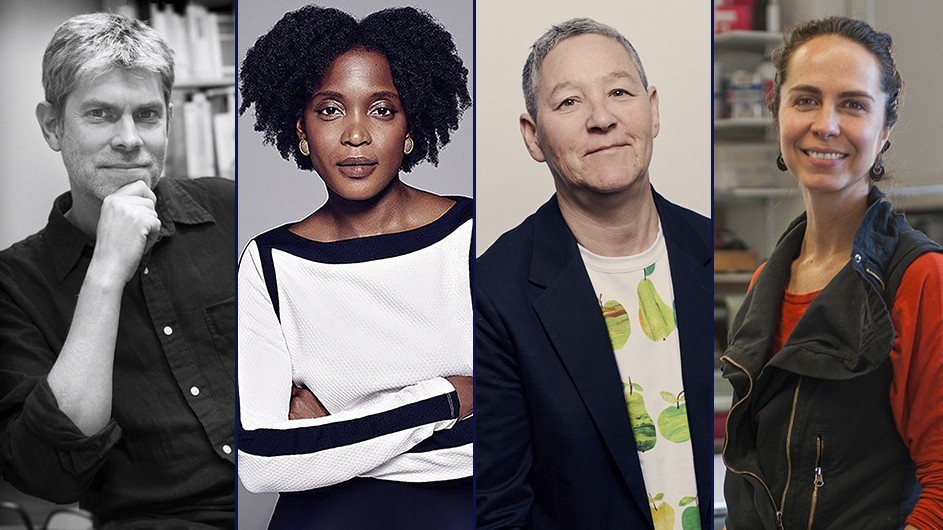
 | | Scientists and media professionals who discussed how films can better portray science, from left: Columbias David Helfand, professor of astronomy; James Gorman, Times editor; Susan Schwartz, ABCNews journalist; Lewis Gilbert of Columbias Earth Institute, and Columbias Brian Greene, professor physics and mathematics. Record Photo by Joe Pineiro. |
|
BY KIM BROCKWAY
oes it matter if the scientific principles alluded to in Superman or Jurassic Park are accurate? Must scientists always be portrayed as mad or as buffoons?
These and other issues were discussed in a recent dialogue between four scientists, two science journalists and a room full of filmmakers, hosted by the School of the Arts Film Division, sponsored by the Alfred P. Sloan Foundation and co-moderated by Larry Engel, professor of film and a documentary filmmaker, and David Helfand, professor of astronomy.
The discussion began with the fundamental issue of whether makers of science and technology films have an obligation to be accurate, as films dealing with such topics do have an impact on the people who watch them. While most agreed that reporters writing about science must tell their stories accurately, filmmakers, unless they are trying to depict a realistic scenario, are not similarly obligated. All agreed however, that it is a missed opportunity when filmmakers dont look to science and scientists for story ideas and characters. Film could even help drive a dialogue between scientists and the public.
Overused and inaccurate stereotypes of scientists in films seemed to trouble the science professors most, with filmmakers often using tired techniques to weave science into films. Helfand observed that it is often the dark and powerful side of science, or science and technology gone awry, that appeals to filmmakers. Lewis Gilbert, director for interdisciplinary programs at Columbias Earth Institute, called for filmmakers to combat these stereotypes, for the scientific community is as diverse as any other community.
Brian Greene, professor of physics and mathematics, described the calls he receives regularly from a friend who works for the sitcom Third Rock From the Sun, requesting a complex equation that could be worked into the program, and questions what this really adds to the story. A genuine partnership between fiction and science, on the other hand, could produce opportunities to communicate compelling material in a friendly medium.
The scientists present did cite some recent films that portray their profession accurately. Contact, starring Jodie Foster, was a favorite, and Darcy Kelly, professor of biological sciences, especially liked Good Will Hunting because it conveyed the passion that often drives a scientist.
For their part, both filmmakers and journalists cited a tendency to feel inadequately prepared to incorporate science into their works; probably because science is so cumulative, it often becomes inaccessible. Susan Schwartz, a medical/science broadcast journalist with ABC News, has found that its best to have some background knowledge of a subject so that good questions can be asked. James Gorman, the editor of the new Circuits section of The New York Times, added that conflicts can arise between science and journalism because reporters tend to look for a solution or breakthrough, in a way similar to how films need a conflict and a resolution; science is more about process.
Scientists, on the other hand, argue that its precisely this process, the story of science, that is compelling and engaging and should be depicted on the big screen. Responding to a question from Lewis Cole, chair of the Graduate Film Division, about why they entered their fields and how they spend a typical day, the scientists demonstrated a breadth of interests and activities, from conducting experiments in a lab, to looking at the universe from an observatory, and to using math equations to picture what cant be pictured physically.
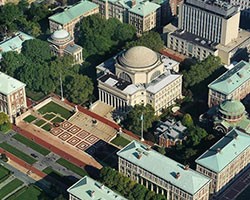
Filmmakers studying at Columbia and searching for story ideas were reminded that they have the advantage of tapping into the Universitys outstanding scientific resources, in the various departments on the Morningside Heights campus, at Lamont-Doherty Earth Observatory and at the Health Sciences Division.
The Sloan Foundation recently awarded a three-year grant to the Film Division to encourage students to develop films and screenplays that treat science and engineers as their primary subjects, to create more realistic and compelling stories about science and technology and to challenge the existing stereotypes about scientists and engineers through the visual media.
|